

Key Takeaways
- Live TV streaming services require only a broadband connection - no technician visit or equipment installation needed.
- Traditional cable typically offers more consistent signal reliability, especially during peak internet usage hours.
- Most live TV streaming services operate month-to-month, while cable commonly involves one- to two-year contracts.
- Channel availability varies by streaming service; cable packages often include more regional sports and local affiliates.
- Live TV streaming lets you watch on phones, tablets, and computers - cable viewing is largely tied to the TV set.
Option A
Live TV Streaming
The flexible, internet-powered alternative to traditional pay-TV.
Best for: Viewers who want channel bundles without long-term contracts and the freedom to watch on multiple devices.
Option B
Traditional Cable
The established, infrastructure-based pay-TV model.
Best for: Households that prioritize signal reliability, a wide channel selection, and bundled home services like internet and phone.
If you want to avoid long-term contracts
Live TV Streaming
Most live TV streaming plans renew monthly, so you can pause or cancel without cancellation fees or multi-year commitments.
If you rely heavily on regional sports or local news
Traditional Cable
Cable providers more consistently carry regional sports networks and every local affiliate, which some streaming bundles still omit.
If you watch TV on multiple devices outside the home
Live TV Streaming
Streaming apps work on smartphones, tablets, and laptops, giving you full live-channel access wherever you have internet.
If internet outages or bandwidth limits are a concern
Traditional Cable
Cable signal delivery is separate from your home internet, so heavy internet usage won't degrade picture quality.
If you're already exploring the broader shift away from linear TV
Live TV Streaming
It bridges live broadcast and on-demand content, making it a natural step into the streaming-first world.
What Each Option Actually Delivers
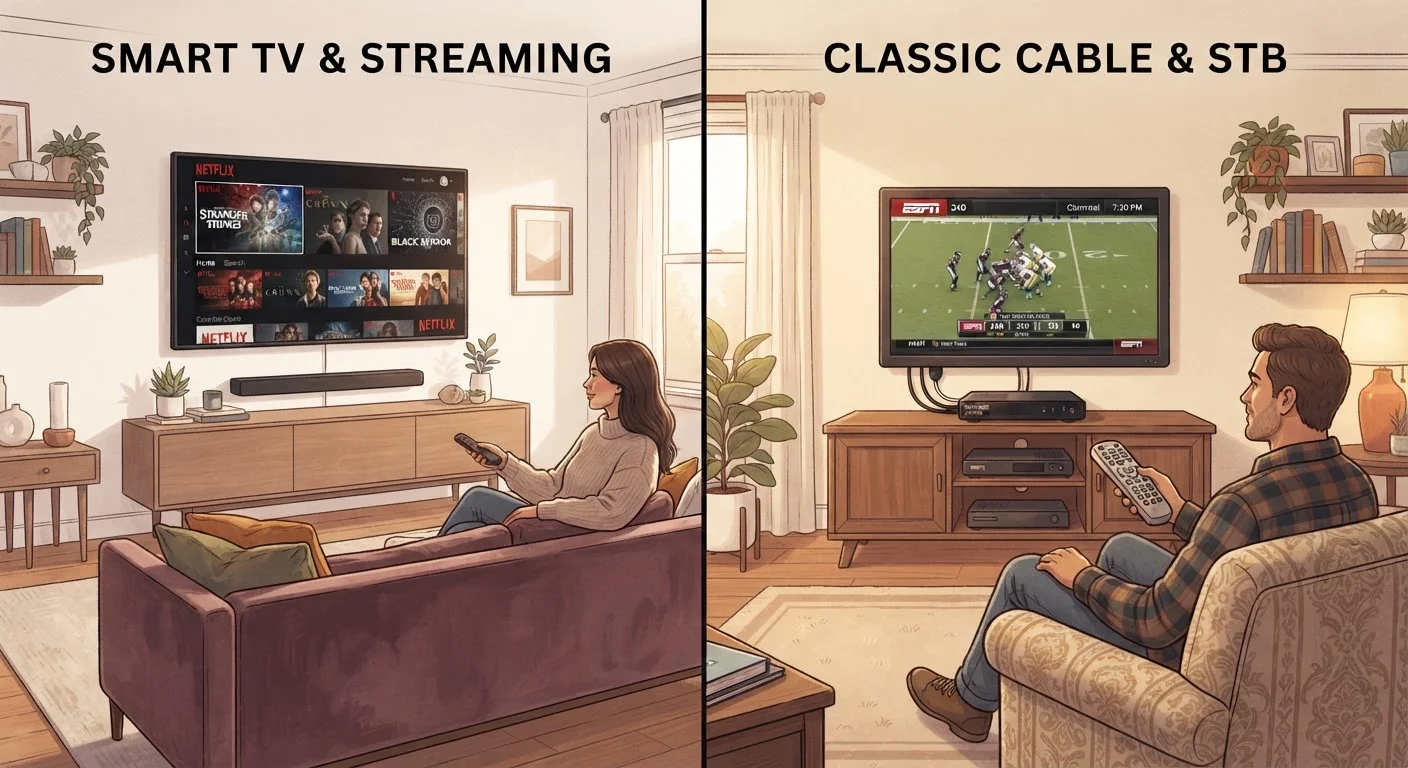
Traditional cable delivers television programming through a physical coaxial cable infrastructure - a system that has been the dominant pay-TV model in the United States since the 1980s. Channels arrive pre-selected in bundled tiers, and a cable box decodes the signal for your TV set. The experience is predictable and well understood by most American households.
Live TV streaming - sometimes called virtual MVPD (multichannel video programming distributor) - replicates that bundle model over broadband internet. Instead of a cable box, you use an app on a smart TV, streaming stick, or mobile device. Services in this category deliver dozens to hundreds of live channels, including news, sports, and entertainment, alongside cloud-based DVR features.
For a broader look at how internet-based delivery transformed the TV landscape, see how video-on-demand reshaped linear TV.
| Criterion | Live TV Streaming | Traditional Cable |
|---|---|---|
| Setup | App-based, no installation | Technician visit, hardware install |
| Contract | Typically month-to-month | Usually 1-2 year agreement |
| Signal reliability | Depends on internet speed | Generally consistent |
| Device flexibility | TV, phone, tablet, laptop | Primarily cable-connected TVs |
| Local channels | Available in most markets | Comprehensive local coverage |
| Regional sports networks | Varies; some gaps | More consistently included |
| Cloud/DVR recording | Cloud DVR (storage limits vary) | Set-top box DVR |
| Price transparency | Rates have risen; fewer add-on fees | Promo rates often increase after intro |
Channel Selection, Sports, and Local Channels
Channel availability is one of the sharpest differences between the two options. Cable packages are assembled through long-standing carriage agreements with networks and typically include a broad roster of local affiliates (ABC, CBS, NBC, Fox, PBS) and regional sports networks. Blackout restrictions apply to both models, but cable providers have historically had stronger relationships with local broadcasters.
Live TV streaming services have expanded their channel lineups substantially, though coverage varies by service and by ZIP code. Regional sports networks, in particular, remain a pain point - some major live streaming services have dropped or never carried certain RSNs due to licensing disputes. If catching your local NBA, NHL, or MLB team on a regional channel matters, it's worth verifying coverage in your area before switching.
Sports rights are also migrating quickly toward streaming platforms more broadly. How live rights are reshaping where fans watch explains that ongoing shift in detail.
~76M
US cable TV subscribers (2023 estimate)
According to Leichtman Research Group, traditional cable and satellite subscriptions have declined steadily as streaming alternatives grow.
~14M
Virtual MVPD subscribers in the US
Industry analysts estimated the live TV streaming subscriber base surpassed 14 million US households by 2023, with continued growth projected.
Contracts, Flexibility, and Hidden Costs
Traditional cable providers typically require one- to two-year service agreements. Early termination fees can run into the hundreds of dollars, and promotional pricing often gives way to significantly higher rates after the introductory period. Equipment rental fees, broadcast TV surcharges, and regional sports fees frequently add to the base bill.
Live TV streaming services generally operate without contracts - subscribers pay month to month and can cancel anytime. That said, pricing has risen steadily across the industry in recent years, narrowing the cost gap with cable. Cloud DVR storage limits and the number of simultaneous streams allowed can also vary by plan tier, so it's worth reading the fine print before subscribing.
For a practical checklist of what to evaluate before committing to any streaming plan, see questions worth asking about any platform.
Reliability, Picture Quality, and Device Flexibility
Cable's biggest technical advantage is signal independence from your home internet connection. Picture quality on cable is consistent because it doesn't compete with other bandwidth-hungry devices on your network. Live TV streaming, by contrast, is entirely dependent on internet speed and stability. During peak usage hours or if your router is overloaded, buffering and quality drops can occur.
On the device front, live TV streaming has a clear edge. Streaming apps run on smart TVs, phones, tablets, laptops, and media players, meaning your live channel lineup travels with you. Cable viewing is largely anchored to the TV sets connected to cable boxes in your home.
If you're thinking about the hardware side of a streaming setup, comparing smart TVs, streaming sticks, and game consoles walks through the main options. Those planning a full transition can also explore cord-cutting from start to finish for a step-by-step guide.
Internet Speed Matters for Streaming
Most live TV streaming services recommend a minimum broadband speed of 25 Mbps for HD streaming and higher for 4K or multiple simultaneous streams. If your household has several devices streaming or gaming at once, your available bandwidth matters significantly. Checking your plan's speed against your household's typical usage is a useful first step before switching away from cable.