

| Mandatory Bluetooth codec | SBC (required on all devices) (Bluetooth SIG specification) |
| LDAC max bitrate | 990 kbps (Sony / Android Open Source Project documentation) |
| aptX HD max bitrate | 576 kbps (Qualcomm product documentation) |
| Android LDAC support (native) | Android 8.0 (Oreo) and later (Android Open Source Project) |
| AAC primary ecosystem | iOS / Apple devices |
| Codec negotiation rule | Both source and headphones must support the same codec |
Why Codecs Matter in Wireless Audio
When you stream music over Bluetooth, audio doesn't travel as raw, uncompressed data. Instead, it's encoded on the source device - your phone, laptop, or tablet - compressed into a transmittable format, and then decoded by your headphones or earbuds. That encoding and decoding process is handled by a codec (short for coder-decoder). The codec chosen determines how much audio data gets transmitted, how it's compressed, and ultimately how the sound reaches your ears.
This matters because Bluetooth has a limited bandwidth ceiling. Unlike a wired connection, which passes audio data with essentially no compression penalty, a wireless link must squeeze audio into that constrained pipe. Different codecs take different approaches to that compression challenge - with meaningful trade-offs in audio quality, latency, and device compatibility. For a broader foundation on how Bluetooth connections work before diving into codecs, see our Bluetooth basics explainer.
| Mandatory Bluetooth codec | SBC (required on all devices) (Bluetooth SIG specification) |
| LDAC max bitrate | 990 kbps (Sony / Android Open Source Project documentation) |
| aptX HD max bitrate | 576 kbps (Qualcomm product documentation) |
| Android LDAC support (native) | Android 8.0 (Oreo) and later (Android Open Source Project) |
| AAC primary ecosystem | iOS / Apple devices |
| Codec negotiation rule | Both source and headphones must support the same codec |
The Four Major Codecs, Decoded
SBC - The Universal Baseline
SBC (Subband Coding) is the mandatory Bluetooth audio codec - every Bluetooth audio device is required to support it. It's the fallback that guarantees compatibility when nothing better is available. SBC operates at a maximum bitrate of around 328 kbps and uses relatively aggressive compression. The result is audio quality that is functional and listenable, but noticeably less detailed than higher-tier codecs when direct comparisons are made. It also tends to carry higher latency, which can cause a visible lip-sync gap when watching video.
AAC - Apple's Preferred Path
AAC (Advanced Audio Coding) is the codec Apple uses across its ecosystem and is widely supported on iOS devices. At equivalent bitrates, AAC is generally considered more efficient than SBC - meaning it retains more audio detail per kilobit. On Apple hardware, AAC implementation tends to be consistent and well-optimized, making it a solid choice for iPhone users. On Android, AAC performance varies significantly by manufacturer and device, so the real-world benefit is less predictable outside the Apple ecosystem.
aptX - Qualcomm's Quality Tier
aptX is a family of codecs developed by Qualcomm. The base aptX codec targets CD-quality audio at 352 kbps with lower latency than SBC. The family has expanded over time to include aptX HD, which supports higher-resolution audio up to 576 kbps, and aptX Adaptive, which dynamically adjusts bitrate based on connection conditions. aptX requires support on both the transmitting device and the receiving headphones - if either side doesn't support it, the connection falls back to SBC or AAC.
LDAC - Sony's High-Resolution Option
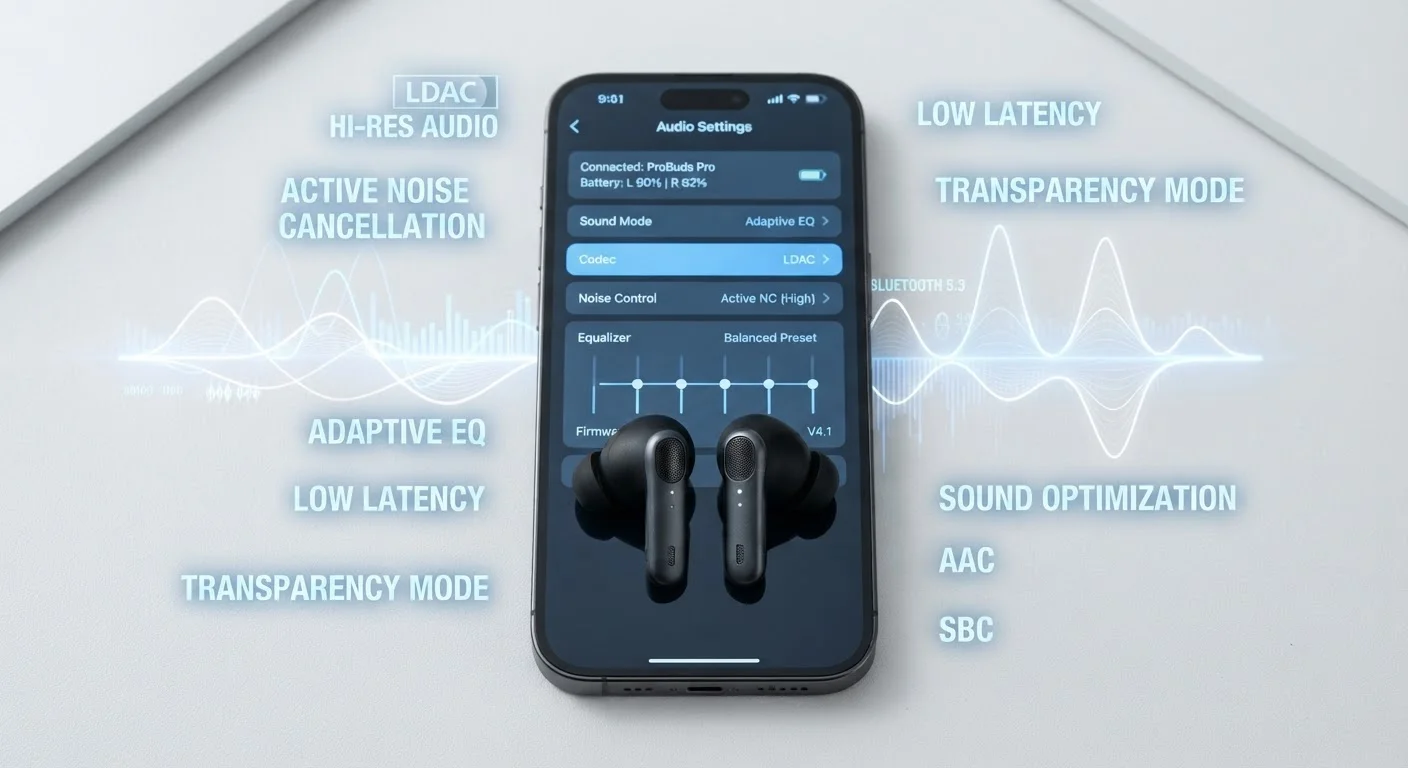
LDAC, developed by Sony and now part of the Android Open Source Project, transmits audio at up to 990 kbps - roughly three times the data throughput of SBC. This allows it to carry high-resolution audio files with significantly less compression. LDAC operates in three modes: 330, 660, and 990 kbps. At 990 kbps, it can approach the quality of a wired connection, but this mode is also most sensitive to interference and distance. Android devices running version 8.0 or later can use LDAC natively, provided the headphones also support it.
Codec
Short for coder-decoder. A codec is the algorithm that compresses audio data for transmission and decompresses it for playback. In Bluetooth audio, the codec determines how much data is sent and how that compression affects sound quality.
Bitrate
The amount of audio data transmitted per second, measured in kilobits per second (kbps). Higher bitrates generally allow more audio detail to be preserved, though the quality of the source file and the codec's efficiency also play significant roles.
Latency
The delay between when audio is sent from a source device and when it reaches your ears. In Bluetooth audio, latency is influenced by the codec - higher latency can cause lip-sync issues when watching video.
Codec negotiation
The automatic process where a Bluetooth source device and receiving device agree on which codec to use. The connection always uses the highest-quality codec that both devices support; if there's no shared higher codec, they fall back to SBC.
High-resolution audio
Audio recorded or mastered at higher sampling rates and bit depths than standard CD quality (44.1 kHz / 16-bit). Transmitting high-resolution audio wirelessly requires a high-bandwidth codec such as LDAC or aptX HD.
The Conditions That Actually Determine What You Hear
Understanding the codec hierarchy is only half the picture. A codec can only perform at its ceiling when several conditions align:
- Both devices must support the same codec. The connection always negotiates down to the highest codec both sides share. A pair of LDAC headphones paired with a device that only outputs AAC will use AAC.
- The source audio must be high enough quality. Streaming compressed audio at 128 kbps through LDAC won't produce high-resolution results - the source file is already the bottleneck. For context on how streaming platforms handle audio quality upstream, see our explainer on streaming audio quality.
- RF environment matters. LDAC at 990 kbps is susceptible to wireless interference and distance degradation. In crowded wireless environments, a device running LDAC may automatically step down to a lower bitrate mode.
- Your ears and equipment are the final judge. Controlled listening tests suggest audible differences between codecs exist, but they can be subtle and listening-context-dependent. Not every listener in every environment will notice a difference between aptX and LDAC.
990 kbps
LDAC peak wireless bitrate
Sony's LDAC codec can transmit up to 990 kbps - approximately three times the ceiling of standard SBC, according to Sony's published specifications.
~328 kbps
SBC maximum bitrate
SBC, the universal fallback codec required on all Bluetooth audio devices, tops out at approximately 328 kbps under optimal conditions.
For listeners making the jump from wired audio, these codec trade-offs are part of a broader set of differences to weigh. See our wired vs. wireless earbuds breakdown for a full comparison.