

Key Takeaways
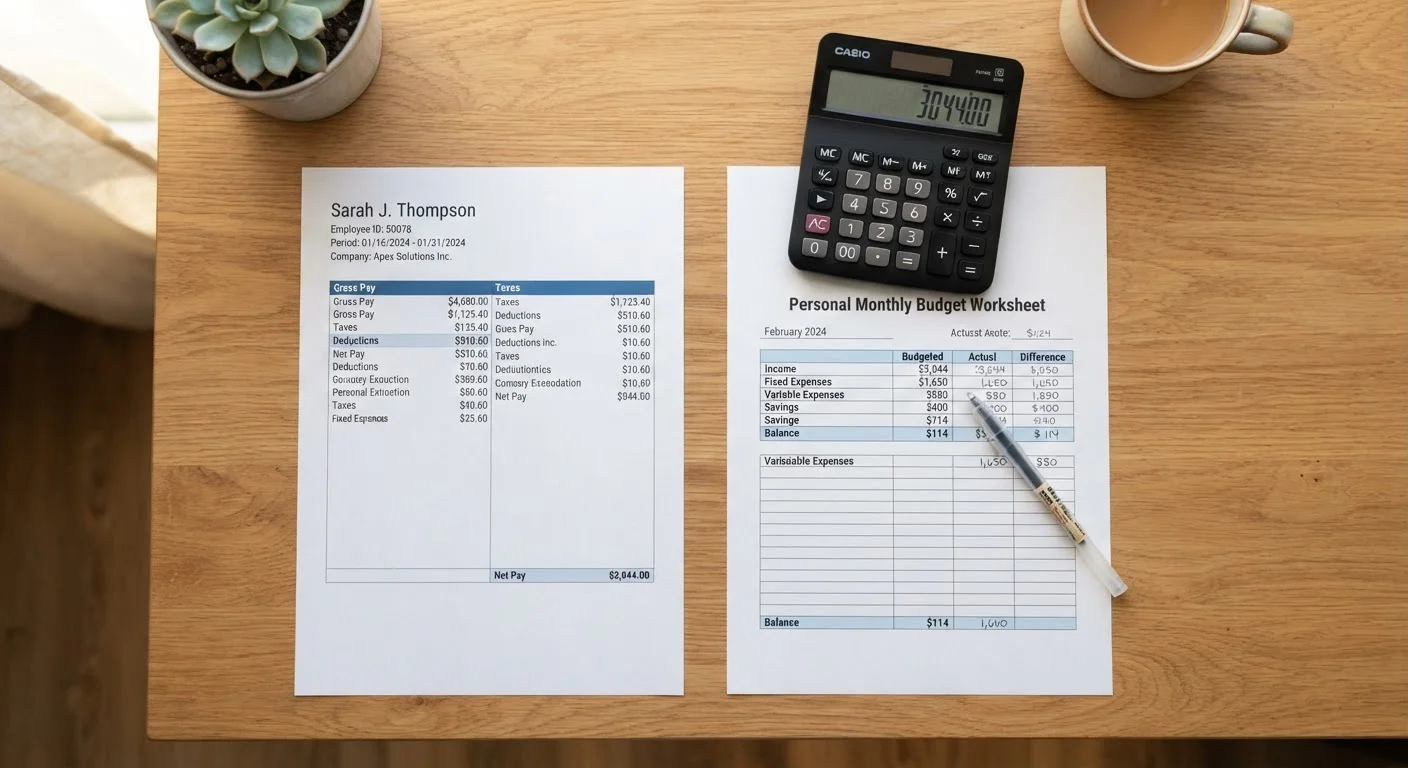
- Always build your budget using net income - the amount deposited into your account after deductions.
- Budgeting from gross income routinely overstates available funds, leading to shortfalls.
- Pre-tax deductions like 401(k) and HSA contributions lower both gross income and your tax bill.
- Your effective take-home pay can differ significantly from someone earning the same salary.
- Understanding the gap between gross and net income helps you make informed decisions about withholding and benefits.
Gross Income vs. Net Income
Gross income is the total amount you earn before any deductions - taxes, Social Security, Medicare, health insurance premiums, or retirement contributions. Net income (also called take-home pay) is what actually lands in your bank account after all those deductions are removed. When you build a budget, only net income reflects the money you can actually spend or save.
Pre-tax deductions such as 401(k) contributions and health savings account (HSA) deposits reduce your gross income before federal income tax is calculated, which is why net income can vary significantly from person to person even at the same salary level.
Why This Distinction Can Make or Break a Budget
Many people anchor their financial plans to a salary figure - $60,000 a year, $5,000 a month - without accounting for what taxes and benefits deductions take off the top. The result is a budget that looks balanced on paper but runs short every pay period. This isn't a math error; it's a framing error.
Gross income is what your employer agrees to pay you. Net income is what you actually control. The difference between those two numbers is entirely made up of obligations you've already committed to - the government's share, your health coverage, your future retirement. These aren't optional line items you can spend around; they're already gone before your check is written.
For a practical vocabulary refresh, see common budgeting terms every consumer should know - it covers gross pay, net pay, and related concepts in plain language.
Gross Income Still Matters for Some Calculations
While net income is the right basis for day-to-day budgeting, gross income is used in other important financial contexts - including mortgage qualification, loan applications, and certain tax calculations. Lenders typically assess debt-to-income ratios using gross income, which is a separate calculation from how you manage your monthly cash flow.
What Gets Subtracted Between Gross and Net
Understanding the deduction categories helps you see exactly where the gap comes from:
- Federal income tax: Withheld based on your W-4 elections and tax bracket. This alone often represents 12-22% of income for middle-income earners.
- State income tax: Varies by state - some have none; others reach 9-10%.
- FICA taxes: Social Security (6.2%) and Medicare (1.45%) are flat-rate deductions that apply to most workers.
- Employer benefits: Health, dental, and vision insurance premiums paid through payroll reduce take-home pay, though they're often partially subsidized by your employer.
- Retirement contributions: Pre-tax 401(k) or 403(b) contributions reduce taxable income but also reduce net pay immediately.
- HSA or FSA contributions: Health savings and flexible spending account deposits are pre-tax, lowering both taxable income and take-home pay.
For many full-time employees, the total gap between gross and net can range from 25% to 40% depending on location, benefit elections, and retirement contribution rate.
~30%
Typical gap between gross and net pay
For many middle-income US workers, combined federal taxes, FICA, and benefit deductions reduce gross pay by roughly 25-35%, according to general payroll and tax data.
6.2%
Social Security tax rate for employees
The IRS sets the employee Social Security withholding rate at 6.2% of wages, applied on earnings up to the annual wage base limit.
How to Build Your Budget From the Right Number
Start with your pay stub, not your offer letter. Locate the net pay figure - the amount actually deposited. If your pay frequency is bi-weekly (every two weeks), you receive 26 paychecks per year. To convert to a monthly figure, multiply one net paycheck by 26 and divide by 12.
Once you have a reliable monthly net income figure, apply it as the ceiling for all spending and saving categories. A common framework is to allocate roughly 50% toward needs (housing, utilities, groceries), 30% toward wants (dining out, entertainment), and 20% toward savings and debt repayment - but these ratios should serve as a starting point, not a rigid rule. See percentage-based budgeting using ratios for a deeper look at how this approach scales with income changes.
If your income varies month to month - due to freelance work, commissions, or seasonal employment - budgeting from a single figure gets more complex. The guide to budgeting on an irregular income outlines practical strategies for those situations.
Use Your Pay Stub, Not Your Salary
Before setting any spending limits, pull your most recent pay stub and note the net pay line. If your pay schedule is bi-weekly, multiply that net amount by 26, then divide by 12 to get your true monthly income. This single step eliminates the most common budgeting error consumers make.
A Note on Pre-Tax Deductions and Long-Term Planning
One nuance worth understanding: pre-tax deductions reduce your net income now but can work in your favor over time. Contributing to a 401(k) lowers your taxable gross income, which may reduce your federal tax bill - meaning the true cost of that contribution is less than the dollar amount withheld. The same logic applies to HSA contributions.
This is why comparing your take-home pay to a colleague earning the same salary can be misleading. Different benefit elections and contribution rates produce different net incomes from identical gross salaries. Your budget needs to reflect your specific paycheck, not a theoretical one.
If you're coordinating finances with a partner, the same principle applies to each income separately. Building a household budget with two incomes walks through how to align two different net pay figures into a shared spending plan.
You may also want to revisit your W-4 withholding elections periodically - especially after major life changes like marriage, a new dependent, or a significant income shift - to ensure your withholding is calibrated accurately. A tax professional can help you evaluate your situation.
This article is for general informational and educational purposes only. It does not constitute personalized financial, tax, or legal advice. Consult a qualified financial adviser or tax professional for guidance specific to your circumstances.