

Key Takeaways
- Risk tolerance reflects both your financial situation and your emotional comfort with uncertainty.
- It is shaped by factors including your time horizon, income stability, and personal psychology.
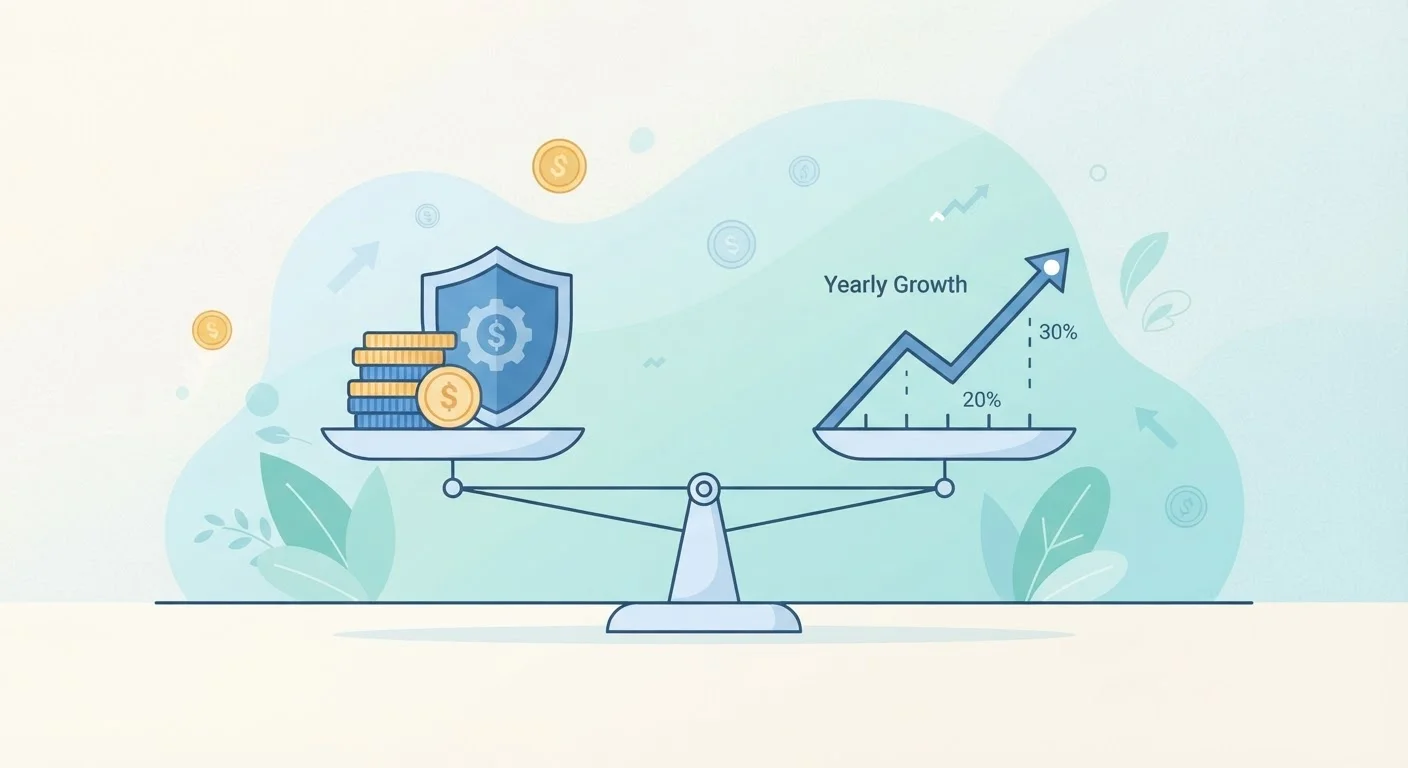
- Higher potential returns generally come with higher potential for loss - this trade-off is unavoidable.
- Your risk tolerance can change over time as your life circumstances evolve.
- Understanding it helps you choose investments you can stick with through market ups and downs.
Investment Risk Tolerance
Investment risk tolerance is your ability and willingness to accept the possibility of losing money in exchange for the chance to earn more over time. Every investment carries some degree of uncertainty, and risk tolerance describes how much of that uncertainty you can realistically handle - both financially and emotionally. Knowing where you stand helps guide smarter, more sustainable investment decisions.
Risk tolerance is typically assessed along two dimensions: capacity (your financial ability to absorb losses) and attitude (your psychological comfort with volatility). These two dimensions don't always align.
Why Risk Is Central to Investing
Every investment involves a trade-off: the possibility of earning more comes with the possibility of losing some - or all - of what you put in. This isn't a flaw in the system; it's a fundamental feature of how investing works. To learn more about what investing actually means, see our introduction to investing.
Risk and return are closely linked. Investments with the potential for higher returns - such as stocks - tend to be more volatile, meaning their value can swing significantly in the short term. Investments with more predictable, stable returns - such as government bonds - typically offer less growth potential. Understanding this relationship is the starting point for thinking about your own comfort with risk.
“The investor's chief problem - and even his worst enemy - is likely to be himself.”
— Benjamin Graham, Author of 'The Intelligent Investor' and pioneer of value investing
What Shapes Your Risk Tolerance
Risk tolerance isn't fixed or universal. It's influenced by a combination of factors that are unique to each person:
- Time horizon: How long you plan to stay invested matters enormously. The role of time horizon in investment planning explains why a longer runway generally allows for more short-term volatility.
- Income and financial stability: If your income is steady and your emergency fund is solid, you may be better positioned to absorb investment losses than someone whose finances are more precarious.
- Financial goals: Saving for retirement in 30 years is a different objective than saving for a home purchase in five. Near-term goals typically call for more conservative approaches.
- Emotional temperament: Some people can watch their portfolio drop 20% and stay calm. Others lose sleep over a 5% dip. Neither reaction is wrong - both are important data about yourself.
~40%
US adults with no investment account
According to Gallup polling, a significant share of Americans hold no stocks, funds, or bonds - often citing fear of loss as a key barrier.
20+ years
Average time for markets to recover from major downturns
Historical data shows that major US stock market indices have recovered from significant declines over time, though past performance does not guarantee future results.
Two Dimensions: Capacity vs. Attitude
A useful way to think about risk tolerance is to separate it into two distinct questions:
- Can you afford the loss? This is your risk capacity - an objective measure based on your income, debts, savings, and goals. If a significant portfolio decline would derail your financial life, your capacity for risk is limited regardless of how you feel about it emotionally.
- Can you handle the anxiety? This is your risk attitude - the psychological side. Even if you can technically afford a loss, the stress of watching your investments fall may cause you to make reactive decisions, like selling at the worst possible time.
Both dimensions matter. A mismatch - say, high financial capacity but low emotional tolerance - often leads to poor outcomes. The goal is to find an approach where both are reasonably aligned.
A Simple Self-Check for Risk Attitude
Imagine your investment portfolio dropped 20% in value over three months. Ask yourself honestly: Would you stay the course, add more, or feel compelled to sell? Your gut reaction is valuable information. If the thought of a significant decline feels unbearable, a more conservative portfolio - one you can stick with - may serve you better than a theoretically optimal but emotionally unsustainable one.
Putting It Into Practice
Understanding your risk tolerance is a means to an end: it helps you build a portfolio structured in a way you can actually stay committed to. This connects directly to concepts like asset allocation - how you divide your money across different types of investments - and diversification, which can help manage overall exposure to any single risk.
Many financial institutions offer risk tolerance questionnaires as a starting point. These can be helpful, but they're not a substitute for speaking with a qualified financial adviser who can assess your full picture. This article provides general information only and is not personalized financial advice.
This article is for general informational and educational purposes only. It does not constitute personalized financial, investment, tax, or legal advice. Please consult a qualified financial adviser before making investment decisions.