

Key Takeaways
- Stocks offer the highest growth potential but carry the most risk, including the possibility of losing your investment.
- Bonds are loans you make to governments or companies and typically offer lower but more predictable returns.
- Cash and cash equivalents prioritize safety and liquidity over growth.
- Combining all three asset classes in a portfolio is a common strategy for managing risk.
- Your ideal mix of assets depends on your goals, time horizon, and personal risk tolerance.
- No asset class guarantees a specific return - all carry some degree of risk.
Asset Class
An asset class is a category of investment that shares similar characteristics and behaves in comparable ways in the market. The three core asset classes are stocks, bonds, and cash (or cash equivalents). Together, they form the building blocks of nearly every investment portfolio.
Asset classes are also defined by their legal structure and how they respond to market conditions; low correlation between classes is the principle behind diversification.
Why Asset Classes Matter
Before you can build a sensible investment strategy, you need to understand what you're working with. Every investment you'll encounter - whether inside a retirement account, a brokerage account, or a simple savings product - can be sorted into one of three fundamental categories: stocks, bonds, and cash. Knowing how each behaves, and why, gives you a foundation for making more informed decisions about your money.
This article is general financial education, not personalized investment advice. For guidance tailored to your situation, consult a qualified financial adviser. You can also explore our plain-English investing glossary for definitions of common terms you'll encounter along the way.
~10%
Average annual stock market return (historical, pre-inflation)
The U.S. stock market has historically averaged roughly 10% annual returns before inflation, according to long-term data tracked by financial researchers - though individual years vary enormously and past results do not predict future performance.
3-5%
Typical yield range for investment-grade bonds
Investment-grade corporate and government bonds have generally offered yields in the low-to-mid single digits, though actual rates fluctuate significantly with Federal Reserve policy and market conditions.
3-6 months
Recommended emergency fund in cash equivalents
Financial planning organizations broadly recommend holding three to six months of living expenses in liquid, safe accounts before investing surplus income.
Stocks: Ownership With a Side of Risk
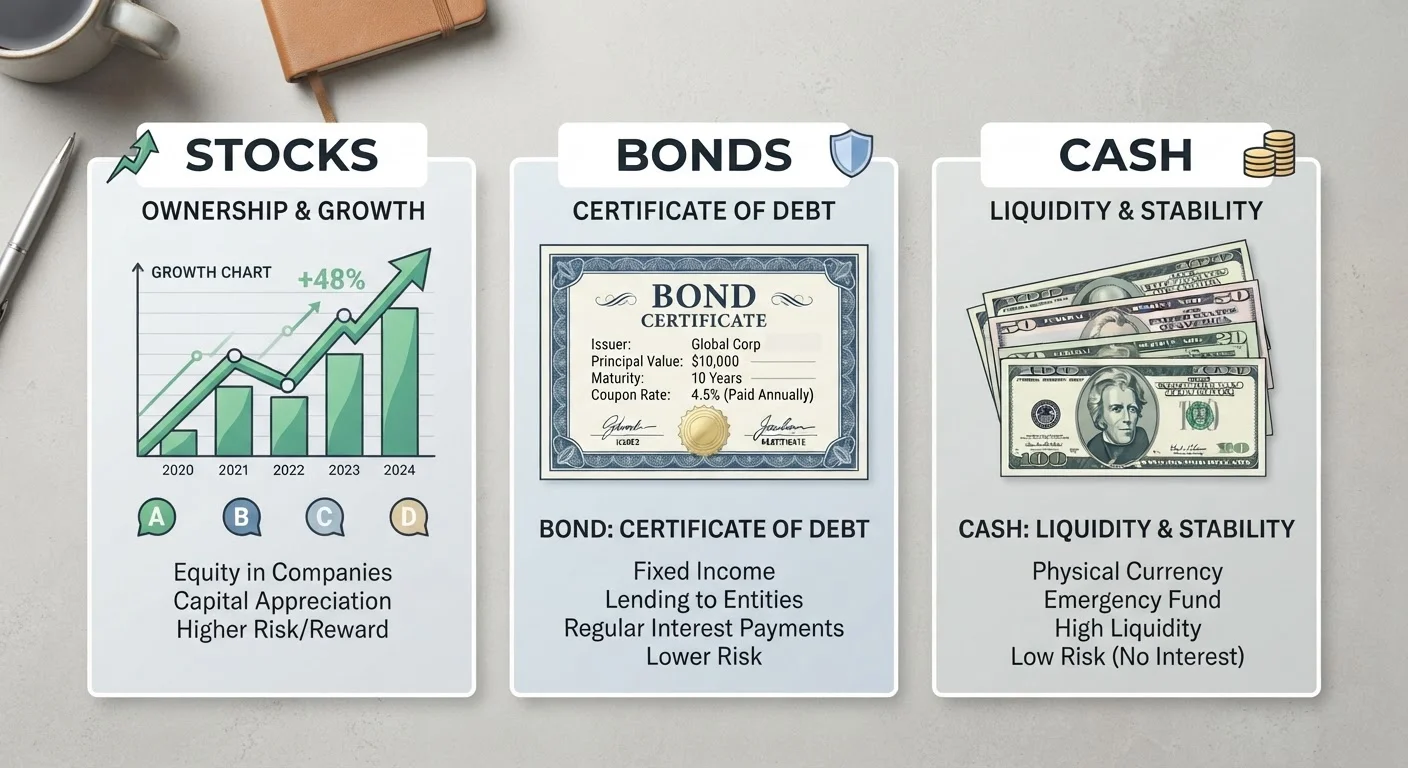
When you buy a stock, you purchase a small share of ownership in a company. If the company grows and becomes more profitable, your shares generally increase in value. Some companies also pay dividends - regular cash distributions from profits - providing a secondary income stream.
The trade-off is volatility. Stock prices can swing dramatically based on company performance, economic conditions, investor sentiment, and global events. A company can also fail entirely, leaving shareholders with little or nothing. This is why stocks are considered the highest-risk of the three core asset classes - but also why they've historically produced the highest long-term returns over extended periods. Past performance, however, does not guarantee future results.
Bonds: Lending Your Money for a Predictable Return
A bond is essentially a loan. When you buy a bond, you're lending money to a government (like the U.S. Treasury) or a corporation in exchange for regular interest payments - called the coupon - and the return of your original investment when the bond matures.
Bonds are generally less volatile than stocks, making them a stabilizing force in a portfolio. However, they are not risk-free. If interest rates rise after you buy a bond, its market value typically falls. And if the issuer runs into financial trouble, there's a chance they could default. Government bonds from stable nations are considered low-risk; corporate bonds vary depending on the issuer's financial health.
Check a Bond's Credit Rating Before Investing
Credit rating agencies assign letter grades to bonds that reflect the issuer's likelihood of repayment. Higher-rated bonds (often called 'investment grade') carry lower default risk; lower-rated bonds (sometimes called 'high yield' or 'junk') offer higher interest to compensate for greater risk. Understanding these ratings can help you assess what you're taking on - though ratings are not guarantees.
Cash: Safety and Flexibility First
Cash and cash equivalents - such as high-yield savings accounts, money market funds, and short-term Treasury bills - prioritize two things above all else: safety and liquidity. Liquidity means the ability to access your money quickly without a significant loss in value.
Cash is the right tool for emergency funds, short-term savings goals, or simply as a cushion within a broader portfolio. The drawback: over long periods, returns on cash often fail to keep up with inflation, meaning your purchasing power can gradually erode. Cash is a shelter, not a growth engine.
How the Three Asset Classes Work Together
The real power of understanding asset classes lies in how you combine them. Because stocks, bonds, and cash don't always move in the same direction at the same time, holding a mix - a strategy called diversification - can help manage the overall risk of a portfolio.
For example, when stock markets drop sharply, bonds sometimes hold steady or even rise in value, helping to cushion losses. Cash preserves value in turbulent periods and gives you flexibility to act when opportunities arise.
Your ideal blend of the three will depend on factors personal to you: how long you plan to invest, what financial goals you're working toward, and how much short-term loss you can stomach without abandoning your plan. Our beginner's investing guide walks through how to start thinking about those questions in practical terms.
“Diversification is the only free lunch in investing. By spreading your holdings across different asset classes, you can reduce risk without necessarily sacrificing return.”
— Harry Markowitz, Nobel Prize-winning economist and pioneer of Modern Portfolio Theory
For a broader view of how these concepts fit into the full investing picture, see our comprehensive introduction to investing from first principles.
This article is for general informational and educational purposes only and does not constitute personalized financial, investment, tax, or legal advice. Consult a qualified financial professional before making decisions about your own money.