

Key Takeaways
- Target-date funds are named for your expected retirement year and manage their own asset mix automatically.
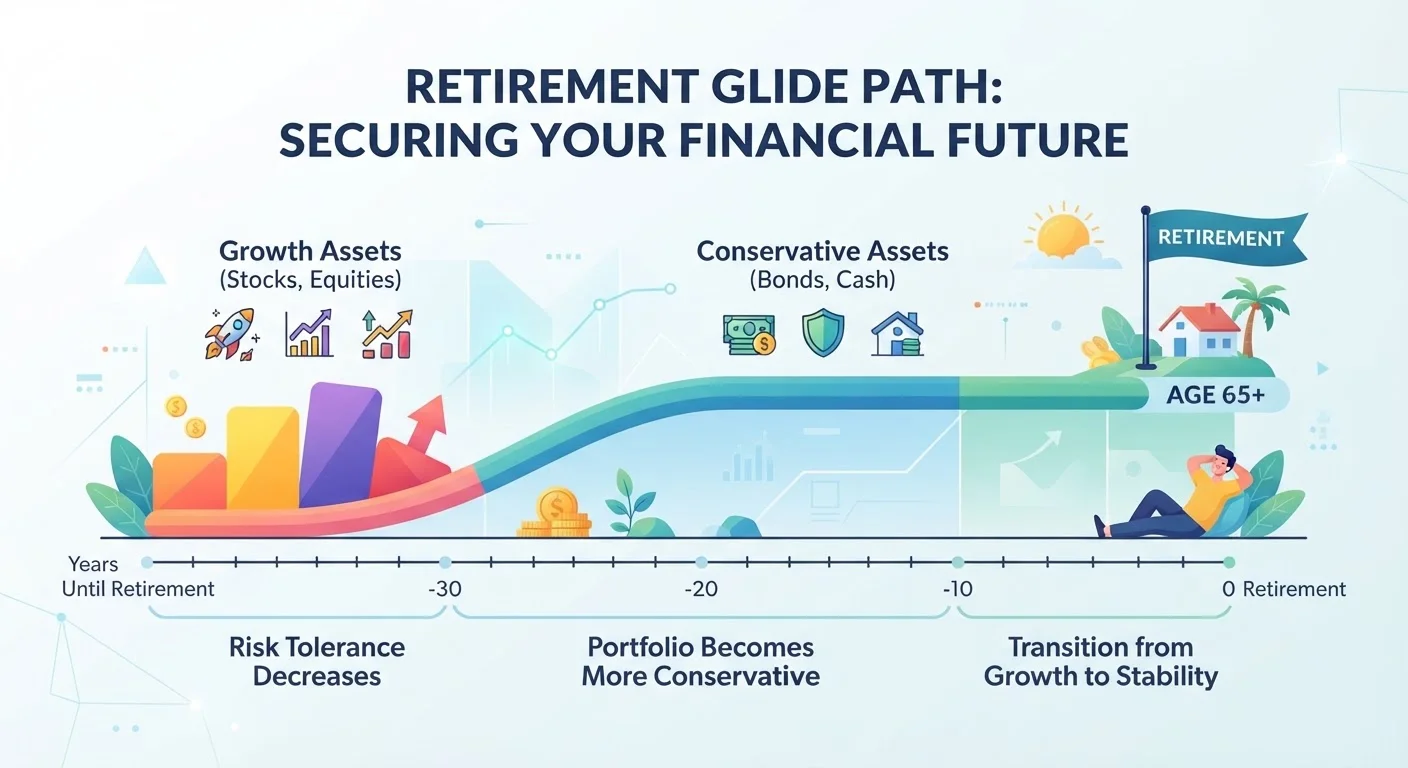
- The shift from growth to conservative investments over time is called a glide path.
- These funds are designed for hands-off investors who want built-in diversification and rebalancing.
- Glide path designs differ between fund providers, so two funds with the same year can invest quite differently.
- Target-date funds typically carry expense ratios, which are annual fees expressed as a percentage of your investment.
Target-Date Fund
A target-date fund is a type of investment fund designed to simplify retirement saving. You choose a fund named after the approximate year you plan to retire - such as a "2045 Fund" - and the fund automatically adjusts its mix of investments over time. Early on, it holds more growth-oriented assets like stocks; as the target date approaches, it gradually shifts toward more conservative options like bonds.
The automatic shift in asset allocation is called a "glide path," and it varies by fund provider. Some glide paths continue shifting even after the target date, a design referred to as "through" retirement, while others stop adjusting at the target year, known as "to" retirement.
The Basic Idea Behind a Target-Date Fund
Investing for retirement involves dozens of decisions: which asset types to hold, how much of each, and when to shift your mix as you get older. For many people, managing all of that is daunting. A target-date fund bundles those decisions into a single, self-adjusting investment.
You pick a fund that matches your expected retirement year, contribute regularly - often through a workplace 401(k) - and the fund handles the rest. It starts with a heavier emphasis on assets with higher growth potential, typically stocks, and gradually moves toward more stable assets, such as bonds, as the target year approaches.
Understanding how asset allocation works helps clarify why this shift matters: a younger investor has time to ride out market volatility, while someone nearing retirement generally needs more stability to protect what they've accumulated.
$3.5T+
Estimated U.S. assets in target-date funds
According to Morningstar research, target-date fund assets in the U.S. have grown substantially over the past decade, reflecting their widespread adoption in workplace retirement plans.
~80%
401(k) plans offering target-date funds
Research from the Investment Company Institute suggests the vast majority of employer-sponsored 401(k) plans include target-date funds as an investment option.
How the Glide Path Works
The glide path is the engine behind a target-date fund's automatic adjustments. Think of it as a slow, pre-planned pivot. A fund dated 30 years out might hold 90% in stocks and 10% in bonds. A fund just five years from its target might flip that ratio, holding far more bonds than stocks.
This rebalancing happens automatically - the fund manager executes it on a set schedule without any action required from you. If you want to understand what rebalancing involves more broadly, what rebalancing means and when portfolios are adjusted covers the concept in depth.
Two glide path designs exist:
- "To" retirement: The fund reaches its most conservative allocation at the target date and stops adjusting.
- "Through" retirement: The fund continues shifting toward conservative assets for years after the target date, accounting for the fact that retirees may live another 20-30 years.
Neither design is universally superior - each reflects different assumptions about how long a retiree will draw down their savings.
Check Your Fund's Glide Path Design
Before relying on a target-date fund as your primary retirement investment, look up whether it uses a "to" or "through" glide path. This detail affects how conservative the fund becomes at and after your target date. You can usually find this information in the fund's prospectus or on the fund provider's website.
What's Inside a Target-Date Fund
Most target-date funds are actually funds of funds - they hold a basket of underlying mutual funds or index funds rather than individual stocks and bonds directly. This structure provides broad diversification across thousands of securities with a single investment.
The underlying funds often include a mix of domestic stocks, international stocks, and bonds. Some funds also include real estate investment trusts (REITs) or inflation-protected bonds. For more on the building blocks, see what index funds are and how they work.
Because target-date funds layer fees - both a fund-level expense ratio and underlying fund fees - costs can be higher than holding individual index funds directly. Reviewing the fund prospectus helps you understand total costs before investing.
Important Considerations Before Using One
Target-date funds are designed for convenience, but they aren't a perfect fit for every investor. A few things worth knowing:
- One-size assumptions: The fund assumes you'll retire in a specific year and applies a standardized glide path. Your actual risk tolerance or retirement timeline may differ from that assumption.
- Variation between providers: Two funds with the same target year can have very different allocations. One provider's 2040 Fund may hold significantly more in stocks than another's. Compare them using each fund's prospectus or fact sheet.
- They don't account for your whole picture: If you hold other investments alongside a target-date fund, the combined allocation may not match your goals. Understanding how different fund types compare can help you evaluate how a target-date fund fits within a broader strategy.
Once you near or reach retirement, your financial priorities shift considerably. How budgeting changes in retirement explains what to expect when income from work is replaced by drawing down saved assets.
This article is for general informational and educational purposes only and does not constitute personalized financial, investment, or tax advice. Consult a licensed financial adviser before making investment decisions.