

Key Takeaways
- Dairy is not the only reliable dietary calcium source - many plant and fortified foods provide substantial amounts.
- Absorption rate matters: some plant foods contain compounds that reduce how much calcium the body actually uses.
- Fortified foods like plant-based milks and certain juices can closely match dairy's calcium contribution.
- Vitamin D works alongside calcium - adequate vitamin D is essential for the body to absorb calcium effectively.
- Variety across multiple food sources is a practical strategy for meeting daily calcium needs without dairy.
Why Calcium Sources Beyond Dairy Matter
Calcium is essential for bone structure, muscle function, and nerve signaling - yet many people associate it almost exclusively with milk and cheese. In reality, a wide range of plant-based and fortified foods contribute meaningfully to daily calcium intake. This matters for people who avoid dairy due to lactose intolerance, allergies, ethical preferences, or simply personal taste.
The recommended daily intake for most adults in the US is around 1,000 mg, rising to 1,200 mg for women over 50 and men over 70, according to the National Institutes of Health. Meeting these targets without dairy is entirely feasible - but it does require some awareness of which foods deliver calcium and how well the body absorbs it. If you're exploring broader dietary patterns, our overview of nutritional strengths across plant-based and omnivorous diets provides helpful context.
Bioavailability: A Key Factor to Understand
Calcium content listed on nutrition labels reflects total calcium in a food, not the amount your body actually absorbs. High-oxalate vegetables like spinach can have their calcium almost entirely blocked from absorption. Low-oxalate greens like kale and bok choy are significantly more useful. Checking both the calcium content and the oxalate level of a food gives a more accurate picture of its real contribution to your intake.
One key concept: bioavailability. Not all dietary calcium is equally absorbed. Factors such as oxalate and phytate content in certain plant foods can reduce absorption. Cooking methods and portion sizes also influence how much calcium your body actually takes in from a given meal.
Plant and Non-Dairy Calcium Sources Worth Including
Fortified Plant-Based Milks
Soy, almond, oat, and rice milks are commonly fortified with calcium carbonate or calcium phosphate, bringing their calcium content close to that of cow's milk - typically around 300 mg per cup. Soy milk tends to have a slight edge in overall nutritional profile, also offering protein comparable to dairy. Always check the label, since fortification levels vary by brand and product line, and shake the carton well as calcium can settle.
Fortified soy milk can deliver around 300 mg of calcium per cup, rivaling dairy.
Tofu (Made with Calcium Sulfate)
Firm tofu prepared using calcium sulfate as a coagulant can be an exceptionally rich calcium source - some varieties provide over 400 mg per half-cup serving. Bioavailability appears reasonably good. Importantly, not all tofu is made this way; tofu set with nigari (magnesium chloride) contains far less calcium. Checking the ingredients list for calcium sulfate is a quick way to identify the higher-calcium options.
Calcium-set tofu can exceed 400 mg per half-cup - one of the densest plant-based sources.
White Beans and Other Legumes
White beans (navy, cannellini, great northern) are among the most calcium-rich legumes, with roughly 130-160 mg per cooked cup. Other legumes - chickpeas, black beans, lentils - contribute smaller amounts but still add to daily totals. Legumes also deliver fiber, plant protein, and magnesium, making them a nutritionally versatile addition to meals regardless of dairy intake. Soaking dried beans before cooking can help reduce phytates, which may modestly improve mineral absorption.
White beans offer a meaningful calcium contribution alongside fiber and plant protein.
Leafy Greens with Low Oxalate Content
Not all greens are equally useful for calcium. Spinach and beet greens are high in oxalates, which bind calcium and sharply limit its absorption - making them poor calcium sources despite appearing calcium-rich on paper. By contrast, bok choy, kale, broccoli, and collard greens have low oxalate levels and good bioavailability, with absorption rates for some of these vegetables reportedly exceeding that of milk. A cup of cooked collard greens can provide roughly 260 mg of well-absorbed calcium.
Kale and bok choy offer calcium that is absorbed more efficiently than spinach due to lower oxalate levels.
Fortified Orange Juice
Many commercially available orange juices are fortified with calcium citrate malate, a form that research suggests is absorbed effectively. A standard 8-ounce serving of fortified orange juice typically provides around 300-350 mg of calcium. This can be a useful option for people who want variety but should be balanced against the natural sugar content of juice - making it more suitable as one source among several rather than a primary daily strategy.
Calcium-fortified orange juice delivers around 300 mg per serving with good absorption rates.
Almonds and Other Nuts and Seeds
Almonds are the most calcium-rich of the common tree nuts, providing roughly 75-80 mg per ounce (about 23 almonds). Chia seeds offer a more concentrated source, with approximately 180 mg per two-tablespoon serving, along with omega-3 fatty acids. Sesame seeds - and tahini made from them - are also notable, containing around 130 mg per two tablespoons. While these foods contribute smaller per-serving amounts than tofu or fortified beverages, they add up meaningfully when consumed regularly across the day.
Chia seeds pack roughly 180 mg of calcium per two tablespoons, making them a nutrient-dense addition.
Canned Fish with Edible Bones
For those who eat fish but not dairy, canned sardines and canned salmon with bones are among the most calcium-dense animal-source options outside of dairy. The soft, edible bones are where the calcium resides - a 3-ounce serving of canned sardines can provide roughly 325 mg. These fish also supply omega-3 fatty acids and vitamin D, which supports calcium absorption, creating a particularly useful nutritional pairing.
Canned sardines with bones deliver over 300 mg of calcium per serving alongside vitamin D.
Pairing Foods to Improve Calcium Absorption
Vitamin D plays a direct role in how efficiently the body absorbs calcium from food. Including vitamin D-rich foods or spending time in sunlight can enhance the value of your calcium-rich meals. Separately, spreading calcium intake across the day - rather than consuming it all at once - may support more effective absorption, as the body has limits on how much it can process in a single sitting.
For a deeper look at planning a nutritionally complete diet without animal products, the guide to vegetarian nutrition covers calcium alongside other nutrients that deserve extra attention.
Putting It All Together
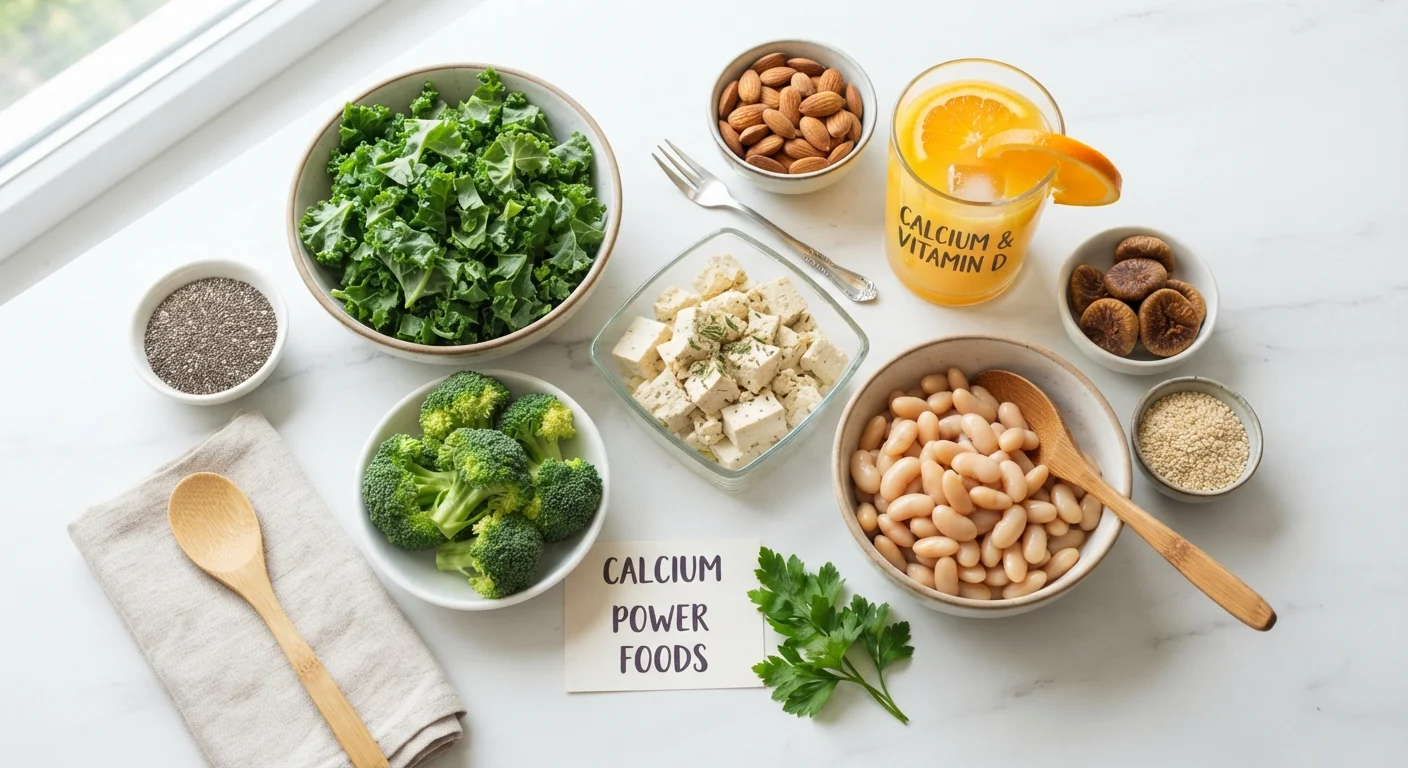
No single food needs to shoulder the entire calcium burden. A practical approach is to combine several sources across meals - a handful of almonds, a serving of cooked kale, a cup of fortified plant milk, and a portion of white beans can collectively add up to a substantial contribution toward daily needs. Pairing calcium-rich foods with adequate vitamin D is also important, since vitamin D is required for efficient calcium absorption.
Calcium needs shift across life stages, too. Older adults in particular may need to pay closer attention - our article on nutritional shifts after 50 addresses how calcium requirements change with age and why they deserve priority.
If you have concerns about meeting your calcium needs - especially with underlying health conditions, bone health history, or specific dietary restrictions - consulting a registered dietitian or qualified healthcare provider is the most reliable next step. This article is intended as general nutritional information, not personalized medical or dietary advice.
This article is for informational purposes only and does not constitute medical or nutritional advice. Consult a qualified healthcare professional for guidance specific to your health needs.