

Key Takeaways
- Purchase price is only one input; maintenance, energy use, and lifespan all affect real value.
- A lower sticker price frequently signals shorter useful life or higher operating costs.
- Calculating cost-per-year is a practical way to compare products across different price tiers.
- Repairability and parts availability meaningfully extend - or cut short - a product's useful life.
- Timing a purchase around sales cycles matters less than buying a product that holds up over time.
Total Cost of Ownership
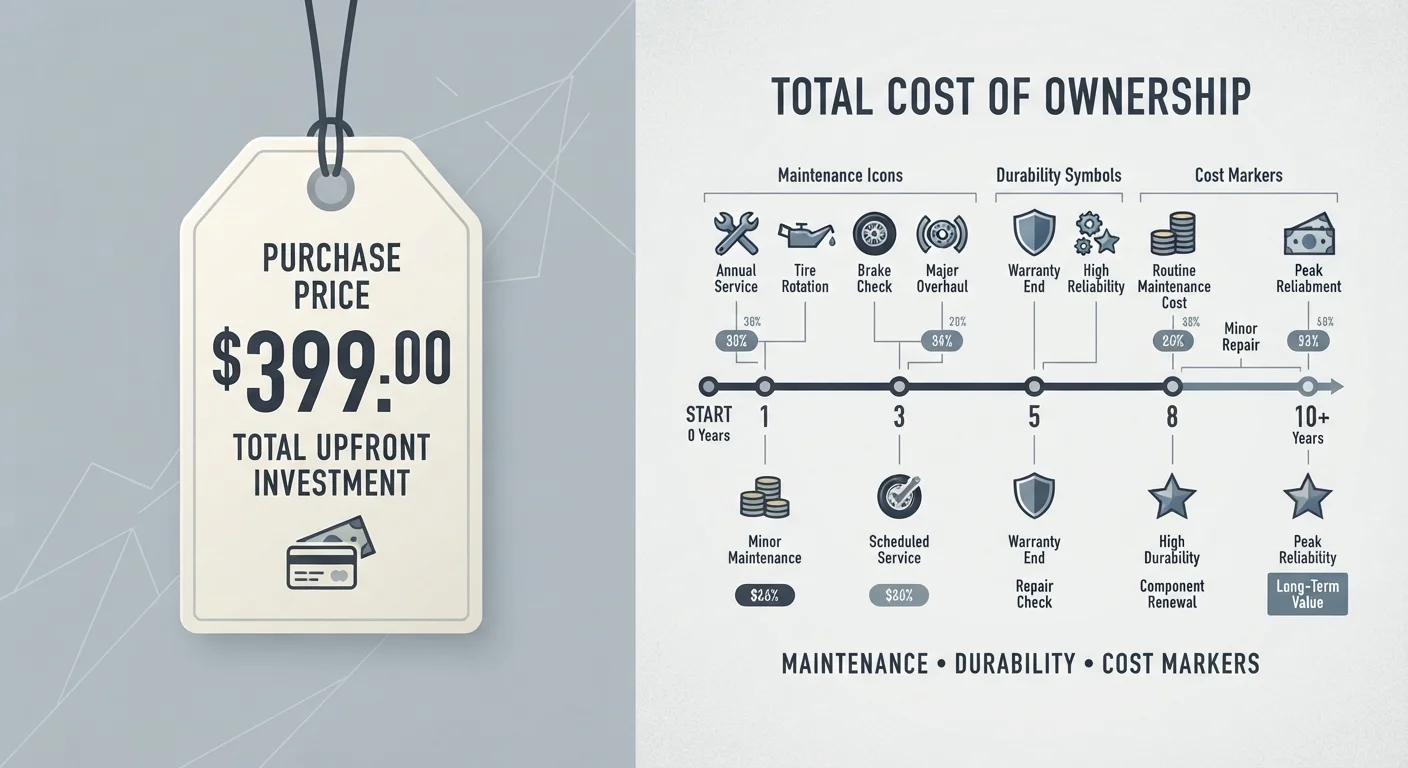
Total cost of ownership (TCO) is the complete financial picture of buying and using a product over its full lifespan - not just what you pay at checkout. It includes ongoing expenses like maintenance, repairs, energy consumption, and eventual replacement. A cheaper upfront price can easily become the more expensive option once these factors are counted.
In corporate procurement, TCO is a formal methodology used to compare capital expenditure against operational expenditure. Consumer applications of the same logic are less formal but equally valid.
Why the Sticker Price Is an Incomplete Metric
Most purchase decisions are anchored on price - what something costs at the register. That number is concrete, comparable, and immediate. But it captures only a fraction of what you'll actually spend on a product during its useful life.
The gap between purchase price and true cost grows wider with categories like appliances, vehicles, electronics, and tools - anything you'll use repeatedly over years. Energy consumption, consumable parts, servicing requirements, and eventual disposal fees all accumulate quietly after you've taken the item home.
Shipping, installation, and accessories are among the costs that frequently catch buyers off guard. These aren't edge cases - they're predictable components of ownership that don't appear on the price tag.
2-3×
Operating costs vs. purchase price over lifespan
Consumer research consistently shows that operating and maintenance costs frequently exceed the original purchase price for major appliances and vehicles over a 10-year ownership period.
~30%
Energy cost share of appliance lifetime cost
The U.S. Department of Energy has noted that energy consumption can account for roughly 30% or more of the total cost of ownership for common household appliances.
5-10 years
Lifespan gap between budget and durable-tier products
Industry durability testing across appliance and tool categories commonly finds a 5-to-10-year gap in useful life between entry-level and higher-durability product tiers.
Cost-Per-Year: A More Useful Unit of Comparison
One practical reframe is to stop thinking in purchase price and start thinking in cost-per-year. The calculation is straightforward: divide the purchase price by the product's realistic lifespan in years, then add estimated annual operating costs - energy, filters, maintenance, or other recurring expenses.
This single number lets you compare products across very different price tiers on an equal footing. A product priced at twice the entry-level option but lasting three times as long comes out ahead on this metric - often by a meaningful margin.
Setting a realistic budget for a major purchase means working this figure in from the start, not as an afterthought when a repair bill arrives.
Make Cost-Per-Year Your Default Comparison Unit
Before comparing two products on price, estimate how long each will realistically last and what it will cost annually to run or maintain. Divide total cost by expected years of use. This single step often reverses which option looks like the better deal - and it takes less than five minutes to calculate.
Repairability, Parts Availability, and Useful Life
A product's useful life is not fixed at the point of manufacture - it's shaped by whether you can maintain and repair it when something fails. This makes repairability a purchasing criterion worth investigating before you buy.
Key questions to research: Are replacement parts available and reasonably priced? Is there a repair network - either manufacturer-authorized or independent - that services this product? Does the manufacturer publish repair documentation, or is the unit designed to be replaced rather than fixed?
Products that score poorly on these questions tend to have artificially shortened lifespans. That has both financial and environmental implications worth weighing before committing to a purchase.
Where Timing and Sales Cycles Fit In
Seasonal sales cycles and promotional discounts do affect value - but their impact is secondary to the underlying quality of what you're buying. A 20% discount on a product with a two-year lifespan may deliver less total value than paying full price for something that lasts six years.
That said, timing matters within the right framework. If you've already identified a product with strong durability and reasonable operating costs, buying during a period of genuine price reduction improves your overall position. The decision sequence should be: identify the right product first, then optimize on price.
Loyalty points versus immediate discounts is a related tradeoff - and the same principle applies: the structure that delivers more value over time usually wins over the one that looks larger in the moment.
“Consumers consistently underweight future costs when making purchase decisions - a well-documented behavioral pattern that leads to systematically poor value outcomes over time.”
— Richard Thaler, Nobel laureate in Economics, known for research on consumer decision-making and behavioral economics