

Key Takeaways
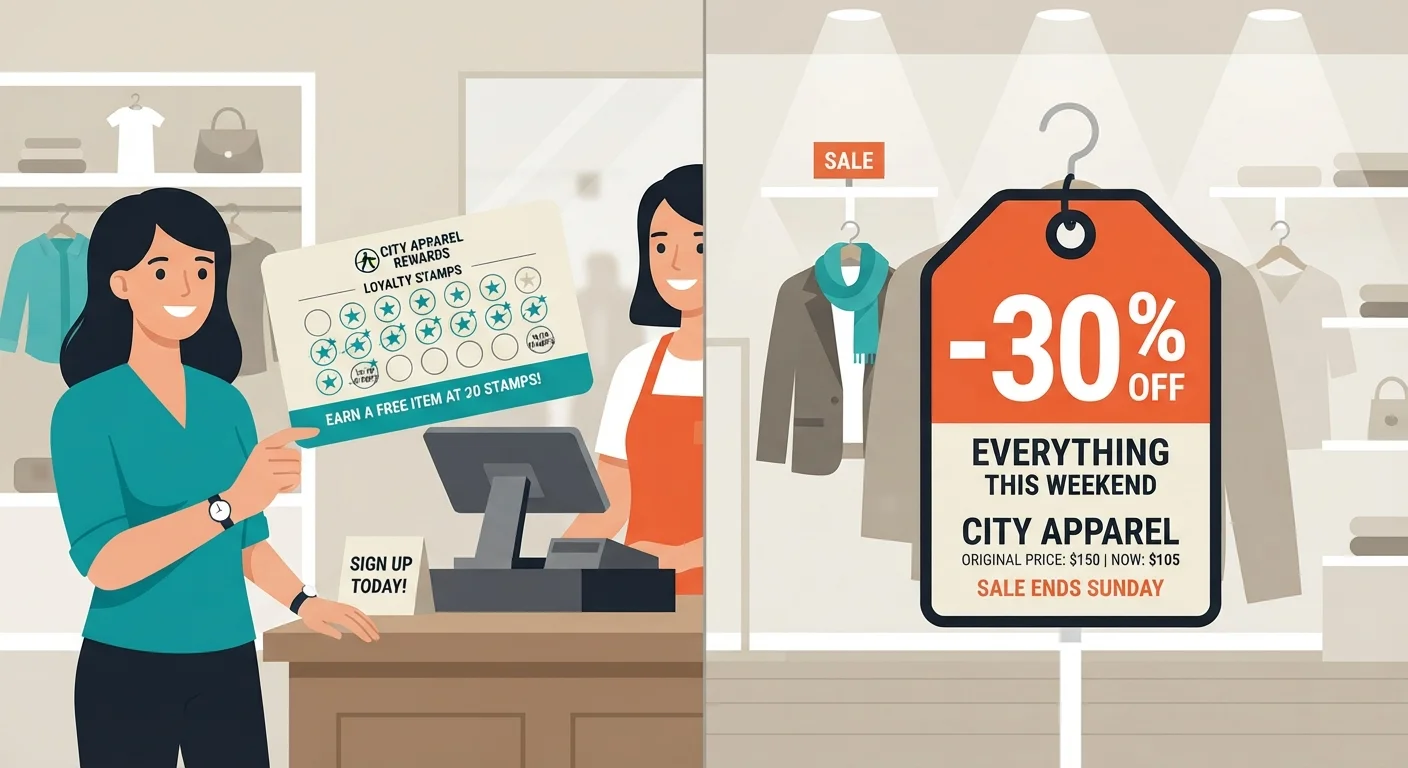
- Loyalty programs are designed to build habitual purchasing patterns; one-time discounts are designed to close a single transaction.
- Research generally shows loyalty programs are more effective at increasing visit frequency than basket size.
- One-time discounts can attract new or lapsed customers but rarely create lasting behavioral change on their own.
- Loyalty programs often collect detailed consumer data that retailers use to personalize future offers.
- The value of either approach depends heavily on how consistently a consumer shops in a given category.
Option A
Loyalty Programs
The long-game relationship builder.
Best for: Shoppers who buy frequently from the same retailer and want cumulative rewards over time.
Option B
One-Time Discounts
The immediate, transactional incentive.
Best for: Consumers making an infrequent or comparison-driven purchase where instant savings matter most.
If you shop regularly at the same store or chain
Loyalty Programs
Repeated purchases compound into meaningful rewards over time, and the behavioral nudge to return is built into the program's structure.
If you're making a one-off or infrequent purchase
One-Time Discounts
There's no long-term commitment required, and the savings are immediate and transparent - no points accumulation needed.
If you're evaluating where to spend across multiple retailers
One-Time Discounts
Instant discounts let you compare real prices without locking in to a single retailer's ecosystem.
If you want to maximize value on a specific category you buy often
Loyalty Programs
Category-specific programs (groceries, fuel, pharmacy) tend to reward concentrated spending in ways that add up meaningfully over months.
How Each Incentive Is Designed to Work
Loyalty programs and one-time discounts are both tools for influencing consumer behavior - but they operate on fundamentally different timelines and psychological mechanisms.
Loyalty programs are built on the principle of deferred reward. By requiring customers to accumulate points, stamps, or tiers before redeeming value, they create a sense of investment in the retailer relationship. That sunk-cost dynamic - "I already have 400 points, I may as well shop here again" - is the engine retailers count on. The data retailers collect through these programs also allows them to personalize offers, which can make the program feel more relevant to individual shoppers.
One-time discounts work on an opposite logic: immediate gratification. A percentage-off promotion or a limited coupon removes purchase hesitation at the moment of decision. They're particularly effective at converting undecided shoppers or drawing customers away from a competing retailer. But because there's no ongoing structure, the behavioral effect typically ends at the point of purchase.
| Criterion | Loyalty Programs | One-Time Discounts |
|---|---|---|
| Primary goal | Drive repeat visits over time | Convert a single transaction |
| Reward timing | Deferred (points accumulate) | Immediate (savings at checkout) |
| Data collection | Extensive - tracks purchase history | Minimal - usually no account needed |
| Behavioral effect | Increases purchase frequency | Drives trial and switching |
| Complexity for consumer | Moderate - rules, tiers, expirations | Low - simple price reduction |
| Retailer retention benefit | High - builds switching costs | Low - no ongoing obligation |
For a closer look at how points-based structures compare to upfront savings within loyalty frameworks, see our article on accumulating points vs. capturing immediate discounts.
What the Evidence Says About Behavioral Change
Consumer behavior research consistently finds that loyalty programs are more effective at increasing purchase frequency than at increasing the size of each transaction. When a shopper knows a free reward is within reach, they tend to visit more often - but they don't necessarily spend more per trip. This pattern is well-documented in sectors like grocery, coffee, and fuel.
~83%
US adults enrolled in at least one loyalty program
Bond Brand Loyalty's research has consistently found loyalty program participation among US consumers to be above 80%, though engagement rates are considerably lower.
44%
Consumers who change spending to maximize rewards
According to McKinsey research on loyalty programs, less than half of enrolled members actively alter their behavior to earn more rewards.
One-time discounts, by contrast, are stronger drivers of trial and switching behavior. They're effective at getting someone to try a new store or brand they wouldn't have considered at full price. The limitation is that without a follow-up retention mechanism, many of those customers don't return - meaning the discount cost the retailer margin without producing a lasting customer relationship.
It's worth noting that the two approaches are often combined intentionally. A retailer might use a one-time discount to attract a new customer, then enroll them in a loyalty program at the point of purchase to begin the retention cycle. Consumers who are aware of this pattern can make more deliberate choices about when to engage with each incentive type.
If you're prone to signing up for programs reflexively, questions worth asking before joining a loyalty program offers a useful checklist for evaluating what you're actually agreeing to.
Hidden Costs and Overlooked Tradeoffs
Neither incentive type is without strings. Loyalty programs often require sharing personal data - purchase history, contact information, and sometimes location - in exchange for rewards. Consumers should understand that their shopping behavior becomes part of a retailer's customer database, which shapes how they're marketed to going forward.
Points can also expire, devalue, or come with redemption restrictions that reduce their practical worth. For a clear-eyed look at where loyalty value tends to get lost, see our piece on loyalty points mistakes that leave value on the table.
One-time discounts carry their own subtle costs. Promotional pricing can anchor expectations - shoppers who buy at a steep discount sometimes become unwilling to pay full price in the future, which affects their relationship with a brand or retailer long-term. Frequent discounting by retailers also signals something about their normal pricing strategy that's worth paying attention to.
Cashback Programs Blur the Line
Cashback programs occupy a middle ground between loyalty programs and one-time discounts. They often function like loyalty programs structurally but deliver value that feels more like a direct discount. Understanding how earning and redemption cycles work in these programs helps consumers evaluate them more accurately. Our overview of how cashback programs work breaks down the key details.
For broader context on how recurring spending commitments stack up against one-time purchases, our comparison of subscriptions vs. one-time purchases covers the tradeoffs in more depth.