

Key Takeaways
- Matching your schedule to your real lifestyle dramatically improves long-term consistency.
- Balancing cardio, strength, and flexibility work prevents burnout and supports well-rounded fitness.
- Starting with three to four sessions per week is more sustainable than jumping to six.
- Tracking workouts helps reveal patterns and catch plateaus before they stall progress.
- Scheduled rest days are an active training tool, not wasted time.
What you will need
Why Most Workout Schedules Fall Apart
The most common reason exercise plans collapse isn't laziness - it's misalignment. People design schedules for an idealized version of their week, then feel like failures when reality intervenes. Overcrowded plans, wrong timing, no recovery buffer, and no flexibility mechanism all stack against long-term success.
The good news: building a sticky schedule is mostly a design problem, not a willpower problem. When the structure fits your actual life, showing up stops feeling like a negotiation and starts feeling like routine. The steps below walk you through that design process, starting with an honest look at what your week actually looks like.
What you will need
Tools That Make Scheduling Easier
You don't need sophisticated equipment to plan a workout week - you need visibility and a way to record what happens. A paper planner works just as well as a premium app. What matters is that your plan lives somewhere you'll see it daily and that you can review it honestly after a couple of weeks.
Weekly planner or calendar app
Block out workout sessions visually so training time is treated as a firm commitment.
Training log or journal
Record exercises, sets, reps, and how you felt to track progress over time.
Fitness tracking app or wearable
Automatically logs active minutes, heart rate zones, and recovery data to complement your written log.
Timer or interval app
Manages work-to-rest ratios for circuit or HIIT-style sessions.
How to Build Your Weekly Plan
Follow the steps below in order. Each one builds on the last, so skipping ahead - especially past the audit phase - tends to produce the same over-ambitious schedules that fail in week one.
Audit your real week - not your ideal one
Before writing a single workout, spend five minutes mapping your actual week. Identify which days have consistent windows of 30-60 minutes and which are genuinely chaotic. Morning person? Evening-only available? Blocked every Wednesday? Be honest. A plan built around your real schedule survives; one built around aspirations usually doesn't make it past week two.
Choose a realistic session frequency
For most beginners, three to four sessions per week hits the sweet spot between meaningful stimulus and adequate recovery. Intermediate exercisers often manage four to five. Resist the urge to schedule seven days - accumulated fatigue compounds, and a missed day can feel like failure rather than a normal fluctuation. If time is tight, shorter, well-structured sessions can still deliver real benefits.
Distribute training types across the week
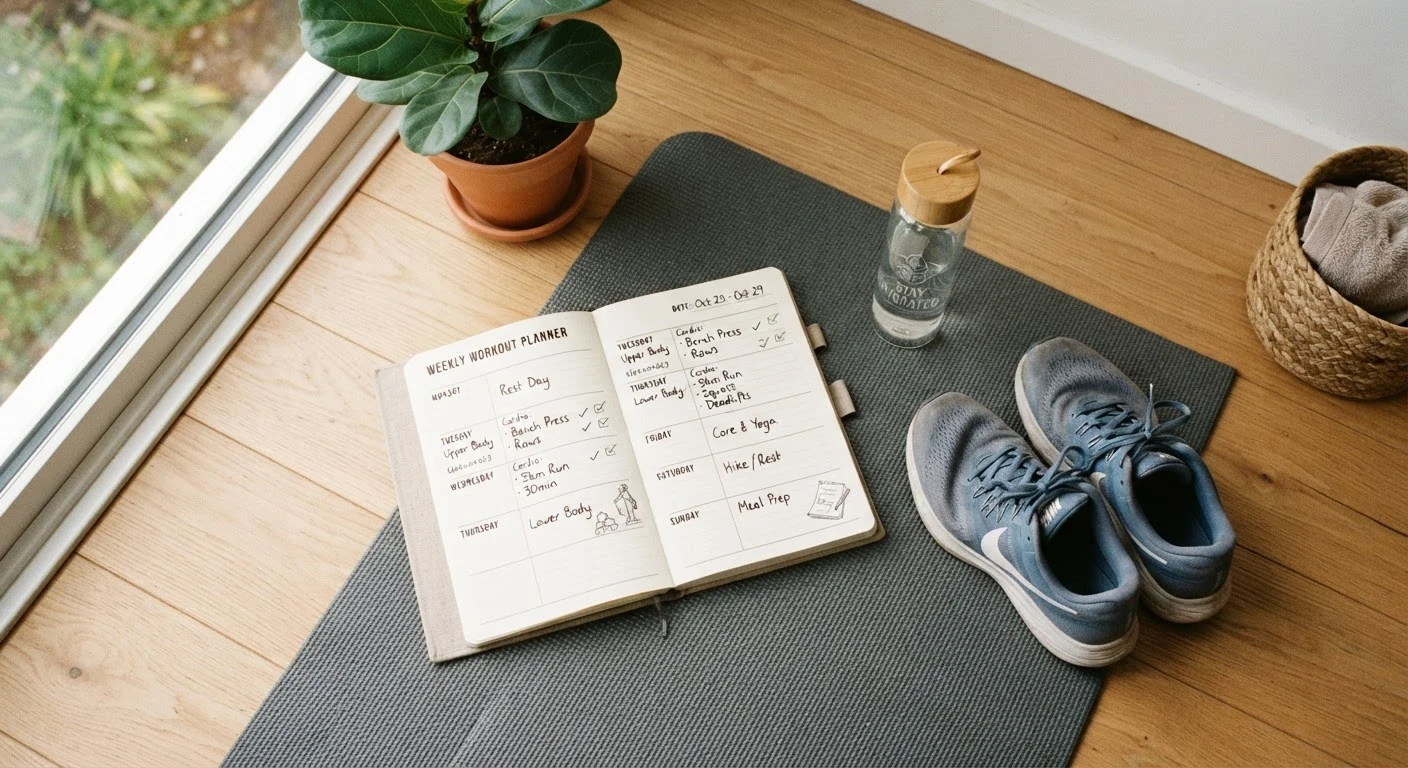
Avoid stacking the same type of workout on consecutive days. A practical template for four sessions might look like: strength on Monday, cardio on Tuesday, rest or light movement on Wednesday, strength on Thursday, cardio or mobility on Saturday. This spacing lets muscles repair between stress sessions. If you're new to lifting, a beginner strength framework can help you structure those sessions effectively.
Schedule rest days deliberately
Rest days are not gaps in willpower - they are the period when adaptation actually occurs. Muscles rebuild stronger, the nervous system recovers, and motivation resets. Mark at least one or two full rest days on your calendar as intentionally as you mark workouts. For a deeper look at the physiology behind recovery, see why rest days are a feature, not a flaw.
Run the schedule for two weeks, then review
Treat the first two weeks as a pilot, not a commitment. After 14 days, ask: Which sessions felt manageable? Which kept getting skipped? Were you consistently sore or energized? Honest answers reveal whether your frequency, timing, or workout types need adjusting. Small pivots now prevent full abandonment later. Logging what you do makes this review far more useful - tracking key data points helps expose patterns you can't see from memory alone.
Pair Your Fitness Plan With Nutrition
A workout schedule works best when your eating habits support your training demands. Weekly meal planning can reduce decision fatigue and ensure you're fueling sessions and recovery appropriately. You don't need a rigid diet - just a general framework that aligns with your activity level.
Adjusting as You Go
A weekly schedule is a living document. Life shifts - travel, illness, seasonal work demands - and your plan needs to shift with it. When disruption hits, the goal isn't to compensate with double sessions; it's to resume as close to your normal pattern as possible. One missed week doesn't erase fitness gains.
For readers whose schedule is especially tight, efficient shorter workouts are a proven way to maintain momentum when full sessions aren't available. Progress compounds over consistent months, not perfect ones.
Check With a Professional Before Starting
If you have a pre-existing health condition, recent injury, or haven't exercised regularly in a long time, consult a qualified healthcare professional or certified fitness specialist before beginning a new training program. This article provides general educational information and is not a substitute for personalized medical or exercise advice.
Consistency Beats Intensity Every Time
A moderate plan you follow for twelve weeks will outperform an aggressive plan you abandon after two. When in doubt, scale back the intensity or frequency until the habit is firmly embedded - then progress from a position of strength. Sustainable fitness is built in months and years, not days.
This article is for general informational and educational purposes only and does not constitute medical or fitness advice. Always consult a qualified healthcare or fitness professional before beginning a new exercise program, particularly if you have existing health conditions or injuries.