
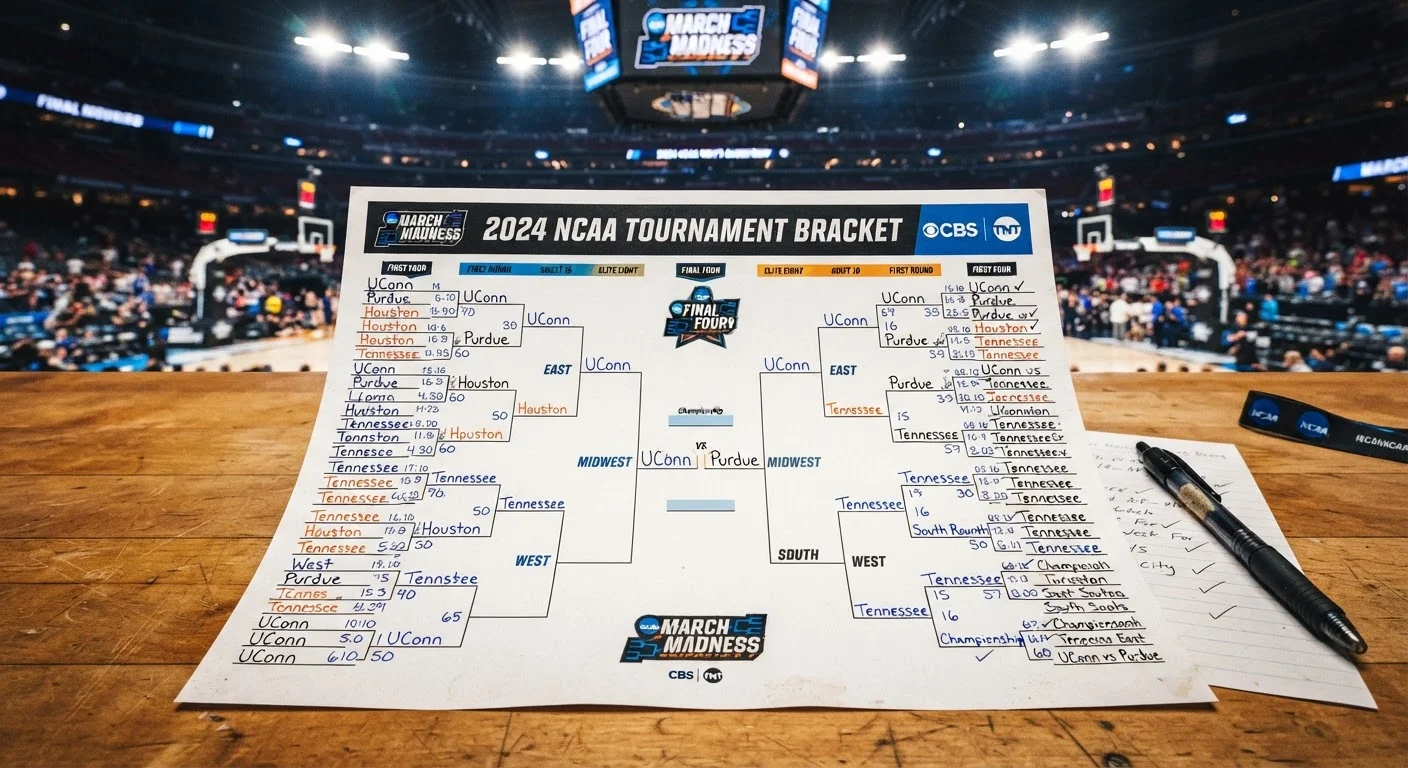
Key Takeaways
- The NCAA Tournament fields 68 college basketball teams competing in a single-elimination format each March.
- Teams are divided into four regions and seeded 1 through 16 based on their regular-season performance.
- Only six rounds of games stand between the opening tip-off and the national championship.
- Lower-seeded underdogs, called Cinderellas, regularly topple higher-ranked programs and reshape brackets.
- Filling out a bracket is about understanding matchup context, not just picking favorites to win every game.
Start here
What Is the NCAA Tournament?
Build your foundation
Seeds, Regions, and How the Bracket Is Built
Follow the action
The Road to the Final Four
Understand the drama
Upsets, Cinderellas, and Why They Matter
Put it into practice
How to Fill Out a Bracket Like a Thoughtful Fan
What Is the NCAA Tournament?
Every spring, college basketball reaches its loudest, most chaotic peak: the NCAA Division I Men's Basketball Tournament, widely known as March Madness. Sixty-eight programs from across the country compete in a high-stakes, single-elimination format - lose one game and your season is over, no exceptions.
The tournament is organized and run by the NCAA (National Collegiate Athletic Association), and selection is handled by a committee that evaluates regular-season records, strength of schedule, conference performance, and other criteria. The result is a bracket that sparks debates in offices, living rooms, and sports bars from coast to coast.
Seed
A numerical ranking (1 to 16) assigned to each team within their regional bracket. Lower numbers indicate stronger teams as evaluated by the selection committee.
Region
One of four divisions of the bracket - each containing 16 seeded teams that compete against each other until one regional champion emerges.
Selection Sunday
The day the NCAA publicly announces the full 68-team tournament field and bracket matchups, typically held in mid-March.
Single-elimination
A tournament format where one loss ends a team's season immediately - there are no second chances or consolation rounds within the bracket.
Final Four
The tournament's penultimate stage, featuring the four regional champions competing at a neutral-site venue for a spot in the national championship game.
Cinderella
An underdog team - typically a low seed - that advances much further than expected, capturing widespread fan interest along the way.
Seeds, Regions, and How the Bracket Is Built
The 68-team field is divided into four geographic regions - historically labeled East, West, South, and Midwest. Within each region, teams are seeded (ranked) from 1 to 16. A No. 1 seed is the committee's top-rated team in that region; a No. 16 seed is considered the weakest entry.
First-round matchups are always set by seed: the No. 1 plays the No. 16, No. 2 plays No. 15, and so on. This structure rewards strong regular seasons while still giving every invited team a legitimate path forward - at least on paper.
Before the main 64-team bracket begins, four additional play-in games (the First Four) determine which teams fill the last spots. Most casual fans treat Selection Sunday - the day the bracket is officially revealed - as a sport unto itself.
The Road to the Final Four
Six rounds separate the opening tip-off from the national champion. Here's how the journey unfolds:
- First Round (Round of 64): All 32 first-round matchups are played across two frenzied days.
- Second Round (Round of 32): Winners advance and face new opponents; the field halves again.
- Sweet Sixteen: Four regional brackets each narrow to four teams.
- Elite Eight: One winner per region is crowned, earning a trip to the Final Four.
- Final Four: The four regional champions meet at a single neutral-site arena for the national semifinals.
- National Championship: The two semifinal winners compete for the title.
For fans who follow the NFL postseason, the structure feels familiar but more expansive - our NFL playoff bracket explainer walks through how that system compares.
Track Your Bracket Round by Round
Most bracket platforms update results in real time as games conclude. Check in after each round rather than waiting until the tournament is over - adjusting your attention to surviving teams keeps the experience more engaging throughout all six rounds.
Upsets, Cinderellas, and Why They Matter
No element of March Madness captures more attention than the upset - a lower-seeded team knocking off a higher-ranked opponent. When a No. 12 seed eliminates a No. 5, it doesn't just flip one game; it potentially reshapes dozens of submitted brackets at once.
Teams that keep winning beyond everyone's expectations earn the nickname Cinderella, a nod to the fairy tale underdog. These programs often come from smaller conferences with little national media coverage, making their deep runs feel genuinely miraculous to fans watching for the first time.
Historically, No. 12 seeds win their first-round matchup with notable frequency, making the 5-vs-12 game one of the most watched in any bracket. On the more extreme end, UMBC's 2018 first-round win over Virginia - the first-ever No. 16 over No. 1 upset - remains the tournament's defining shock moment.
Upsets Don't Follow a Schedule
While certain seed matchups produce upsets more often than others, no outcome is predictable. Picking too many upsets can be just as damaging to a bracket as being too conservative. Use historical trends as context, not as a formula.
How to Fill Out a Bracket Like a Thoughtful Fan
Filling out a bracket is part analysis, part gut instinct, and - let's be honest - part luck. A few grounding principles can sharpen your picks without overcorrecting into pure randomness.
- Respect the 1 and 2 seeds: They reach the Elite Eight at a high rate historically. Picking all four No. 1 seeds to the Final Four is rarely a disaster.
- Expect a few upsets early: The 5-vs-12 matchup is historically competitive. Picking one or two No. 12 seeds to advance is supported by the tournament's track record.
- Know your teams, not just their seeds: Coaching experience, three-point shooting percentages, and defensive efficiency matter more than rankings alone.
- Don't chase last year's Cinderella: Lightning rarely strikes twice for the same program in consecutive tournaments.
For fans curious about the terminology that surrounds tournament coverage - from point spreads to over/unders - our sports terminology guide explains those concepts in plain language without endorsing wagering.
The bracket is a map, not a guarantee. Enjoy the ride, stay flexible, and let the games surprise you - that's the whole point.