
Key Takeaways
- Box scores are structured summaries of game statistics covering individual and team performance.
- Each major sport - baseball, basketball, and hockey - has its own critical columns to prioritize.
- Contextualizing numbers against team totals reveals the true story behind individual stat lines.
- Efficiency stats like shooting percentage matter more than raw counting numbers alone.
- Reading box scores regularly builds a sharper eye for standings implications and player trends.
What you will need
What a Box Score Actually Is
A box score is a compact statistical summary of a completed game. It organizes every player's contributions - points, rebounds, innings pitched, saves - into a single grid that lets fans reconstruct the narrative of what happened without watching every minute of it. The term dates back to 19th-century baseball journalism, but the format has since been adapted across virtually every major North American sport.
Understanding how to read one efficiently is a foundational skill for any serious sports follower. Whether you're tracking a pennant race, monitoring a fantasy roster, or simply keeping up across multiple leagues, the box score is your most reliable snapshot. For a broader look at how teams use this same data on the organizational level, see our piece on how analytics has reshaped team-building.
What you will need
Sport-by-Sport Breakdown of Key Columns
Each sport's box score has a distinct structure. Knowing which columns to prioritize saves time and sharpens interpretation.
Baseball
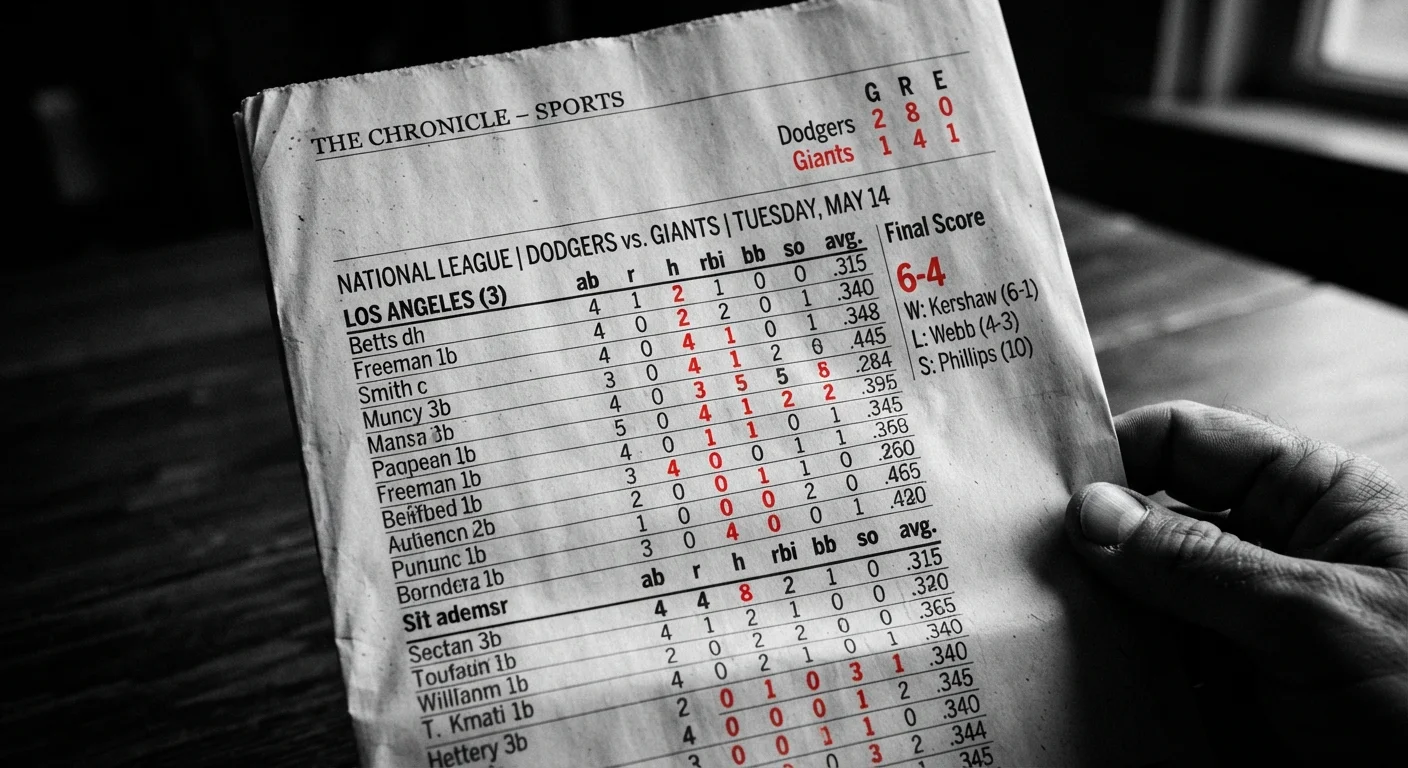
Start with the line score - the inning-by-inning run totals at the top. Then move to the batting section: focus on AB (at-bats), H (hits), RBI (runs batted in), and BB (walks). For pitchers, prioritize IP (innings pitched), ER (earned runs), K (strikeouts), and BB. A starter who goes 7 innings with 2 earned runs and 8 strikeouts had a strong outing regardless of the win-loss decision.
Basketball
The essential columns are PTS, REB, AST, FG% (field goal percentage), and +/- (plus-minus, which reflects how the score moved while that player was on the floor). Raw point totals can mislead - a player who scores 28 on 9-of-26 shooting hurt their team's efficiency. For a deeper dive into metrics that go beyond the box score, our advanced basketball stats explainer covers PER, True Shooting, and BPM in plain language.
Hockey
Look at G (goals), A (assists), +/-, SOG (shots on goal), and for goaltenders, SV% (save percentage). A goalie with a .935 SV% in a loss still performed at a high level; the context matters enormously.
Start With One Sport, Then Expand
If box scores are new to you, pick the sport you follow most closely and read one full box score after every game for two weeks. The repetition builds pattern recognition fast. Once the columns feel natural in one sport, applying the same analytical habit to a second or third league takes far less effort.
How to Read the Numbers in Context
Individual stats only carry weight when you compare them against the team total and the game situation. Here's how to do that efficiently.
Read the Final Score and Line Score First
Before diving into individual rows, absorb the macro result. Was this a blowout or a one-possession game? In baseball, check whether runs were bunched in one inning or spread out - that tells you whether one explosion or sustained execution drove the outcome.
Identify the Leading Performers on Each Side
Scan both teams' stat lines for the top contributors. In basketball, sort mentally by points and assists. In baseball, look for multi-hit games and the starting pitcher's line. In hockey, find who had multi-point nights and what the goaltender's save percentage was.
Check Efficiency, Not Just Volume
High counting stats can mask poor performance. A basketball player with 22 points on 7-of-23 shooting may have cost their team more than they contributed. In baseball, a pitcher with 5 innings and 4 earned runs looked better than 3 innings with 6 earned runs - volume matters alongside rate. Always cross-reference the raw number against attempts or opportunities.
Note Absences, Bench Contributions, and Team Totals
Check whether a star player is missing from the roster entirely - an absent name in the box score can explain a surprising result. Also compare bench scoring totals in basketball; a dominant reserve unit often swings close games. Team totals at the bottom of each column (total rebounds, total assists, total shots on goal) provide essential proportion context for individual lines.
Connect the Box Score to Standings and Trends
Ask: does this result change playoff positioning? Did a key player post their third consecutive strong performance, or have they gone cold over the last week? A single box score is a data point; its value multiplies when you link it to the larger season narrative.
Once you're comfortable parsing a single box score quickly, try applying this skill across multiple leagues simultaneously - our guide on following multiple sports seasons at once offers a practical framework. And if you're curious how these same numbers influence front-office decisions, sports analytics changed how athletes are evaluated is worth a read.
Putting It All Together
A box score rewards patient readers. The headline number - a player's point total, a team's final score - is just the entry point. The real story lives in shooting splits, on-court differentials, and the quiet contributions that don't make highlight reels. Understanding what NBA standings numbers actually mean becomes far more intuitive once you're comfortable reading box scores regularly, because you start to see how individual game outputs accumulate into playoff positioning.
Treat the box score not as a verdict, but as a prompt for better questions: Who was efficient? Who got lucky? Which role player quietly changed the game? That habit of inquiry is what separates a casual fan from an informed one.
Box Scores Don't Capture Everything
Defensive positioning, shot quality, communication, and hustle plays rarely appear in a standard box score. A player can post a modest stat line while providing enormous defensive value that never shows up in the grid. Use box scores as a starting point for understanding a game, not a complete evaluation tool.