

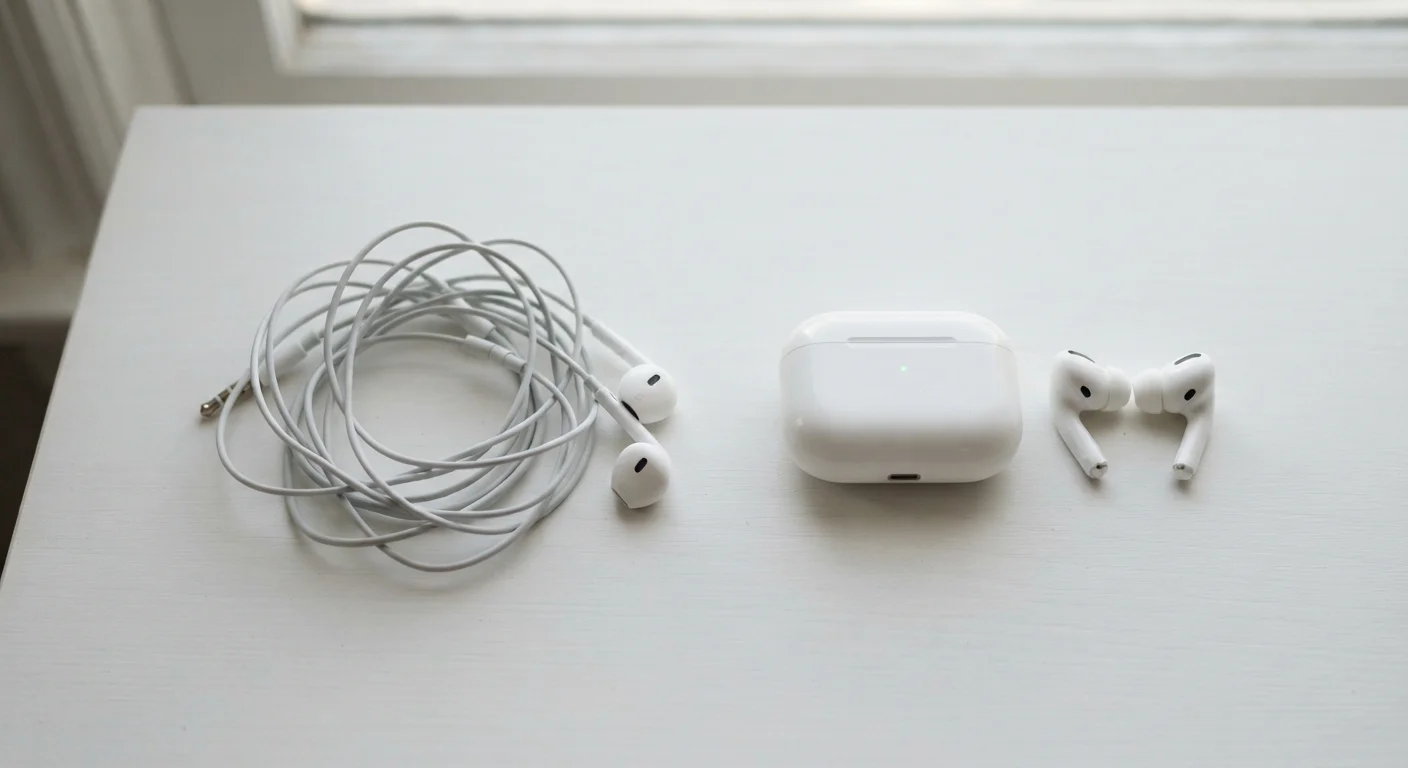
Key Takeaways
- Wired earbuds deliver audio with zero latency and no battery dependency, making them reliable for critical listening.
- Wireless earbuds introduce Bluetooth latency, which is largely imperceptible for music but can matter in video and gaming.
- Battery life in wireless earbuds typically ranges from 5 to 10 hours per charge, with cases extending that significantly.
- Wireless models often include features like active noise cancellation and touch controls that wired earbuds rarely offer.
- Wired earbuds are gradually being phased out of new smartphone designs due to the removal of the headphone jack.
- Neither option is universally superior - the right choice depends on how and where you listen.
Option A
Wired Earbuds
The dependable, no-compromise audio standard.
Best for: Listeners who prioritize consistent sound quality and never want to worry about battery life.
Option B
Wireless Earbuds
The flexible, cord-free everyday companion.
Best for: Active users and commuters who value freedom of movement and smart features like noise cancellation.
If you listen critically to music and care deeply about audio accuracy
Wired Earbuds
Wired connections bypass Bluetooth compression entirely, delivering the audio signal without additional processing steps that can alter the sound.
If you exercise regularly or commute and need freedom of movement
Wireless Earbuds
No cable to snag or tangle makes wireless earbuds far more practical during physical activity and travel.
If you use earbuds primarily for video calls or online gaming
Wired Earbuds
Wired connections eliminate latency concerns, keeping audio and video fully synchronized without any configuration.
If you want noise cancellation or hands-free voice assistant access
Wireless Earbuds
Active noise cancellation and smart assistant integration are almost exclusively found in wireless earbud designs.
If your phone no longer has a headphone jack
Wireless Earbuds
Without a native 3.5mm port, wireless earbuds are the most straightforward listening solution on modern smartphones.
The Core Difference: What the Cable Actually Does
A cable does more than carry audio from one point to another - it creates a direct, analog electrical connection between the source and your ears. That connection is continuous and requires no encoding or decoding. Wireless earbuds, by contrast, receive a Bluetooth signal that has been compressed, transmitted wirelessly, and decoded by a chip inside the earbud itself.
This distinction shapes almost every practical difference between the two formats. Neither approach is inherently flawed, but understanding what each one requires - and gives up - makes the choice much easier to navigate.
| Criterion | Wired Earbuds | Wireless Earbuds |
|---|---|---|
| Audio latency | Zero - direct analog signal | Small delay; varies by codec and mode |
| Sound compression | None - uncompressed signal | Bluetooth codec compression applied |
| Battery required | No - draws from source device | Yes - typically 5-10 hrs per charge |
| Active noise cancellation | Rarely available | Common in mid- to higher-tier models |
| Cable management | Cable can tangle or snag | No cable; small case required |
| Headphone jack needed | Yes - or adapter for modern phones | No - Bluetooth only |
| Setup complexity | Plug in and play | One-time pairing required |
| Durability risk | Cable and connector wear over time | Battery degrades after repeated cycles |
Sound Quality: Compression, Codecs, and What You Actually Hear
Bluetooth audio compression has improved substantially over the past decade. Modern wireless earbuds use higher-quality codecs - standardized methods for compressing and decompressing audio - that preserve significantly more detail than earlier versions. For most everyday listening, including music and podcasts, the difference between a wired connection and a high-quality Bluetooth stream is subtle enough that most people won't notice it.
Where the distinction becomes more apparent is in controlled, quiet environments with well-recorded material. Audiophiles and detail-oriented listeners tend to prefer wired connections for exactly this reason. If audio fidelity is a priority, the quality of the audio source itself is often as important as the earbud format you choose.
aptX Lossless
Bluetooth codec targeting CD-quality audio
Qualcomm's aptX Lossless codec, introduced in 2021, is designed to transmit audio at up to 1 Mbps - the bitrate needed to match CD-quality playback over Bluetooth.
~100ms
Typical standard Bluetooth audio delay
Standard Bluetooth A2DP connections can introduce roughly 100-200ms of latency; low-latency modes and newer codecs aim to reduce this to under 40ms.
30+ hours
Total playback with charging case
Many wireless earbud systems offer 6-10 hours of earbud battery life plus additional charges stored in the case, reaching 30 or more hours total before a wall charge is needed.
Latency, Battery Life, and Day-to-Day Tradeoffs
Latency - the delay between a sound being produced and reaching your ears - is effectively zero with wired earbuds. Wireless earbuds introduce a small delay through the Bluetooth transmission process. For music listening, this is imperceptible. For watching video or playing games, even a modest delay can create a noticeable mismatch between what you see and what you hear. Many wireless earbuds now include low-latency modes designed to address this, though performance varies.
Battery life is the most obvious constraint wireless earbuds introduce. Most models offer between five and ten hours of playback on a single charge, with charging cases typically providing two to four additional full charges. Running out of battery mid-commute is a real possibility wired earbuds never present. On the other hand, wireless earbuds remove the physical stress a cable places on connectors over time - a common cause of wired earbud failure.
Adapter Compatibility Worth Knowing
If you prefer wired earbuds but your device lacks a 3.5mm headphone jack, USB-C to 3.5mm adapters are widely available and generally inexpensive. However, not all adapters include a digital-to-analog converter (DAC), which can affect audio quality on some devices. Checking compatibility with your specific phone or laptop before purchasing an adapter is worthwhile.
Features, Compatibility, and Where Each Format Is Heading
Wireless earbuds have become the primary vehicle for earbud innovation. Active noise cancellation (ANC), transparency modes, touch and gesture controls, automatic ear detection, and voice assistant integration are almost all found in wireless designs. Wired earbuds, by comparison, tend to be simpler - a deliberate design philosophy that also makes them easier to use without any setup.
Compatibility is increasingly shaping this decision. Many current smartphones - particularly flagship Android models and all recent iPhones - have removed the 3.5mm headphone jack. Wired earbuds still work via USB-C or Lightning adapters, but that adds a step. If you're rebuilding your personal audio setup around a modern device, wireless is often the path of least resistance. That said, wired earbuds remain widely used with laptops, dedicated audio players, and older phones where the headphone jack survives.