

Key Takeaways
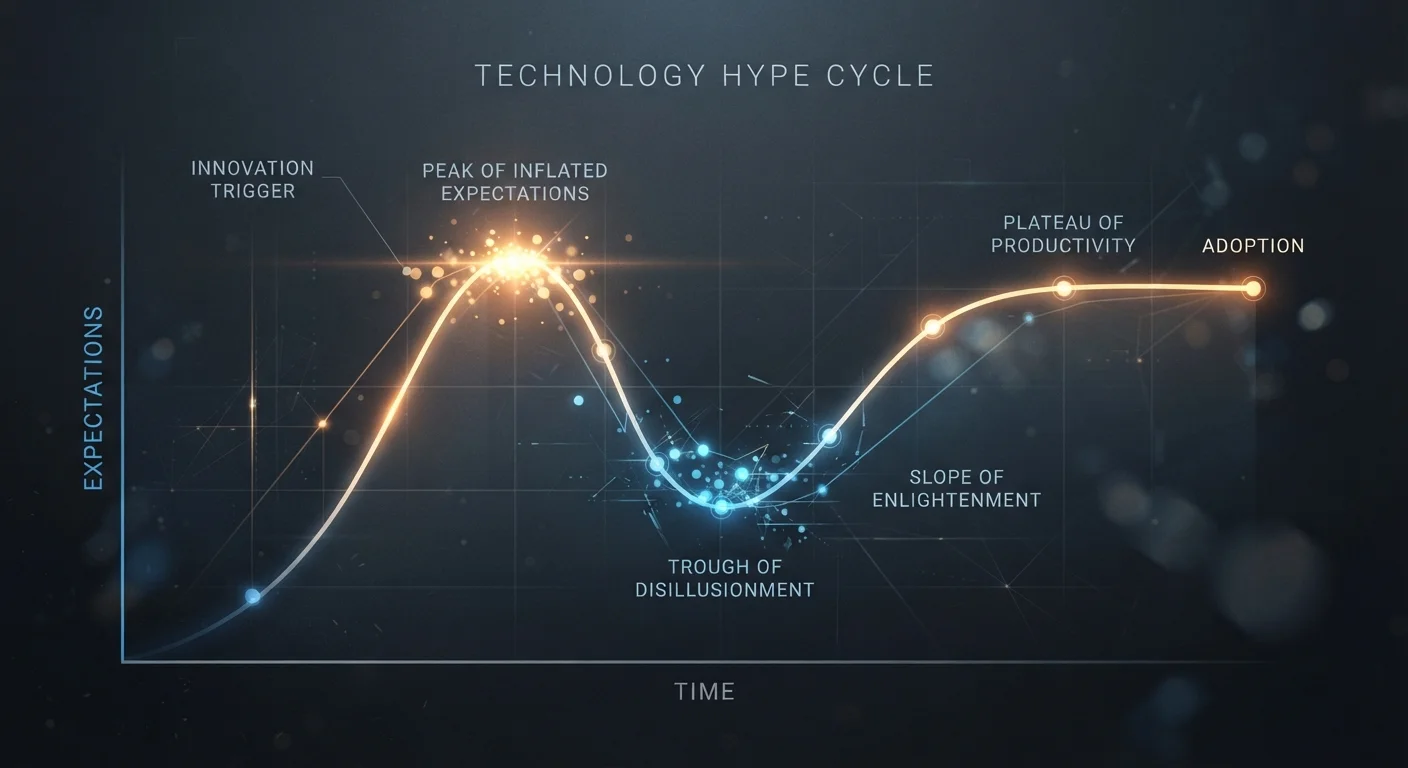
- Hype-stage trends attract media buzz and investment but lack real-world adoption evidence.
- Mature trends show up in infrastructure, regulation, and workforce training - not just headlines.
- Watching enterprise spending, failure rates, and standardization offers clearer signals than press releases.
- Consumer behavior shifts, not announcements, are the most reliable indicator of lasting change.
Why Distinguishing Hype From Reality Matters
Every significant technology - from cloud computing to contactless payments - spent time in a zone where excitement outpaced evidence. During that window, the noise can be deafening: breathless headlines, soaring valuations, and sweeping predictions about how everything is about to change. The problem is that the same noise surrounds technologies that never deliver, making it genuinely difficult for everyday consumers to know what deserves attention.
Learning to read the underlying signals - rather than the marketing surface - is a practical skill. It helps you make smarter decisions about which tools to adopt, which careers to invest in, and which trends to let play out before acting. The indicators below aren't foolproof, but taken together they offer a much clearer picture than any single headline. For a deeper look at how past breakthroughs quietly became everyday infrastructure, see how yesterday's emerging trends became the systems we rely on.
Enterprise adoption moves beyond pilot programs
During peak hype, companies announce pilots, proofs-of-concept, and partnerships - but rarely full deployment. A maturing trend is one where organizations are integrating it into core operations, not just experimenting at the edges. Look for multi-year contracts, budget line items, and operational teams built around the technology rather than one-off press releases about trials.
Full operational deployment, not a pilot announcement, signals that a trend has genuine legs.
Failure stories start appearing publicly
This sounds counterintuitive, but public discussion of failures and limitations is actually a sign of maturity. During hype phases, only success stories circulate. As a technology matures, practitioners write honestly about what didn't work, which use cases fell short, and what the real cost structure looks like. Honest post-mortems require real-world experience - which hype-stage tech simply hasn't accumulated yet.
Honest failure stories signal real-world experience that the hype stage never produces.
Regulatory and standards bodies get involved
Governments and standards organizations tend to focus on technologies that are actually affecting people at scale. When a field attracts serious regulatory attention - rulemaking, hearings, formal standards development - it typically means adoption is broad enough to warrant governance. This is distinct from politicians mentioning a technology to seem current; look for actual proposed rules, standards bodies publishing specifications, or legal frameworks being updated. Autonomous vehicles are a useful example: the progression through safety standards mirrors the technology's real-world deployment stages, as explored in how autonomous vehicle technology actually progresses through levels.
Regulatory rulemaking tracks scale of adoption - governments act on what's actually affecting people.
Workforce training and job titles stabilize
When a technology is in hype mode, job titles are fluid and certifications are invented monthly. Maturity arrives when community colleges offer courses, employers post standardized role descriptions, and workers build careers around specific skill sets. The normalization of training pipelines - not just bootcamp sprints - indicates that demand has settled into something predictable and durable.
Standardized job titles and community college courses signal a technology has found its footing.
The press coverage shifts from wonder to nuance
Hype-stage coverage tends toward superlatives: revolutionary, transformative, game-changing. As a technology matures, reporting becomes more granular - cost analyses, implementation challenges, sector-specific applications, and competing approaches. The move from big-picture proclamations to detailed, qualified assessments reflects real practitioner experience entering public discourse. If every article you read still sounds like a launch announcement, the technology hasn't been stress-tested yet. How AI milestones get overstated in media coverage illustrates exactly this pattern in a fast-moving field.
Detailed, qualified reporting replacing breathless proclamations is a reliable maturity marker.
Consumer behavior changes without prompting
The clearest sign that a technology has crossed into mainstream relevance is when people use it without thinking about it as a trend. They're not early adopters making a statement - they're just getting things done. Cloud storage, GPS navigation, and digital payments all reached this threshold. When consumers stop describing a behavior as new and start treating it as routine, the hype cycle has completed its most important loop.
When everyday users stop noticing they're using a technology, the hype cycle is complete.
Putting the Signals Together
No single indicator tells the full story. A technology can attract enterprise spending and still underdeliver; it can generate regulatory attention before it's commercially viable. The value is in reading multiple signals simultaneously - and noticing when they converge or conflict.
When you see consistent adoption in unglamorous, operational contexts alongside workforce integration, standardized tooling, and a quieter press, that convergence is a strong sign a trend has crossed from hype to durable infrastructure. When the opposite is true - constant rebranding, sky-high expectations, and little to show in day-to-day use - treat the excitement as a starting point for scrutiny, not a reason to act. For sharper tools to evaluate individual claims, a practical framework for reading tech headlines critically covers the thinking habits that help most. And if you're curious how this pattern plays out in another consumer domain, distinguishing durable retail shifts from short-lived fads applies the same logic to consumer trends.
Track the unglamorous signals
The most reliable maturity indicators rarely make headlines. Insurance pricing changes, procurement language in government contracts, and curriculum updates at vocational schools are all publicly available and far more informative than press releases. Building the habit of checking these secondary sources gives you a significant advantage in reading where a technology actually stands.