

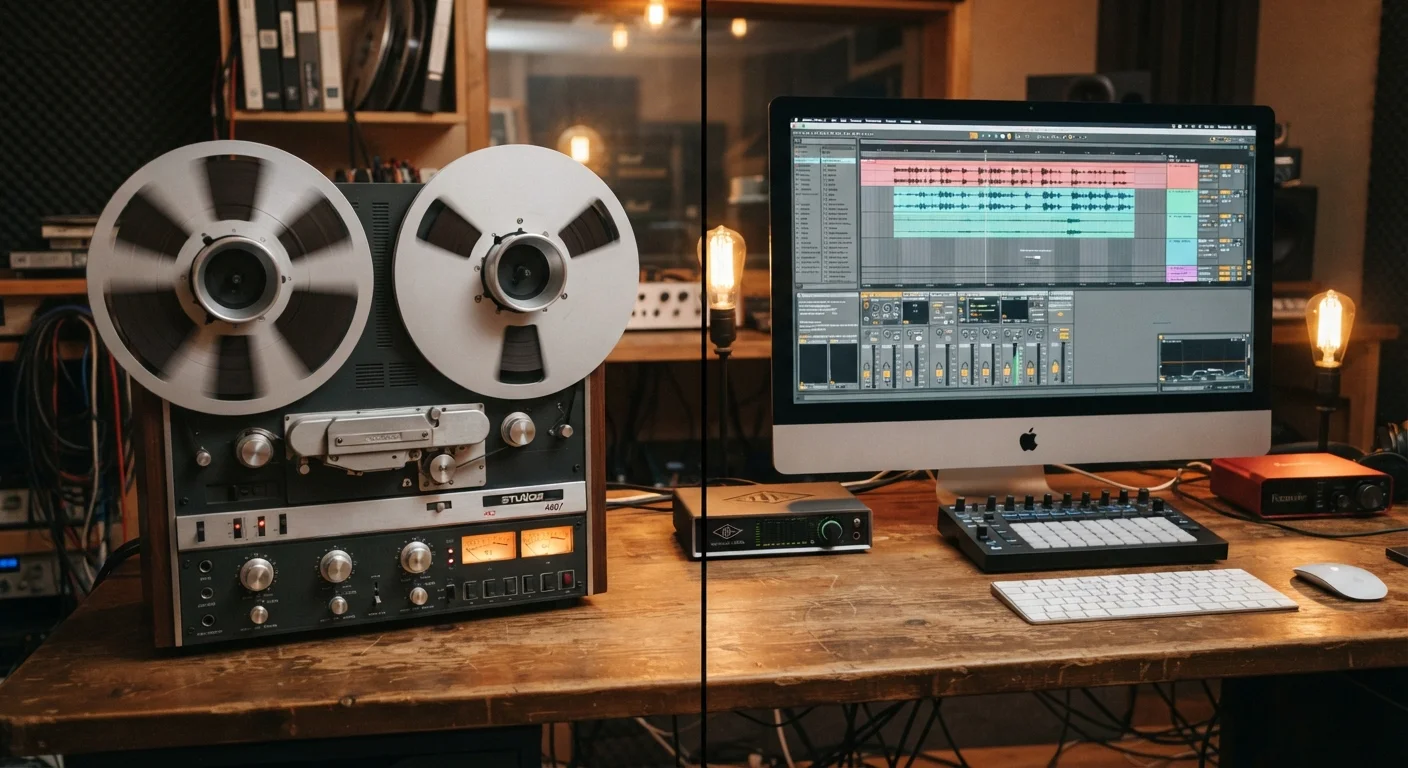
Key Takeaways
- Analog recording captures sound as continuous waveforms on magnetic tape, while digital converts audio into binary data sampled at set intervals.
- Tape introduces pleasing harmonic distortion and compression that many listeners perceive as "warmth," a characteristic digital doesn't replicate by default.
- Digital recording offers near-unlimited editing, lossless duplication, and no tape hiss - advantages that transformed modern music production.
- Many contemporary artists deliberately blend both approaches, recording to tape before mixing in digital environments.
- The debate is as much about aesthetic preference as technical superiority - neither format objectively wins for every listener or genre.
Option A
Analog Recording
The warm, tactile standard that shaped decades of beloved music.
Best for: Artists and listeners who prize tonal warmth, natural harmonic character, and the organic imperfections of live performance.
Option B
Digital Recording
The precise, flexible modern method powering nearly all contemporary music.
Best for: Producers, engineers, and musicians who need editing flexibility, consistency, and scalable storage without signal degradation.
If you crave rich, organic tonal character and love classic rock or jazz
Analog Recording
Tape saturation and natural compression add warmth and depth that many listeners associate with the golden era of studio albums.
If you produce music at home or need precise editing and repeatability
Digital Recording
Digital audio workstations offer unmatched flexibility - infinite undos, plug-in processing, and no media degradation over time.
If you're a serious audiophile trying to understand what you're actually hearing
Analog Recording
Analog's continuous waveform captures subtle harmonics that some listeners find more lifelike, though highly trained ears disagree on whether the difference is meaningful.
If you're a working musician on a budget who records regularly
Digital Recording
No tape costs, no maintenance overhead, and professional-quality results are achievable on relatively modest hardware and software setups.
If you want the creative ritual and happy accidents of hands-on recording
Analog Recording
Tape's physical constraints encourage decisive performance choices and spontaneous moments that digital's undo culture can sometimes discourage.
How Each Format Actually Captures Sound
At their core, analog and digital recording answer the same question differently: how do you preserve the invisible phenomenon of sound?
Analog recording works by converting acoustic energy into a continuously varying electrical signal, then imprinting that signal onto magnetic tape. The result is a physical representation of the original waveform - imperfect, yes, but unbroken. When tape saturates under loud signals, it introduces harmonic distortion that human ears tend to perceive as pleasing rather than harsh.
Digital recording takes a fundamentally different approach. It samples the incoming audio signal thousands of times per second - a CD-quality recording captures 44,100 samples per second - and converts each sample into a binary number. Playback reconstructs audio from those numbers with remarkable accuracy. The standard 16-bit, 44.1 kHz format has a theoretical dynamic range exceeding 96 decibels, which surpasses anything the human ear can fully resolve in a typical listening environment.
| Criterion | Analog Recording | Digital Recording |
|---|---|---|
| Signal type | Continuous waveform | Sampled binary data |
| Tonal character | Natural harmonic warmth | Transparent, neutral |
| Noise floor | Tape hiss present | Extremely low noise |
| Editing flexibility | Limited, physical cuts | Near-unlimited, non-destructive |
| Signal degradation over copies | Degrades each generation | No loss across copies |
| Running cost | Ongoing tape expense | Low after initial setup |
| Dynamic range | Roughly 60-70 dB on tape | 96+ dB (16-bit standard) |
Understanding this technical foundation matters because the debate isn't really about which format is "better" - it's about what each format does to music along the way. For a parallel look at how format choices shape listener experience, see our piece on vinyl vs. streaming.
The "Warmth" Argument: Myth or Reality?
No word appears more often in the analog vs. digital debate than warmth - and almost nobody agrees on exactly what it means. Broadly, it refers to a sense of richness, presence, and pleasing tonal roundness. Audiophiles and many recording engineers attribute this quality to the way tape naturally handles audio.
When a signal hits magnetic tape at high levels, the tape gently compresses and introduces even-order harmonic distortion - overtones that relate mathematically to the original note in ways that human hearing generally finds musical. This is the phenomenon behind the beloved sound of classic albums cut in the 1960s and 1970s. Artists from Fleetwood Mac to Led Zeppelin recorded on multitrack tape machines; the medium itself was part of the aesthetic.
44,100
Samples per second in CD-quality audio
The Red Book CD standard, established in 1980 by Philips and Sony, set this sampling rate as the baseline for consumer digital audio.
~60 dB
Typical dynamic range of professional tape
Professional reel-to-reel tape machines generally achieve around 60-70 dB of dynamic range, compared to over 96 dB for 16-bit digital recording.
3rd
Harmonic order tape most commonly adds
Tape saturation predominantly generates second- and third-order harmonics, which music psychoacoustics research suggests humans tend to find less harsh than higher-order distortion.
Digital recording, by contrast, aims for clinical transparency. It doesn't add harmonics or compress signals on its own. What you feed in is (essentially) what you get out. Critics of digital argue this can sound sterile; defenders counter that it's simply honest - and that perceived "warmth" in analog is technically a form of coloration, not accuracy. This same tension between authenticity and character runs through entertainment debates like dubbing vs. subtitles, where one choice preserves original intent while the other prioritizes accessibility.
The Pop Culture Dimension: Why This Debate Endures
The analog vs. digital debate has never been purely technical - it's tangled up with identity, nostalgia, and what different generations think music is supposed to feel like.
When digital recording became commercially dominant in the 1980s, the shift was dramatic. Critics at the time complained that early CDs sounded brittle compared to vinyl-era master tapes. Those complaints fed into what engineers later called the loudness war - a decades-long push to maximize perceived volume in digital masters that squeezed out dynamic range.
Today, many high-profile artists deliberately incorporate tape into their process. Recording to analog first, then transferring to digital for editing - sometimes called a "hybrid" workflow - has become a recognized studio practice. It's a way to capture tape's character while retaining digital's flexibility. Meanwhile, the question of how a recording ultimately reaches listeners adds another layer: streaming platforms interpret audio differently, which can affect what any recording sounds like by the time it reaches your earbuds.
For listeners who want to go deeper on how format choices reveal an artist's intentions, our exploration of live albums vs. studio albums offers a useful companion lens.
Ultimately, neither format has rendered the other obsolete. Tape is a niche medium today, but its influence on how we talk about sound quality - and what we expect music to feel like - is very much alive.