

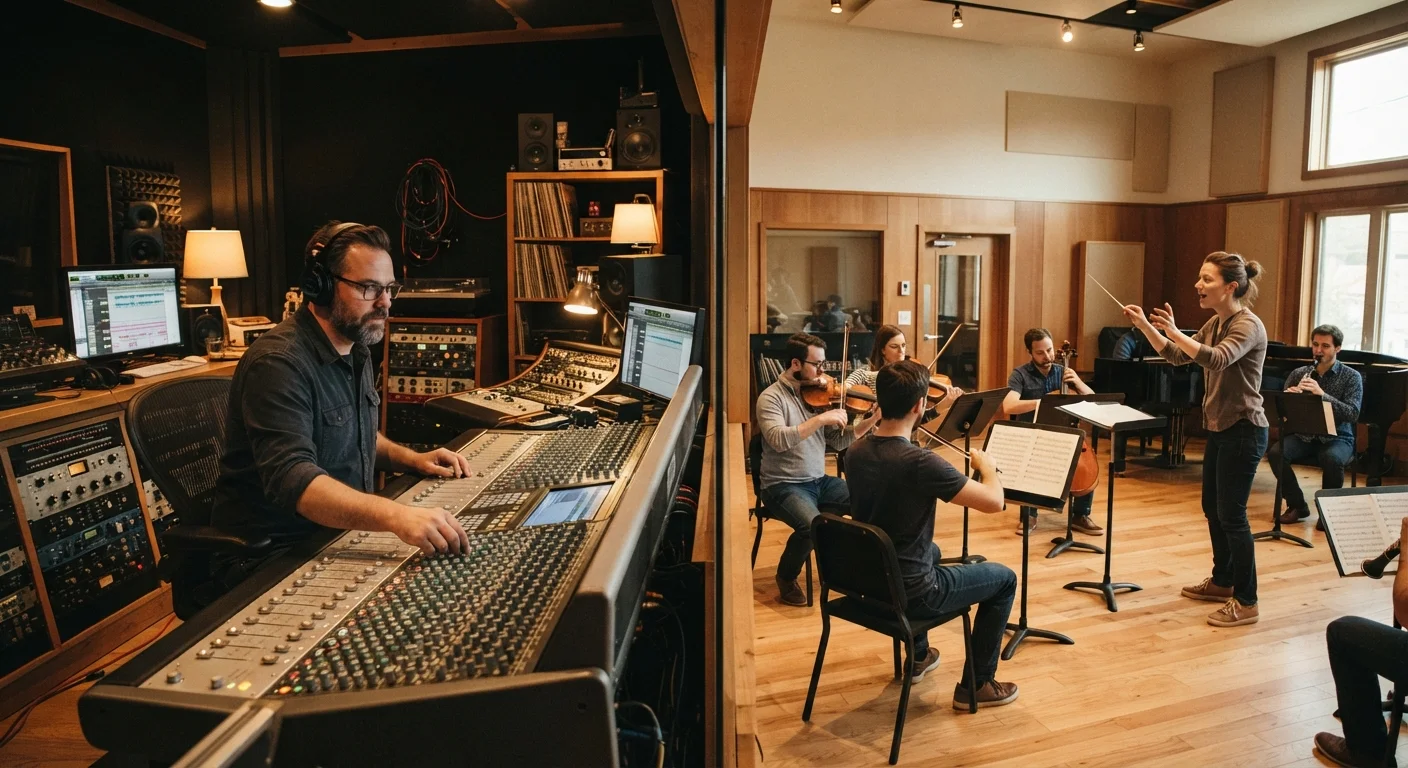
Key Takeaways
- A music producer shapes how a recorded song sounds in the studio, from concept to final mix.
- A music director leads musicians in live or collaborative settings, acting as the artistic point person.
- Both roles influence music deeply, but one primarily lives in the studio and the other on stage or set.
- These roles can overlap - some artists hold both titles depending on the project.
- Understanding the difference helps fans appreciate the full team behind their favorite music.
Option A
Music Producer
The architect behind the sound.
Best for: Crafting the sonic identity of a recording - from beats and instrumentation to the final mix.
Option B
Music Director
The conductor of a live or collaborative musical vision.
Best for: Leading live performances, coordinating musicians, and translating a creative vision into real-time execution.
If you want to understand who crafts the sound of a chart-topping album
Music Producer
Producers make the creative and technical decisions that define a recording's sound, from drum programming to vocal effects and final mastering direction.
If you want to understand who keeps a live concert or TV performance running musically
Music Director
Music directors coordinate live bands, cue musicians, and ensure the performance matches the artist's vision in real time.
If you're following a film or TV show's musical atmosphere
Music Director
In film and television, a music director often oversees how music integrates with scenes, working alongside composers and editors.
Two Titles, Two Very Different Jobs
Credit an album's distinctive sound to its producer. Credit a flawless live performance's musical cohesion to its music director. These two roles are frequently confused - sometimes even by the people who hold them - but they represent genuinely distinct responsibilities in the music world.
The confusion is understandable. Both titles carry creative weight, both shape how music reaches an audience, and both can appear in the same project's liner notes. But their day-to-day work, their tools, and their moments of decision-making are quite different. To understand the split, it helps to think about where the work happens: in the studio, or on the stage (or set).
| Criterion | Music Producer | Music Director |
|---|---|---|
| Primary setting | Recording studio | Live stage, set, or rehearsal space |
| Core responsibility | Shapes the sound of a recording | Coordinates musicians for performance |
| Output | A finished recorded track or album | A live or real-time musical execution |
| Common tools | DAWs, mixing boards, studio gear | Sheet music, live arrangements, cue systems |
| Collaboration style | Works closely with artists and engineers | Leads a band, orchestra, or ensemble |
| Appears in | Album credits, streaming metadata | Tour programs, TV show credits, film credits |
What a Music Producer Actually Does
A music producer is primarily a studio role. They are the person - or increasingly, the team - responsible for the sonic shape of a recorded song or album. That means decisions about instrumentation, tempo, key, arrangement, vocal takes, sound design, and the overall feel of a track. Producers often work closely with the artist from the earliest stages, sometimes co-writing, sometimes just guiding, and sometimes building the entire beat from scratch before a vocalist steps in.
Think of iconic producer-artist collaborations that defined eras: the lush orchestration choices behind classic Motown, the sample-heavy reinventions of hip-hop in the 1990s, or the maximalist pop productions that dominated streaming charts in the 2010s. Behind each of those sounds was a producer making thousands of micro-decisions that shaped the final product. Producing a song is a layered process that spans initial concept, tracking sessions, mixing, and final master approval.
3-6 months
Typical studio album production timeline
Industry estimates suggest major-label albums can take anywhere from a few months to over a year, with production decisions driving much of that schedule.
70%+
Live music revenue share for artists
According to music industry analyses, touring and live performance have consistently represented the majority of revenue for many working musicians, underscoring the music director's importance.
What a Music Director Brings to the Table
A music director's domain is coordination and live execution. Whether working with a touring band, an awards show orchestra, a Broadway pit, or a television variety program, the music director functions as the artistic hub that connects all the musicians. They adapt arrangements for live performance, give cues, manage tempo in real time, and ensure that what the audience hears matches what the artist intended.
In the world of film and television, a music director may also oversee how existing music is licensed, arranged, and integrated into a production - often working alongside a composer who writes original material. This is explored in more depth in our piece on how film scores are composed. Unlike the producer, whose work is captured permanently on a recording, the music director's craft is often most visible in the moment of performance itself.
Where These Roles Overlap - and Where They Don't
Some artists and creative figures hold both titles, either simultaneously on a project or across different phases of their career. A recording artist might produce their own album and then serve as music director on their own arena tour. In those cases, the distinction is about context: studio work versus live work.
The clearest separation is in accountability. A producer owns the sound of a record. A music director owns the sound of a performance. When a live show sounds different from the album - sometimes better, sometimes different in character - those divergences often reflect the music director's interpretive choices.
When One Person Wears Both Hats
In smaller productions - indie tours, school showcases, community theater - it's common for one person to serve as both producer and music director. This is a practical arrangement, not a sign that the roles are the same. It simply means one skilled individual is managing both the recorded and live sides of a project. Larger productions typically split these responsibilities because each demands full attention.