
Video Game Streaming vs. Traditional Console Gaming: How Cloud Gaming Changes the Equation

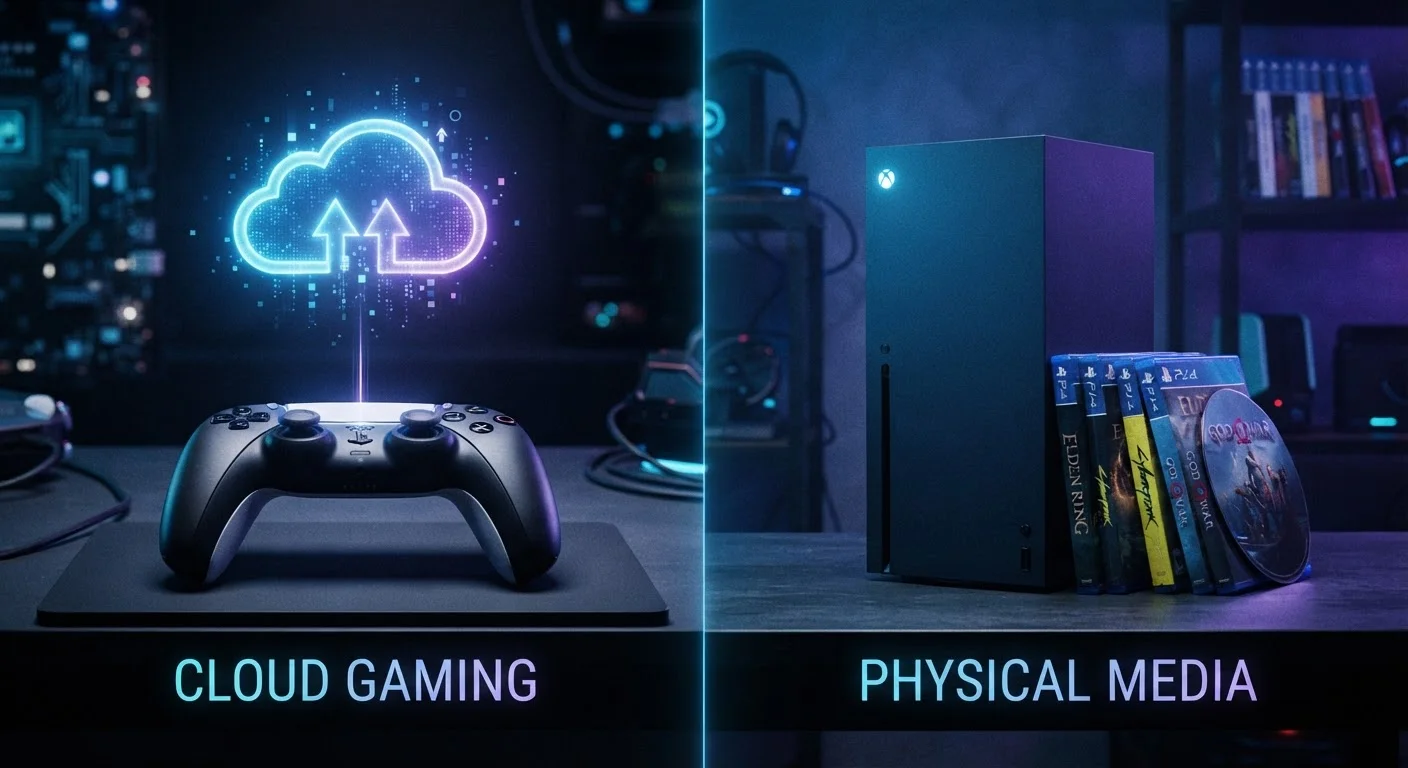
Key Takeaways
- Cloud gaming streams games from remote servers, requiring no dedicated console hardware.
- Traditional consoles deliver consistent performance but demand significant upfront hardware investment.
- Internet connection quality is the single biggest factor limiting cloud gaming experiences.
- Console gaming supports offline play; cloud gaming requires a stable broadband connection at all times.
- Both approaches are expanding in scope, with hybrid options blurring the line between them.
Option A
Cloud Game Streaming
The hardware-free, play-anywhere approach to gaming.
Best for: Casual players or those who want immediate access to games without purchasing expensive hardware.
Option B
Traditional Console Gaming
The established, hardware-driven standard for serious players.
Best for: Dedicated gamers who prioritize peak performance, a physical game library, and offline reliability.
If you want to play without buying expensive hardware
Cloud Game Streaming
Cloud services let you access games via a subscription on devices you already own, eliminating the need to purchase a dedicated console.
If consistent, high-performance play matters most to you
Traditional Console Gaming
Consoles process games locally, meaning frame rates and graphics quality are unaffected by internet fluctuations.
If you travel frequently and want gaming flexibility
Cloud Game Streaming
Cloud platforms work on laptops, tablets, and phones, so your game library travels with you wherever a solid connection exists.
If you live in an area with unreliable broadband
Traditional Console Gaming
Local hardware guarantees full playability without dependence on internet speed or latency.
What Each Approach Actually Means
The core difference between cloud gaming and traditional console gaming comes down to one question: where does the computing happen?
With traditional console gaming, a physical device - a PlayStation, Xbox, or Nintendo Switch - handles all the processing locally. You insert a disc or download a title, and the console's GPU and CPU do the heavy lifting. The experience is self-contained and doesn't depend on your internet speed once a game is installed.
Cloud game streaming flips that model entirely. Instead of running on your hardware, the game runs on powerful remote servers operated by a service provider. Video of the gameplay is then streamed to your screen in real time, and your controller inputs are sent back to the server. If you want to understand the full technology behind this, this explainer on cloud gaming breaks down exactly how those server pipelines work.
Think of it like the shift from owning DVDs to watching Netflix - except instead of just video, you're streaming an interactive experience. That analogy extends further than you'd expect: the same forces that disrupted television are now reshaping how people access games.
| Criterion | Cloud Game Streaming | Traditional Console Gaming |
|---|---|---|
| Hardware required | None (uses existing device) | Dedicated console purchase |
| Upfront cost | Low (subscription-based) | Higher (hardware + games) |
| Performance consistency | Depends on internet speed | High and predictable |
| Offline play | Not supported | Fully supported |
| Device flexibility | Phone, tablet, laptop, TV | Console only |
| Game library ownership | Subscription access only | Permanent after purchase |
| Latency sensitivity | High - network dependent | Low - processed locally |
Performance, Access, and Real-World Trade-offs
Performance remains the sharpest dividing line. Traditional consoles deliver predictable frame rates and visual fidelity because nothing leaves the box - there's no network bottleneck. Cloud gaming, by contrast, introduces latency (the tiny delay between your input and the game's response), which is imperceptible on a low-ping fiber connection but frustrating on slower or congested networks.
~500ms
Noticeable input lag threshold for most players
Research in human-computer interaction suggests most players detect input lag above roughly 100ms in fast-paced games, making low-latency connections critical for cloud gaming.
35 Mbps+
Recommended speed for 4K cloud gaming
Major cloud gaming services generally recommend at least 35 Mbps download speeds to stream games at 4K resolution with stable frame rates.
$300-$500
Typical current-gen console price range
Current-generation console hardware has generally launched in the $299-$499 range, representing the primary upfront cost barrier versus subscription-based cloud alternatives.
Access is where cloud gaming genuinely shines. A mid-range smartphone, a laptop, or even a smart TV with the right app can become a gaming device overnight. That portability also intersects with the broader streaming device landscape - comparing smart TVs, streaming sticks, and consoles as all-around media hubs reveals just how blurry those categories have become.
Cost structures differ meaningfully too. A current-generation console typically requires a notable upfront purchase, plus game costs. Cloud gaming services generally use a monthly subscription model, bundling a rotating library of titles. However, if your internet plan doesn't include robust data allowances, heavy cloud gaming sessions can push against those limits quickly.
Hybrid Models Are Emerging
Several console makers now offer cloud-assisted features alongside local hardware - for example, streaming titles that aren't installed locally while playing others natively. This hybrid approach reduces the either/or nature of the comparison. As broadband infrastructure improves globally, the gap between the two models is expected to narrow further over the coming years.
Ownership is another nuance worth weighing. Physical or downloaded console games are yours to keep. With cloud services, your access depends entirely on the service remaining active and titles staying in the library - a consideration not unlike the broader debate around digital ownership in entertainment.