

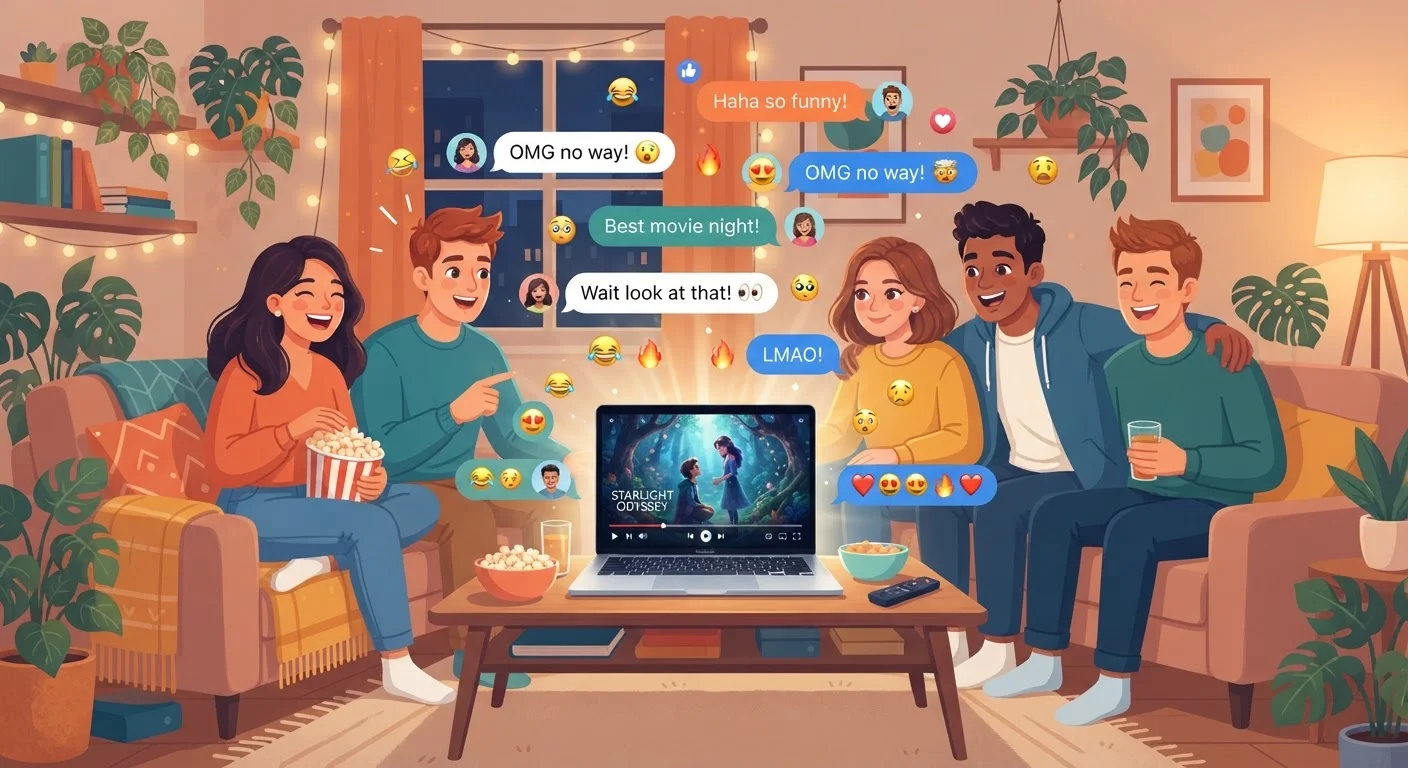
Key Takeaways
- Watch parties synchronize playback across multiple devices so everyone sees the same moment at the same time.
- Most co-viewing features pair synchronized video with a live chat or reaction panel for social commentary.
- Some platforms offer native co-viewing tools; others rely on third-party browser extensions.
- All participants generally need an active subscription to the platform being used.
- Co-viewing can be a meaningful accessibility aid, enabling remote caregivers or family members to watch alongside loved ones.
- Live events like sports or award shows add extra energy to watch parties because viewers react to the same moments simultaneously.
Watch Party / Co-Viewing
A watch party - sometimes called co-viewing - is a feature built into or layered on top of streaming platforms that lets multiple people watch the same content at exactly the same time from different locations. Playback is synchronized so everyone's video starts, pauses, and resumes together, and a shared chat or emoji-reaction panel lets viewers comment in real time. It recreates the social experience of watching TV on the same couch, even when participants are miles apart.
Synchronization is typically handled server-side or via a browser extension by issuing timestamped play/pause commands to all connected clients simultaneously, minimizing the drift that would otherwise occur across different internet speeds.
How Synchronized Watch Parties Actually Work
The core mechanic is straightforward: one person acts as the host and starts the playback session. The platform or extension sends a synchronized signal to every participant, so pressing play, pause, or skip updates the stream for the whole group simultaneously. No one jumps ahead or falls behind accidentally.
Most implementations pair this synchronized playback with a sidebar chat, emoji reactions, or both. Participants type comments that appear in real time beside the video - a digital approximation of the running commentary that makes watching together fun. Some platforms even support video or audio overlays so participants can see each other's faces while they watch.
Native co-viewing tools - those built directly into a platform's app - tend to be the most seamlessly integrated. They often require nothing more than creating a shareable room link. Third-party browser extensions fill the gap where native tools don't exist yet, though they typically require all participants to install the same extension on a desktop browser.
Native Tools vs. Third-Party Extensions
When a platform builds co-viewing directly into its app, setup is usually a matter of a few taps and a shared link. Third-party extensions require every participant to install the same software on a desktop browser, which adds a small setup barrier. If a platform you use doesn't have a native watch party feature, checking the extension's reviews and update history is a good way to assess reliability before relying on it for a group session.
What Makes It Different From Solo Viewing
Watching alone and watching together are fundamentally different emotional experiences, even when the content is identical. Research in media psychology has long noted that shared viewing amplifies emotional responses - laughter lands harder, plot twists feel bigger, and tense moments are more bearable when others are reacting alongside you.
Co-viewing features try to recreate that communal dimension online. The chat sidebar becomes a real-time social layer on top of the content itself. For a suspenseful thriller, that might mean a flood of shocked emojis at a reveal. For a comedy, it's shared laughter in text form. Watching films at home versus in theaters already involves trade-offs, and watch parties bring one of cinema's best qualities - the crowd - back into living rooms, virtually.
“Shared viewing experiences - even mediated through screens - activate many of the same social bonding mechanisms as being physically present with others. The chat layer isn't a distraction; for many viewers, it's the point.”
— Dr. Emily Baumgartner, Media psychology researcher specializing in digital social behavior
Live events add another dimension entirely. Award shows, live sports on streaming platforms, and finales generate the most energetic watch party sessions precisely because reactions are immediate and unscripted.
Practical Considerations Before You Host
Before inviting friends to a watch party, a few practical details are worth confirming. First, verify that the specific title you want to watch is eligible - some platforms restrict co-viewing to certain content categories, and newly released films or licensed content sometimes have limitations.
Second, everyone's subscription tier can matter. On platforms with ad-supported tiers, some participants may see different ad breaks than others, which can disrupt synchronization. Confirming that all participants have a compatible plan avoids mid-movie interruptions.
Third, think about device setup. Native apps on smart TVs often offer the most comfortable viewing experience, but not all support co-viewing. Desktop browsers with an extension may actually provide the most consistent experience for synchronized sessions.
Run a Quick Test Before the Main Event
Host a brief test session with one or two friends before a larger watch party. Play a few minutes of any video, pause and resume, and confirm that everyone's playback stays in sync. Catching drift or technical issues early - rather than mid-movie - saves everyone frustration and keeps the social energy intact.
Families using these features across different households should also be aware of parental control settings - each participant's account retains its own content restrictions, so a child's profile won't automatically unlock adult content just because the host can access it.
If you're evaluating a new platform partly for its co-viewing capabilities, adding it to your checklist of criteria is worthwhile. See questions worth asking before subscribing for a broader framework to guide that decision.
~80%
US adults who stream video content
According to Pew Research Center survey data, a large majority of American adults report using at least one streaming service, forming the base audience for co-viewing features.
2-3x
Higher engagement during shared viewing
Academic studies in media psychology suggest viewers report significantly higher emotional engagement and enjoyment when watching content simultaneously with others, compared to solo viewing of the same material.