

Key Takeaways
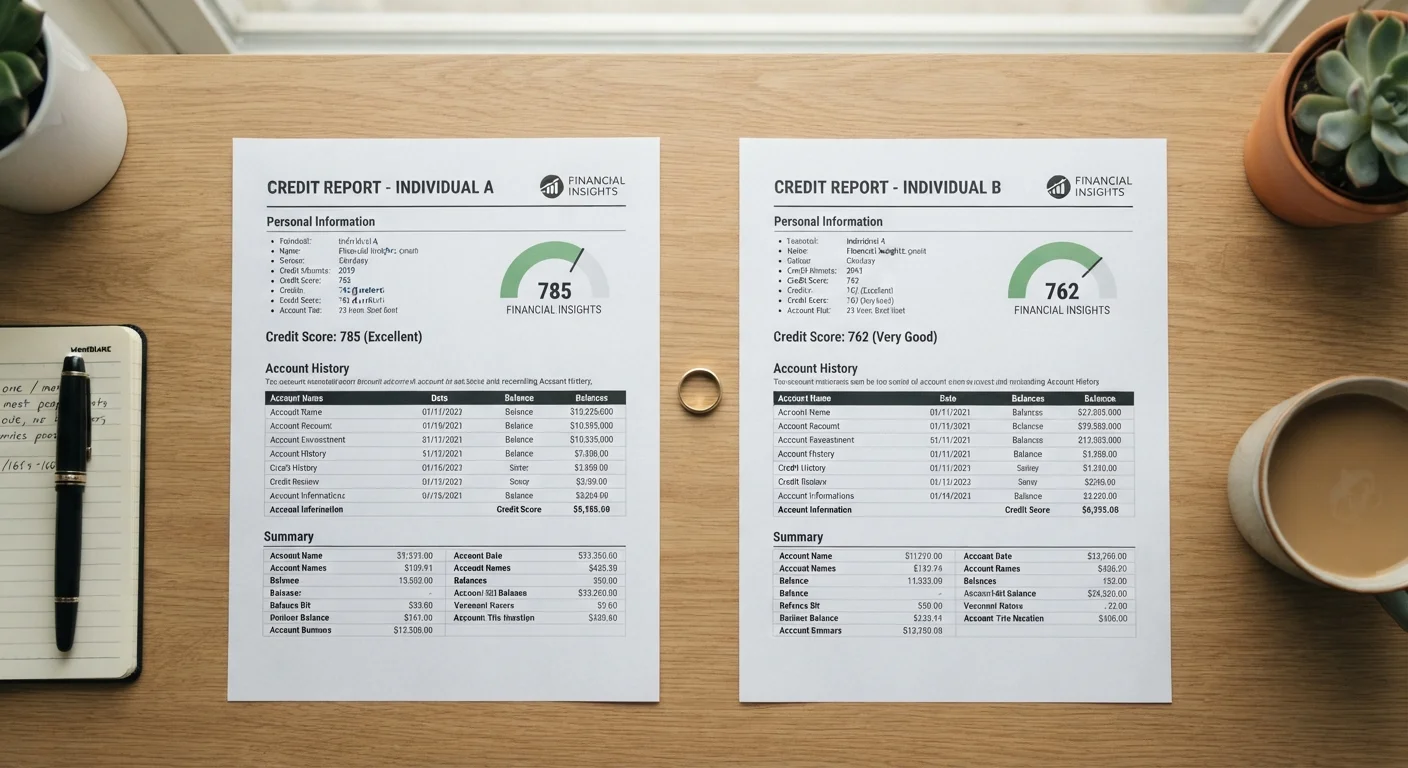
- Marriage does not merge credit files - each spouse keeps a fully independent credit report and score.
- Joint accounts and co-signed loans appear on both partners' credit reports and affect both scores.
- A spouse's poor credit does not directly lower your score, but it can affect joint applications.
- Authorized user status links one partner's account activity to the other's report.
- Lenders evaluating a joint application typically review both credit profiles.
- Understanding these distinctions helps couples make smarter borrowing and credit-building decisions.
Separate Credit Files in Marriage
When two people marry, each spouse keeps their own individual credit file maintained by the three major credit bureaus. There is no such thing as a joint credit score or a merged credit report - each person's credit history remains legally distinct. However, certain financial decisions made together, like opening a joint account or co-signing a loan, can affect both partners' credit profiles.
Credit bureaus track credit by Social Security number, not by marital status. A name change after marriage does not merge files; the bureau links old and new names within the same individual's report.
Your Credit File Belongs to You Alone
One of the most persistent myths in personal finance is that marriage creates a shared credit score. It doesn't. The three major credit bureaus - Equifax, Experian, and TransUnion - track credit history by individual Social Security number. When you marry, no bureau merges your file with your spouse's. Each of you retains a completely independent credit report and, consequently, an independent credit score.
This means the credit history you built before marriage remains yours - for better or worse. If you spent years managing credit cards responsibly and paying loans on time, that positive track record stays in your file. Equally, any past missteps belong only to the person who made them. To understand the underlying mechanics, see our explanation of credit scores vs. credit reports.
A Name Change Doesn't Merge Credit Files
If one spouse changes their last name after marriage, the credit bureaus will link the new name to the existing individual file - they do not create a new file or merge it with a spouse's. Your credit history follows your Social Security number, so a name change has no effect on your score or the contents of your report.
Where Overlap Begins: Joint Accounts and Co-Signed Loans
While marriage alone changes nothing in your credit file, the financial decisions you make as a married couple can create real credit connections. The two primary mechanisms are joint accounts and co-signed loans.
Joint accounts list both spouses as equal account holders. Every lender report associated with that account - on-time payments, late payments, balance levels, and account closure - appears on both credit reports simultaneously. That symmetry is powerful: consistent on-time payments build both profiles, but a single missed payment can ding both scores at once.
Co-signed loans work similarly. When one spouse co-signs a loan for the other, both parties are legally responsible for the debt, and the loan appears on both credit reports. Our guide on co-signing a loan and its credit implications covers this shared responsibility in detail.
9
U.S. community property states
Nine states treat most assets and debts acquired during marriage as jointly owned, though this does not merge individual credit files.
~35%
Weight of payment history in FICO scores
Payment history is the single largest factor in most credit scoring models, making on-time payments on joint accounts especially consequential for both spouses.
3
Separate credit bureaus per individual
Each spouse has three distinct credit files - one at each bureau - none of which are merged upon marriage.
Authorized User Status: A Lighter Connection
A third way credit files can intersect is through authorized user status. If you add your spouse to an existing individual credit card as an authorized user, that card's history typically begins appearing on their credit report - without making them legally responsible for the balance. This is a common strategy for helping a spouse with a thin or damaged credit history benefit from a well-managed older account.
The effect works in both directions, though. If the primary account holder's payment behavior deteriorates, the authorized user's report may reflect that, too. It's worth reviewing how the bureaus each handle and report this data, since reporting practices can vary. Our overview of how the three credit bureaus work explains why scores can differ across bureaus even for the same individual.
Review Both Reports Before Major Borrowing
Before applying jointly for a mortgage or large loan, both partners should review their individual credit reports. You're entitled to a free report from each bureau annually at AnnualCreditReport.com. Catching errors or outdated negative items early gives you time to dispute them before a lender pulls your files.
Joint Credit Applications: When Both Scores Are on the Table
Even when both spouses maintain separate, healthy credit files, there are moments where both profiles are evaluated together. Applying for a mortgage, a joint auto loan, or a shared credit card typically prompts the lender to pull and assess both credit reports. In these cases, a significant gap between scores can influence the interest rate offered or the loan terms, because lenders weigh the risk posed by both applicants.
This doesn't mean a lower-scoring spouse should be excluded from financial planning - it's simply useful information for timing major applications. Couples who understand each other's credit standing are better positioned to decide whether to apply jointly or separately and when it makes sense to work on improving one partner's score before applying. For a broader view of how credit decisions connect to household finances, see our guide on budgeting when two incomes are involved.
This article is for general informational purposes only and does not constitute personalized financial or legal advice. Consult a qualified financial adviser or attorney regarding your specific circumstances.