

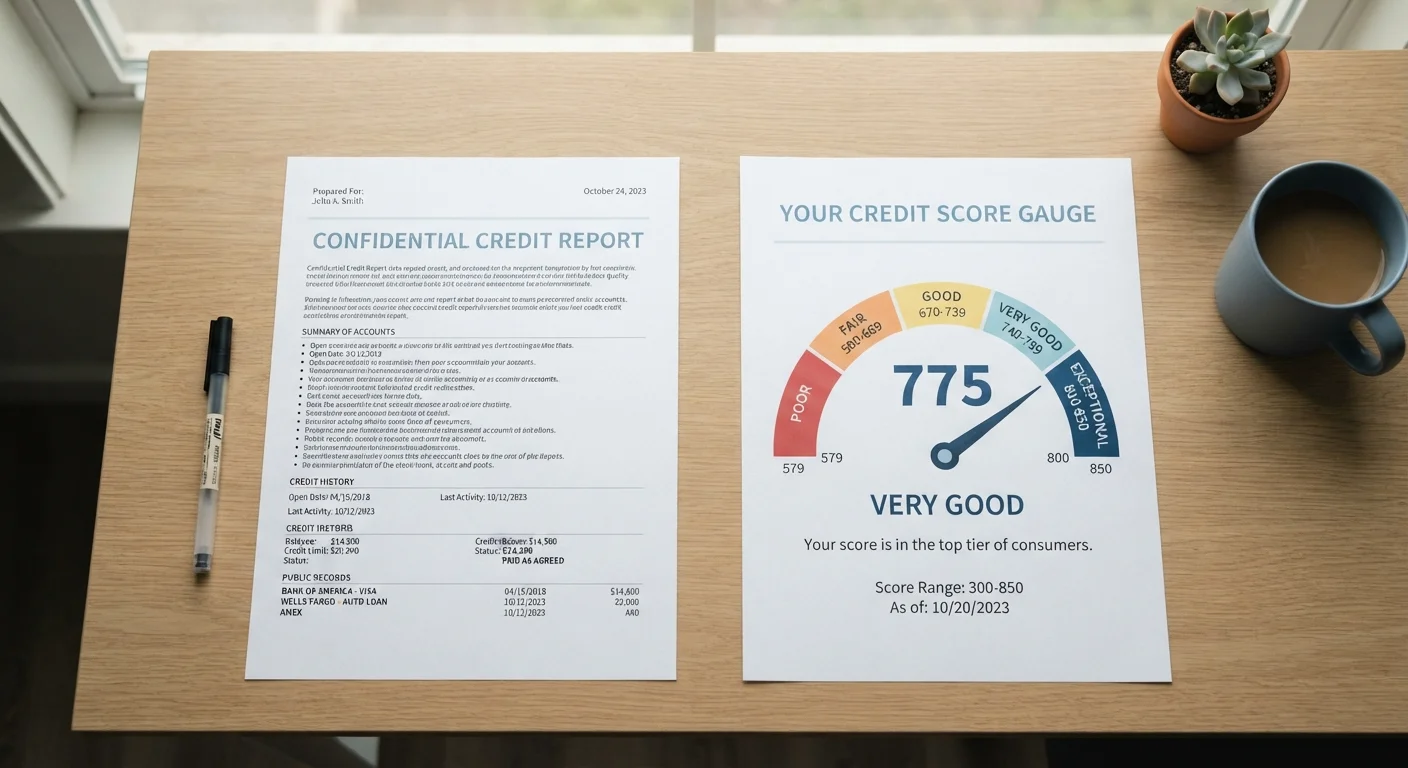
Key Takeaways
- Your credit report is a detailed record of your borrowing history; your credit score is a number derived from it.
- Credit reports are maintained by three major bureaus - Equifax, Experian, and TransUnion - and may differ slightly.
- You're entitled to free copies of your credit reports; scores may require a separate request or service.
- Errors on your credit report can drag down your score, so reviewing both regularly matters.
- Improving your score always starts with understanding what's in your report.
Option A
Credit Report
The detailed financial history behind your credit profile.
Best for: Reviewing the accuracy of your credit history, identifying errors, and understanding what lenders see.
Option B
Credit Score
The quick numerical summary lenders use to assess risk.
Best for: Getting a fast read on your creditworthiness and tracking progress when building or repairing credit.
If you want to check for errors or signs of fraud
Credit Report
Only your report shows the specific accounts, payment history, and inquiries a lender sees. Errors must be caught here before they can be disputed.
If you're preparing to apply for a loan or credit card
Credit Score
Your score gives you a quick benchmark of where you stand and whether timing your application makes sense.
If you're actively working to rebuild credit
Credit Report
Tracking which accounts and behaviors are helping or hurting requires reading the underlying detail, not just watching a number.
If you want a routine snapshot of your credit health
Credit Score
Checking your score regularly is a low-effort way to spot significant changes quickly without reading a full report every time.
Two Different Tools That Work Together
The terms "credit report" and "credit score" often get used as if they mean the same thing. They don't - though they are closely connected. Think of your credit report as a detailed logbook and your credit score as a summary rating that someone calculated by reading that logbook.
Your credit report is a structured document compiled by one of the three major credit bureaus - Equifax, Experian, and TransUnion. It lists your credit accounts, payment history, outstanding balances, how long you've had each account, and any public records like bankruptcies. It also shows who has recently requested access to your file. To understand why these bureaus sometimes show different information, see what the three credit bureaus actually do.
Your credit score, by contrast, is a three-digit number - typically ranging from 300 to 850 under the most widely used models - calculated from the data in your report. It collapses all of that history into a single figure that lenders use to quickly gauge risk. The score itself isn't stored in your report; it's generated on demand using a scoring model applied to your report data.
| Criterion | Credit Report | Credit Score |
|---|---|---|
| What it is | Detailed written record of credit history | Single three-digit number (typically 300-850) |
| Who creates it | Credit bureaus (Equifax, Experian, TransUnion) | Scoring models (e.g., FICO, VantageScore) |
| What it shows | Accounts, balances, payment history, inquiries | Summarized creditworthiness at a point in time |
| How to access it | Free via AnnualCreditReport.com | Often free via card issuer, bank, or consumer tool |
| How often it updates | As lenders report new information (typically monthly) | Recalculated each time it's requested |
| Best used for | Spotting errors, disputing inaccuracies | Tracking trends, gauging loan readiness |
What Each One Contains
Your credit report is a dense document, but it has a predictable structure. It typically includes four main sections: personal identifying information, a list of credit accounts (called tradelines), public records, and a list of credit inquiries. Each open or closed account shows the lender's name, account type, credit limit or loan amount, current balance, payment history, and account status.
For a plain-language walkthrough of every section, reading your credit report without getting overwhelmed breaks it down step by step.
Your credit score, on the other hand, contains no narrative detail. It is just a number, but that number reflects several weighted factors: payment history carries the most weight, followed by amounts owed (particularly your credit utilization rate - the share of available revolving credit you're using), length of credit history, credit mix, and new credit inquiries. For a deeper breakdown, see what your credit score actually measures.
5 factors
Components that determine most credit scores
Payment history, amounts owed, length of history, credit mix, and new inquiries are the five standard inputs used by major scoring models like FICO.
3 bureaus
Major credit bureaus maintaining separate reports
Equifax, Experian, and TransUnion each maintain independent files, which means your report - and derived score - can differ across all three.
1 in 5
Consumers who find errors on credit reports
A Federal Trade Commission study found that roughly one in five consumers identified at least one error on their credit reports that could affect their score.
How to Access Each One - and How Often
Under federal law, you're entitled to a free copy of your credit report from each of the three bureaus once every 12 months through AnnualCreditReport.com, the officially authorized source. Some periods have allowed more frequent free access; check the site for current availability. Reviewing all three matters because lenders don't all report to every bureau, so your reports can differ.
Credit scores are a different matter. Many credit card issuers and financial institutions now offer free score access to their customers, and some consumer tools provide it as well. However, there are many scoring models in use - FICO and VantageScore being the most common - and the version a lender uses when you apply may differ from the one you're viewing. That doesn't make checking your score useless; it just means treating it as a directional indicator rather than a precise forecast.
If you want to stay on top of changes to your report between check-ins, credit monitoring: what it does and what it doesn't explains what those services can and can't do for you.
Not All Scores Are the Same
There are dozens of credit scoring models in use across the lending industry. FICO alone has multiple versions tailored to specific loan types, such as auto lending or mortgage underwriting. When you check your score through a free consumer tool, you may be seeing a different model version than what a specific lender would pull. This doesn't mean the number is meaningless - it's still a useful general indicator - but a noticeable gap between what you see and what a lender quotes you is not necessarily an error.
Why the Distinction Matters in Practice
Understanding the difference between these two tools changes how you approach credit management. If your score dips unexpectedly, the score alone won't tell you why. You need to look at the report to find out whether a payment was reported late, whether a new collection account appeared, or whether your utilization spiked. The score signals that something changed; the report tells you what.
Equally important: errors in credit reports are not uncommon. Outdated information, duplicate accounts, or data mixed in from another person's file can all suppress your score unfairly. The only way to catch and dispute those errors is to read the report itself - a score won't reveal them. Disputing inaccuracies directly with the relevant bureau is a consumer right established under the Fair Credit Reporting Act (FCRA).
In short, your credit score is a useful, fast-moving indicator. Your credit report is the authoritative source. Using both together - regularly reviewing your report for accuracy while keeping an eye on your score for trends - gives you the clearest picture of your credit health.
This article is for general informational and educational purposes only and does not constitute personalized financial or legal advice. For guidance specific to your situation, consult a qualified financial professional.