

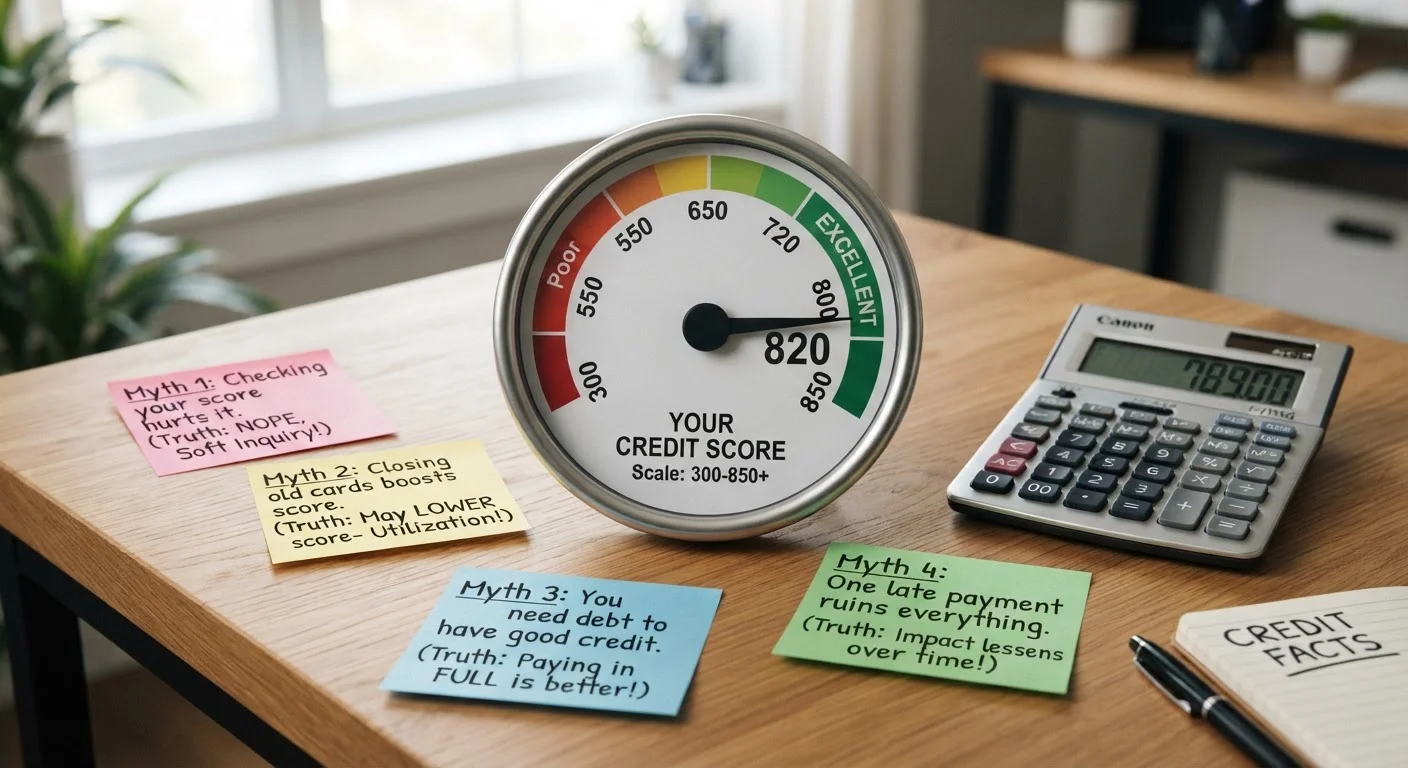
Key Takeaways
- Checking your own credit score never lowers it - only hard inquiries from lenders do.
- Carrying a balance on a credit card does not help your score; it just costs you interest.
- Closing an old credit card can actually hurt your score by reducing available credit and history.
- Income has no direct effect on your credit score calculation.
- A derogatory mark stays on your report for seven years, not indefinitely.
Why Credit Score Myths Are So Persistent
Credit scores touch nearly every major financial milestone - renting an apartment, buying a car, qualifying for a mortgage. Because the stakes are high and the underlying mechanics are genuinely complex, myths fill the knowledge gap. Well-meaning advice passed down from friends, family, or outdated internet articles keeps these misconceptions alive long after they should have been corrected.
The good news: understanding how scoring models actually work gives you real control. For a broader foundation, see our comprehensive guide to credit scores. Below, we address the most durable myths directly.
Myth
Checking your own credit score will lower it.
Fact
Checking your own score is a "soft inquiry" and has zero effect on your score.
Credit inquiries come in two types. A hard inquiry occurs when a lender reviews your credit as part of a loan or credit card application - these can temporarily lower your score by a few points. A soft inquiry occurs when you check your own score, or when a lender pre-screens you for an offer. Soft inquiries are invisible to other lenders and do not affect your score at all. Checking your score regularly is actually a healthy habit - it helps you catch errors and track progress.
Myth
You need to carry a balance on your credit card to build credit.
Fact
Carrying a balance costs you interest and provides no scoring benefit whatsoever.
This is one of the most financially damaging myths in personal finance. Scoring models reward you for using credit responsibly - that means making purchases and paying them off on time. Whether you pay your balance in full each month or carry a portion of it forward, what matters to the model is your payment history and utilization ratio. Carrying a balance only means paying interest charges, which benefit your card issuer - not your score. Pay in full each month whenever possible.
Myth
Closing a credit card you no longer use will help your score.
Fact
Closing an account typically hurts your score by reducing available credit and potentially shortening your credit history.
When you close a credit card, two things happen that can negatively affect your score. First, your total available credit decreases, which raises your utilization ratio - even if your balances haven't changed. Second, if it's an older account, closing it can reduce the average age of your credit accounts over time. Unless a card carries a fee you can't justify, leaving it open and occasionally using it for a small purchase is usually the better strategy.
Myth
A higher income means a higher credit score.
Fact
Income is not a factor in any mainstream credit scoring model.
Credit scores are calculated from information in your credit report - payment history, amounts owed, length of credit history, new credit, and credit mix. Your salary, hourly wage, employment status, or net worth appear nowhere in that calculation. A high earner who misses payments will have a lower score than a moderate earner with a spotless payment record. Lenders may separately consider your income when evaluating your ability to repay, but that is distinct from the credit score itself.
Myth
A negative item stays on your credit report forever.
Fact
Most negative items are removed from your credit report after seven years; bankruptcies may remain up to ten.
Under the Fair Credit Reporting Act (FCRA), most derogatory marks - late payments, collections, charge-offs - must be removed from your report after seven years from the original delinquency date. Chapter 7 bankruptcy can remain for up to ten years. This means even significant financial setbacks have a defined expiration date on your report. In the meantime, adding positive history through on-time payments gradually offsets the impact of older negative items. See our related piece on habits that quietly damage credit over time to understand what to avoid going forward.
What These Corrections Mean for Your Financial Decisions
Acting on bad credit information can be costly in ways that aren't immediately obvious. Someone who avoids checking their own score out of fear damages nothing - but misses the chance to catch errors. Someone who carries a card balance to "build credit" pays unnecessary interest with no scoring benefit. Someone who closes old accounts after paying them off may unintentionally spike their utilization ratio.
Closing Old Accounts Before a Major Application
If you're planning to apply for a mortgage, auto loan, or other significant credit product within the next six to twelve months, avoid closing any credit card accounts in the leadup. Doing so can raise your utilization ratio and lower your score at exactly the moment a lender will be evaluating it. Make any account changes well before - or well after - a major credit application.
Credit utilization - the percentage of your available revolving credit that you're using - is one of the most influential factors in your score. Misunderstanding it is common enough to warrant its own deep dive; our article on credit utilization and how it moves your score explains the mechanics clearly. Separately, if you've spotted errors on your report, the formal dispute process is more straightforward than most people assume.
If you're starting from zero, the path forward is more accessible than many people believe. Our guide on building credit with no history walks through low-risk first steps. And before you close any card - even one you haven't touched in years - read what closing a credit card actually does to your score first.
This article is for general informational and educational purposes only and does not constitute personalized financial or credit advice. For guidance specific to your situation, consult a qualified financial professional.