

Key Takeaways
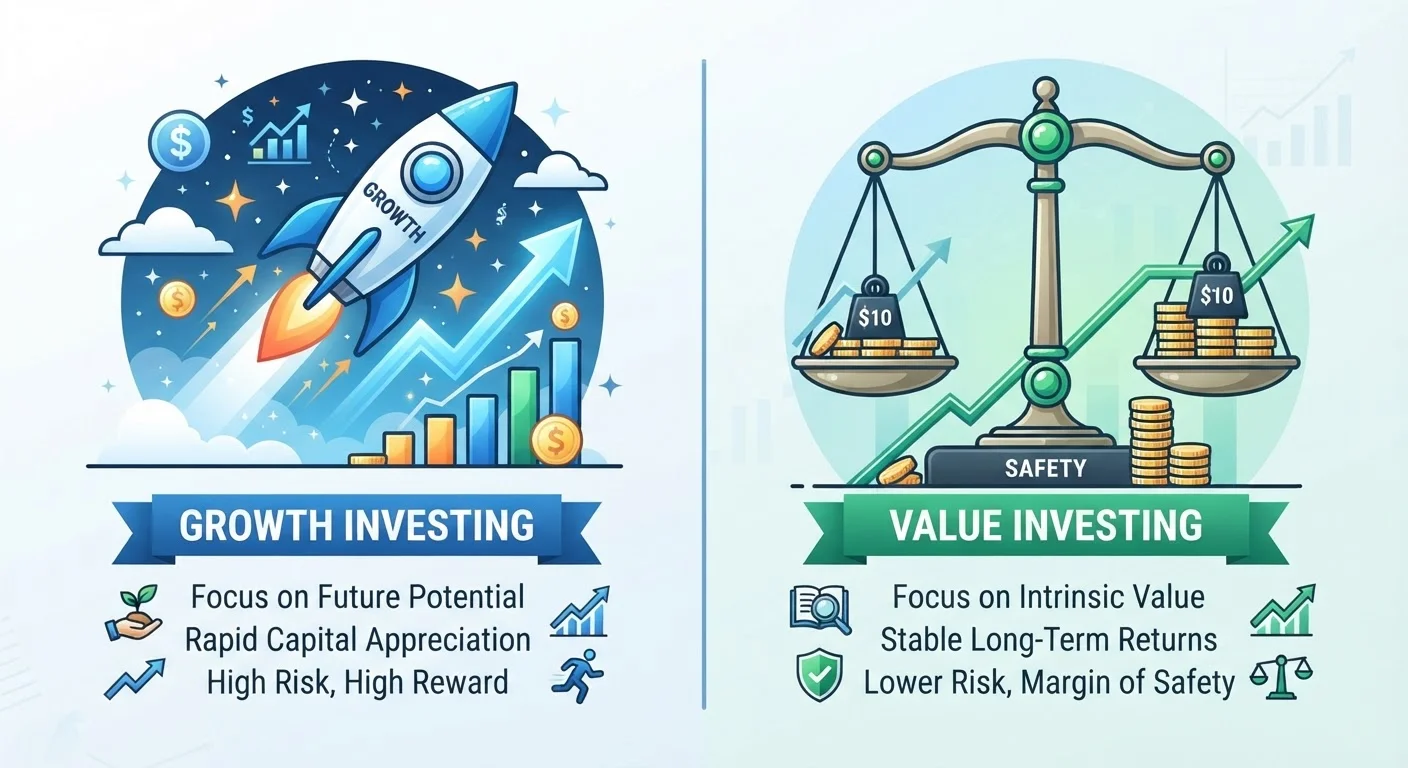
- Growth investing focuses on companies expected to expand faster than the broader market.
- Value investing seeks stocks trading below what analysts estimate the company is truly worth.
- Growth stocks typically carry higher price-to-earnings ratios and greater short-term price swings.
- Value stocks often show lower valuations but may take considerable time to appreciate.
- Neither approach guarantees returns; both carry meaningful investment risk.
- Many long-term investors blend elements of both strategies rather than choosing one exclusively.
Option A
Growth Investing
The forward-looking, potential-driven approach.
Best for: Investors comfortable with higher short-term volatility in exchange for the possibility of above-average long-term capital appreciation.
Option B
Value Investing
The disciplined, fundamentals-first approach.
Best for: Investors who prioritize finding underpriced companies and are willing to wait patiently for the market to recognize that value.
If you have a long time horizon and can tolerate significant price fluctuations
Growth Investing
Growth strategies tend to compound best over long periods, but the ride can be volatile. A longer runway helps smooth out short-term drawdowns.
If you prefer companies with established earnings and lower relative valuations
Value Investing
Value investing emphasizes buying at a discount to intrinsic worth, which can provide a margin of safety - though patience is typically required.
If you want broad exposure without picking individual stocks
Growth Investing
Index funds and ETFs tracking growth benchmarks offer diversified exposure to growth themes without the research burden of stock selection.
If you are uncomfortable with high price-to-earnings multiples
Value Investing
Value stocks usually carry lower valuations relative to earnings, which some investors find easier to rationalize during market downturns.
What Each Philosophy Is Really About
Before comparing these two approaches, it helps to understand what stock investing involves at a fundamental level. If you are new to the concept, our introduction to investing explains what it means to own a share of a company and why the practice matters for building long-term wealth.
Growth investing is built on a simple premise: some companies are growing their revenue, customers, or market share at a rate significantly faster than the overall economy. Investors who follow this approach are willing to pay a premium price today because they believe the company's future earnings will justify - and eventually surpass - that cost. Technology firms and innovative consumer brands are frequently cited examples of this category, though growth companies exist across many industries.
Value investing works from a different angle. Its core idea is that markets occasionally misprice companies - sometimes due to temporary bad news, sector-wide pessimism, or simple investor neglect. Value investors use financial analysis to estimate what a company is genuinely worth (often called intrinsic value) and then look for stocks trading meaningfully below that estimate, seeking what is commonly called a margin of safety.
How They Differ in Practice
The practical differences between growth and value investing show up clearly in the metrics each camp prioritizes.
| Criterion | Growth Investing | Value Investing |
|---|---|---|
| Core question | How fast can this company expand? | Is this company underpriced today? |
| Typical P/E ratio | Higher than market average | Lower than market average |
| Dividend income | Rare; profits reinvested for growth | More common among mature firms |
| Price volatility | Generally higher | Generally lower |
| Time horizon | Long-term capital appreciation focus | Patient wait for market re-pricing |
| Key risk | Growth slows or fails to materialize | Stock remains undervalued indefinitely |
Growth investors often focus on metrics like revenue growth rate, total addressable market, and user or subscriber expansion. They may accept that a company is not yet profitable if the growth trajectory looks compelling. Value investors, by contrast, gravitate toward metrics such as the price-to-earnings (P/E) ratio, price-to-book ratio, and free cash flow - signals that a stock may be trading at a discount to what the underlying business is generating today.
It is worth noting that these categories are not rigid. Many experienced investors draw on foundational investment concepts from both schools - evaluating a company's growth potential while still insisting on reasonable valuations.
Risk, Return, and Realistic Expectations
Neither strategy is inherently safer or more rewarding than the other. Historical data shows that each approach has experienced extended periods of outperformance and underperformance relative to the broader market.
~30-40%
Typical peak-to-trough decline for growth indices in downturns
Growth-oriented indices have historically experienced steep corrections during periods of rising interest rates or economic contraction, illustrating the volatility inherent to the strategy.
Decades
Time value investing may take to pay off
Prominent academic research, including work associated with Fama and French, has documented that value premiums can go through multi-year stretches of underperformance before reasserting themselves.
50%+
Portion of US equity funds blending both styles
Morningstar style-box data consistently shows that a large share of actively managed domestic equity funds occupy a 'blend' category rather than a pure growth or value classification.
Growth stocks tend to be more sensitive to changes in interest rates. When rates rise, the present value of future earnings - the core driver of a growth stock's price - gets discounted more heavily, often pushing prices down sharply. Value stocks can decline too, particularly if the economic conditions causing their low valuation worsen rather than improve.
Investors should also recognize that both strategies involve actively judging individual stocks, which introduces the risk of being wrong. That is one reason some people prefer a passive approach altogether - our article on passive vs. active investing explores that trade-off in depth.
This article is for general educational purposes only and does not constitute personalized investment, financial, or tax advice. All investing involves risk, including the possible loss of principal. Consult a qualified financial professional before making decisions about your own portfolio.