

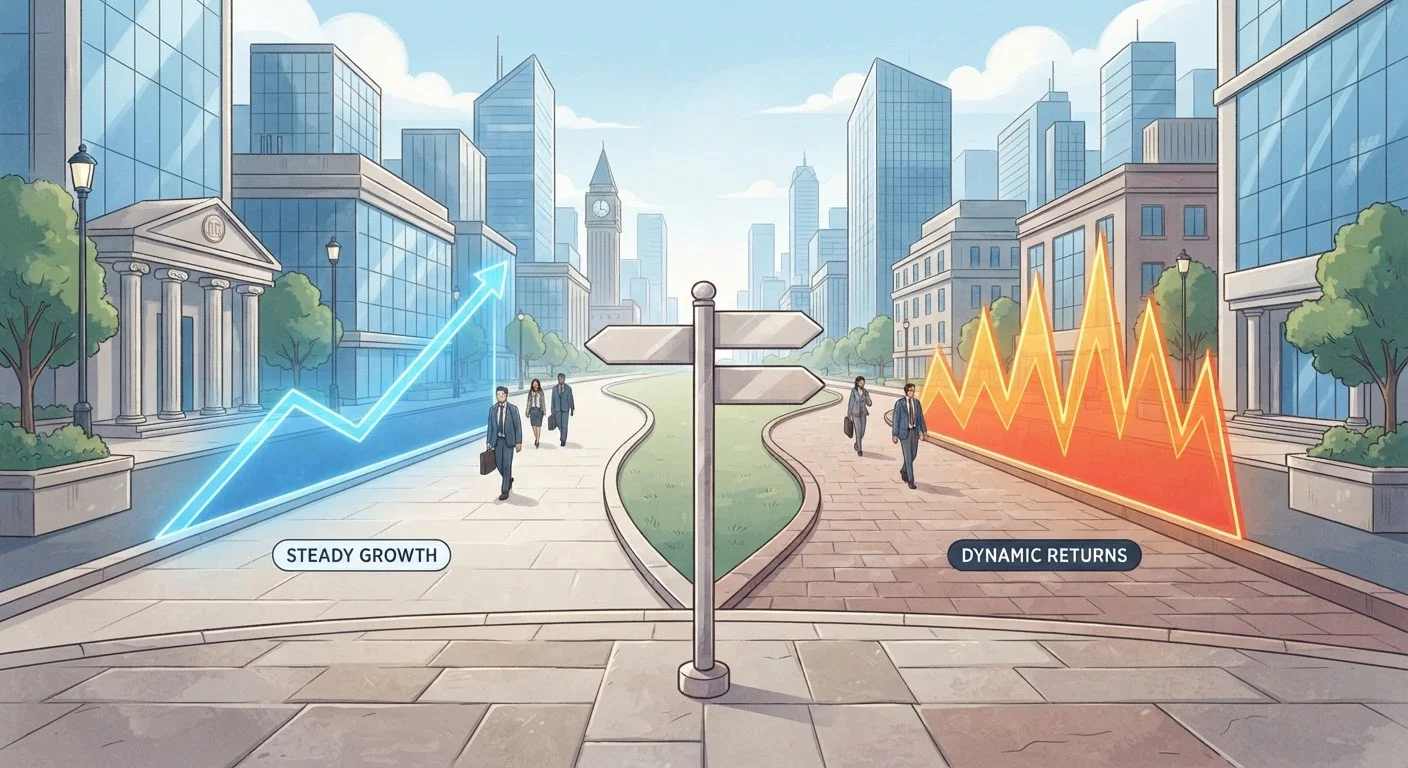
Key Takeaways
- Passive investing tracks a market index; active investing tries to beat the market through selective decisions.
- Research consistently shows most actively managed funds underperform their benchmark indexes over long periods.
- Active investing typically carries higher costs, which compound over time and erode returns.
- Neither approach is universally superior - your goals, timeline, and risk tolerance all matter.
- Consulting a licensed financial adviser can help you determine which approach fits your situation.
Our Verdict
Passive investing has a strong evidence-based track record for most long-term investors, largely due to its lower costs and consistent market exposure. Active investing can offer potential advantages in specific market conditions or asset classes, but those benefits are difficult to predict and rarely materialise consistently after fees. Most financial educators recommend understanding both approaches before committing to either.
| Best for | Recommended |
|---|---|
| Long-term investors seeking low-cost, broad market exposure | Passive investing |
| Investors comfortable with higher costs in pursuit of market-beating returns | Active investing |
| Those who prefer a hands-off, set-and-monitor strategy | Passive investing |
| Investors working with a financial adviser in less efficient market segments | Active investing |
The Core Difference: Philosophy, Not Just Strategy
At its heart, the passive vs. active debate comes down to a single question: Can investors reliably identify mispriced assets and profit from that insight consistently over time? Passive investors say no - or at least, not after accounting for costs. Active investors believe skilled managers can beat the broader market through research, timing, and selection.
If you're new to investing, it helps to start with the basics. Our comprehensive introduction to investing covers how markets work and what different account types mean before you weigh strategies.
Passive investing means buying a portfolio designed to mirror a market index - such as the S&P 500 - rather than trying to outperform it. The goal is to capture the market's return, not exceed it. Trades are infrequent, and costs stay low because no team of analysts is constantly evaluating securities.
Active investing means a manager (or individual) makes deliberate choices about what to buy, when to buy it, and when to sell - with the aim of delivering returns above what the market would naturally provide. This requires ongoing research, skilled judgment, and often, higher fees.
What the Evidence Actually Shows
The debate isn't purely theoretical - decades of data offer meaningful guidance.
~85%
Active large-cap funds underperforming over 10 years
SPIVA U.S. Scorecards have repeatedly found that the large majority of actively managed U.S. large-cap funds underperform the S&P 500 over 10-year periods.
0.03%-1.5%+
Range of fund expense ratios
Passive index funds can charge as little as 0.03% annually, while some actively managed funds charge over 1.5%, according to publicly available fund data.
The S&P Indices Versus Active (SPIVA) scorecards, published by S&P Dow Jones Indices, track how actively managed funds perform against their benchmark indexes. Across most time horizons and fund categories measured, the majority of active funds underperform their passive benchmarks. The gap tends to widen over longer periods - a pattern widely attributed to the compounding drag of management fees and transaction costs.
This doesn't mean active management never works. Some managers do outperform - but identifying them in advance is the challenge. Research on fund performance persistence suggests that past outperformance has limited predictive power for future results. In other words, a fund that beat its benchmark last year isn't reliably likely to do so next year.
It's also worth noting that markets are not identical. Active management has historically shown more mixed results in highly efficient markets (like large-cap U.S. stocks) compared to less efficient ones (like certain international or smaller-company segments).
Look Beyond Short-Term Performance
A fund that outperforms in one year may simply have benefited from favourable market conditions rather than manager skill. When evaluating any fund, look at multi-year performance relative to a comparable benchmark - and always factor in fees. Research on performance persistence suggests outperformance is difficult to sustain consistently over time.
Costs: The Factor That Compounds Over Time
One of the clearest, most measurable differences between passive and active investing is cost. Actively managed funds typically charge higher expense ratios than passively managed index funds, and those fees come out of your returns regardless of performance.
| Passive Investing | Active Investing | |
|---|---|---|
| Goal | Match market returns | Beat market returns |
| Typical costs (expense ratio) | Generally lower (often under 0.20%) | Generally higher (often 0.50%-1.5%+) |
| Trading frequency | Infrequent, index-driven | Frequent, manager-driven |
| Research intensity | Minimal - tracks an index | High - ongoing analysis required |
| Historical long-term performance vs. benchmark | Tends to match benchmark closely | Most funds underperform benchmark over time |
| Hands-on involvement | Low - set and monitor | Higher - requires active decisions |
Even a seemingly small difference - say 0.5% per year - compounds significantly over decades. On a $50,000 portfolio growing at 7% annually, a 1% fee difference could mean tens of thousands of dollars less at retirement. This is why cost awareness is considered foundational to sound investing. Our guide on index funds vs. actively managed funds explores this cost dynamic in more detail.
Fees Quietly Erode Long-Term Returns
High expense ratios don't just reduce your annual return - they reduce the base on which future returns compound. Over a 20- or 30-year investment horizon, seemingly small annual fee differences can translate into large gaps in final portfolio value. Always check the expense ratio before committing to any fund, and understand what you're paying for.
Choosing an Approach: Factors Worth Considering
Neither passive nor active investing is the objectively correct choice for every investor. Several factors are worth examining honestly:
- Time horizon: Passive strategies tend to reward patience. Longer time horizons allow low-cost compounding to work in your favour.
- Cost sensitivity: If minimising fees is a priority, passive funds generally have the structural advantage.
- Involvement preference: Passive investing suits those who want a low-maintenance approach. Active investing - especially if you're making your own stock picks - demands ongoing attention.
- Risk tolerance: Active strategies can produce meaningful deviations from the market, both above and below it. That variability isn't for everyone.
- Specific market exposure: In less-researched market segments, there may be more room for skilled active managers to add value - though this is not guaranteed.
It's also worth challenging assumptions you may already hold about investing. Our article on common investing misconceptions addresses several beliefs that often complicate this decision unnecessarily.
Before you decide, it's also helpful to clarify whether investing is even the right tool for your current financial situation. Saving vs. investing outlines when each approach makes sense, which is foundational to any strategy decision.
This article is for general informational and educational purposes only. It does not constitute personalised financial, investment, tax, or legal advice. Past performance does not guarantee future results. Consult a qualified, licensed financial adviser before making decisions based on your individual circumstances.