

Key Takeaways
- Efflorescence is caused by water carrying dissolved salts to a masonry surface, where they crystallize after evaporation.
- It is not structurally dangerous on its own, but it reliably signals a moisture intrusion problem that warrants attention.
- New construction often produces primary efflorescence that disappears on its own; recurring deposits point to an ongoing water issue.
- Cleaning efflorescence without addressing the moisture source is a temporary fix - the deposits will return.
- Persistent or heavy efflorescence near a foundation or basement wall should be evaluated by a professional.
Efflorescence
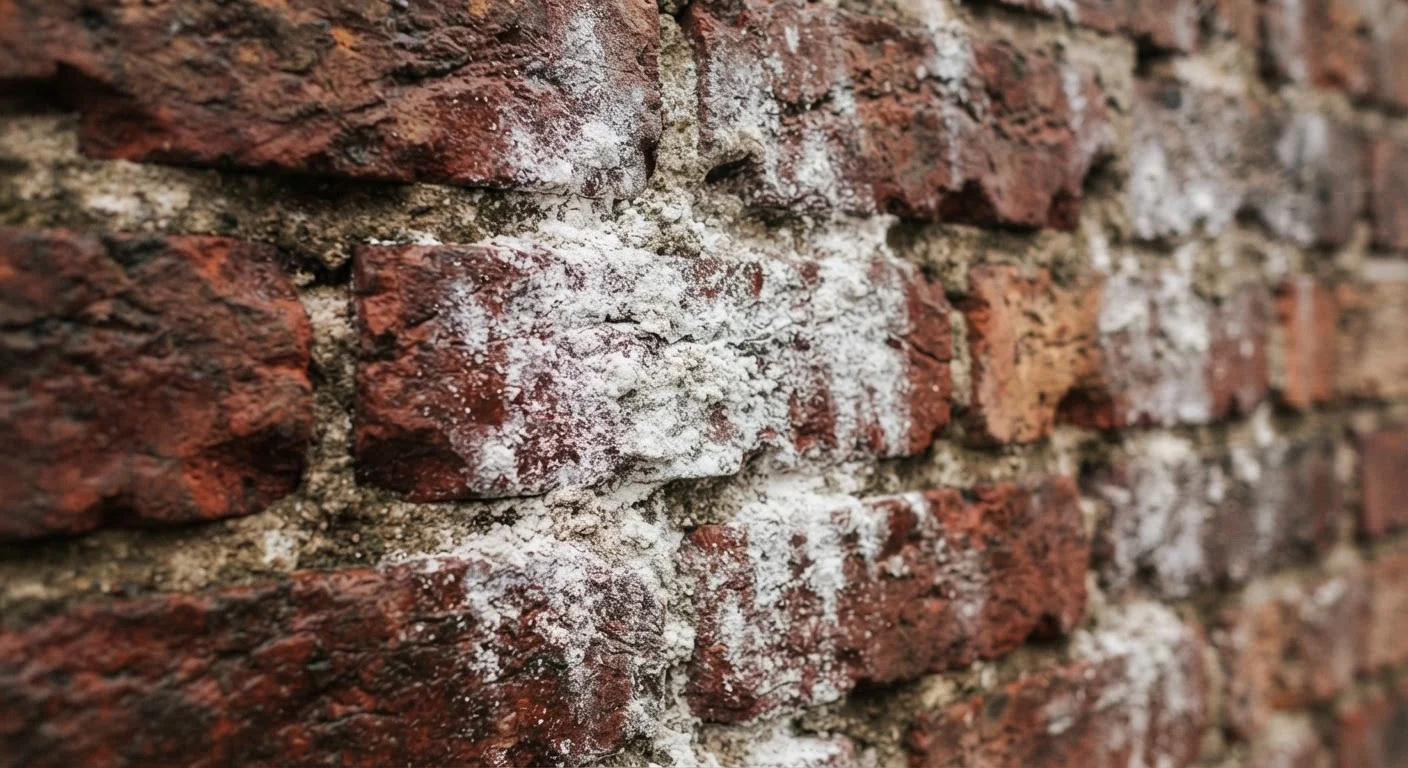
Efflorescence is the white, chalky, or powdery deposit that forms on the surface of concrete, brick, or masonry. It appears when water moves through a material, dissolves soluble salts inside, and then evaporates at the surface - leaving those salts behind as a visible crust. It's common on foundation walls, brick exteriors, basement floors, and retaining walls.
The salts most commonly involved include calcium carbonate, sodium sulfate, and potassium sulfate, depending on the source material and groundwater chemistry.
Why Water Is Always the Real Story
When you notice that chalky white film creeping across a brick wall, a concrete patio, or a basement floor, the instinct is often to scrub it off and move on. But efflorescence is less a stain than a signal - a visible record of water moving where it shouldn't be.
Here's the basic sequence: water enters a masonry material (concrete, brick, mortar, or stone), dissolves naturally occurring soluble salts within the material or in the soil behind it, then migrates toward the surface. When that water evaporates, it leaves the dissolved minerals behind as a powdery white crust. The process is simple chemistry, but the water doing the traveling is what homeowners need to take seriously.
Primary vs. Secondary Efflorescence
Primary efflorescence occurs in newly constructed or freshly placed masonry as residual construction moisture migrates outward. It typically fades within one to two years without intervention. Secondary efflorescence is driven by an ongoing external water source and will keep returning until the moisture pathway is identified and corrected.
The distinction between primary and secondary efflorescence matters for deciding how urgently to act. Primary efflorescence happens in new masonry as construction moisture works its way out - it's largely cosmetic and tends to resolve within the first couple of seasons. Secondary efflorescence returns repeatedly and points to an external water source continuously entering the material.
Where It Shows Up and What Each Location Suggests
Location is one of the most useful clues efflorescence provides:
- Foundation and basement walls: Often the most concerning location. Efflorescence here can indicate groundwater pressure against the foundation, inadequate waterproofing, or cracks allowing water infiltration. It tends to follow the path of least resistance - meaning the staining pattern itself can map moisture entry points.
- Brick exterior walls: Frequently caused by water penetrating through mortar joints, especially in older homes where mortar has cracked or deteriorated. It can also result from water entering from above - flashing failures, clogged gutters, or missing caulk around windows.
- Concrete floors and slabs: Ground moisture wicking upward through an unsealed or cracked slab is the usual cause. This is especially common in below-grade spaces without a proper vapor barrier.
- Retaining walls: These structures hold back soil and the water it contains, so efflorescence is relatively common. Persistent deposits may suggest drainage behind the wall is inadequate.
90%+
Of basement moisture problems linked to exterior water sources
The American Society of Home Inspectors has noted that the vast majority of basement moisture issues stem from surface water not being directed away from the home, rather than rising groundwater.
6 in.
Recommended slope drop over the first 10 feet from foundation
Building science guidance commonly recommends at least a 6-inch drop in grade over the first 10 feet from a foundation wall to direct water away effectively.
Cleaning It vs. Fixing It: Understanding the Difference
Removing the visible deposit is straightforward - and it's a reasonable first step. But it's important to treat cleaning as temporary unless you've identified and resolved the moisture source. Otherwise, the salts will simply return with the next rain cycle.
For cleaning, start with the least aggressive approach: a stiff-bristled brush (dry) to remove loose powder, followed by a rinse with clean water. If deposits are heavier or have bonded to the surface, a diluted white vinegar solution applied with a brush, left briefly, then scrubbed and rinsed can be effective. Allow the surface to dry completely before evaluating results.
Test Before You Seal Anything
Before applying any waterproofing sealer or coating to an affected surface, confirm the surface is genuinely dry by taping a small square of plastic sheeting to the concrete or brick and leaving it for 24-48 hours. If condensation forms on the underside, moisture is still moving through the material, and sealing at that point will trap it inside rather than block it out.
Once the surface is clean and dry, the investigation shifts to the moisture source. Common remediation steps include:
- Improving grade so that ground slopes away from the foundation (at least 6 inches of drop over the first 10 feet is a commonly cited guideline).
- Cleaning and extending gutters and downspouts so water is carried well away from the structure.
- Repointing deteriorated mortar joints on brick exteriors.
- Applying a breathable masonry waterproofing treatment on exterior surfaces after confirming the substrate is dry.
For stucco surfaces with similar moisture-related symptoms, understanding the full wall system first is essential - see our guide to what lies behind stucco surfaces before attempting any patching or sealing.
If efflorescence is heavy, recurring on a foundation wall, or accompanied by cracks, bowing, or water pooling inside a basement, consulting a licensed waterproofing or foundation professional is the right call. These situations can involve hydrostatic pressure (the force of groundwater pushing against a structure) that DIY surface treatments cannot address safely.