

Key Takeaways
- Hardwood can be sanded and refinished multiple times, extending its lifespan by decades with proper care.
- LVP is fully waterproof, making it suitable for kitchens, bathrooms, and basements where hardwood is risky.
- Hardwood typically costs more upfront and requires professional installation in most cases.
- LVP installs faster with floating click-lock systems that many confident DIYers can handle.
- Hardwood may add measurable resale value; LVP's impact on appraisals varies by market and buyer expectations.
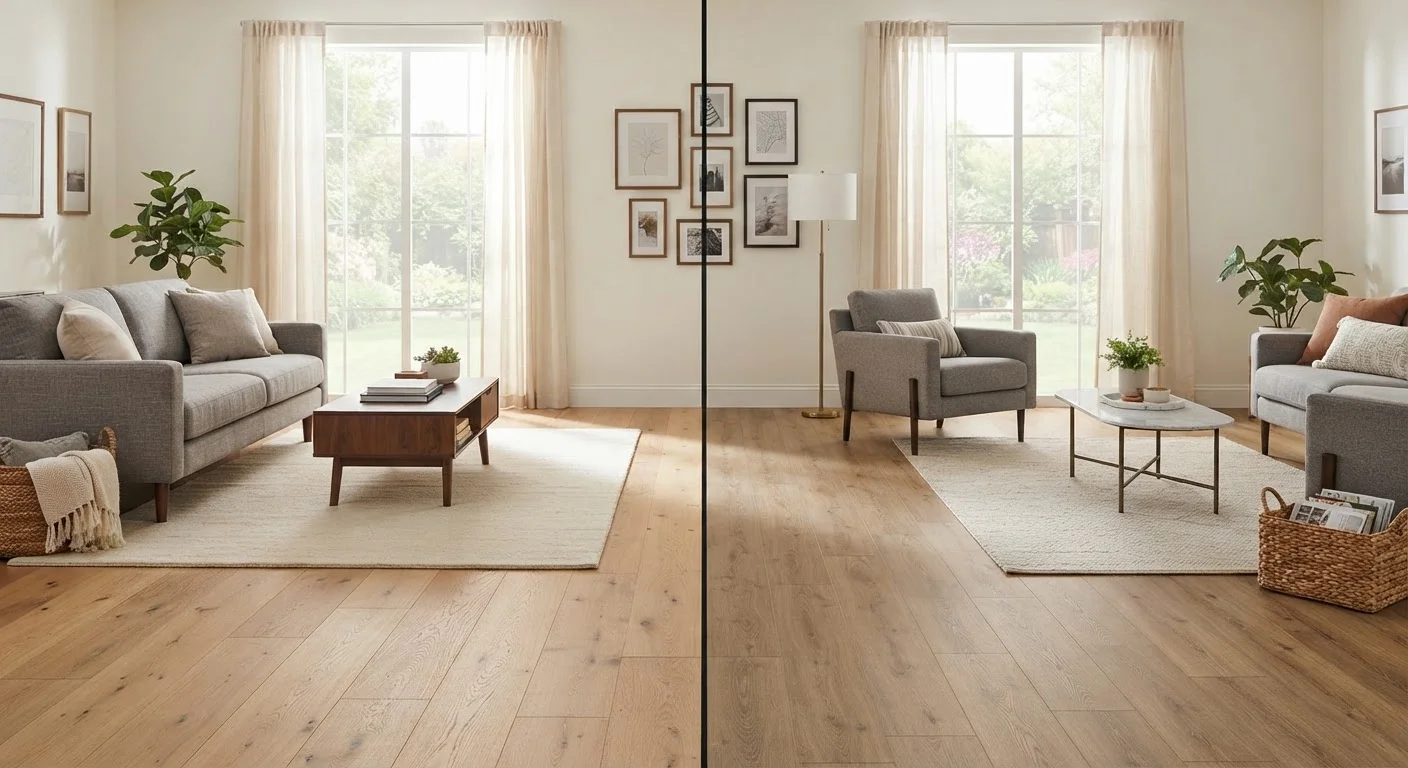
- Both options now come in wide planks and realistic wood-grain visuals, narrowing the aesthetic gap significantly.
Option A
Hardwood Flooring
The timeless, high-value classic.
Best for: Homeowners seeking long-term investment value, natural character, and refinishing potential in low-moisture rooms.
Option B
Luxury Vinyl Plank (LVP)
The practical, moisture-resistant modern alternative.
Best for: Homeowners prioritizing durability, water resistance, and budget-friendliness in high-traffic or moisture-prone spaces.
If you want a floor that can be refinished and last 50+ years
Hardwood Flooring
Solid hardwood can be sanded and re-stained multiple times, making it a genuinely long-lived surface when maintained properly and kept dry.
If you're upgrading a bathroom, laundry room, or basement
Luxury Vinyl Plank (LVP)
LVP is 100% waterproof and handles humidity and occasional spills without warping or swelling - a critical advantage hardwood cannot match.
If you're working within a tight renovation budget
Luxury Vinyl Plank (LVP)
LVP generally costs less per square foot and is easier to install yourself, reducing or eliminating labor costs for capable DIYers.
If resale value and buyer appeal in a premium market matter most
Hardwood Flooring
Real hardwood is widely associated with quality and may appeal more strongly to buyers in competitive real estate markets, though outcomes vary.
If you have pets, children, or very high daily foot traffic
Luxury Vinyl Plank (LVP)
Quality LVP with a thick wear layer resists scratches, dents, and moisture from active households better than most hardwood species.
Understanding What Each Material Actually Is
Hardwood flooring is milled from solid timber - species like oak, maple, hickory, or walnut - cut into planks typically ¾ inch thick. Because it's a natural material, each plank has unique grain patterns and color variation. That same thickness allows it to be sanded flat and refinished when the surface wears down or gets scratched. For guidance on handling surface damage specifically, see our repair guide for hardwood floor scratches.
Luxury Vinyl Plank is an engineered synthetic product made of multiple fused layers: a rigid or semi-rigid core, a high-resolution photographic film layer printed to mimic wood grain, and a clear wear layer on top. Modern LVP is often called WPC (wood-plastic composite) or SPC (stone-plastic composite) depending on its core construction, with SPC being denser and more dimensionally stable under temperature swings.
Engineered hardwood - which uses a real wood veneer bonded over a plywood core - sits between these two options and shares characteristics of both, but falls outside the scope of this direct comparison.
Cost, Installation, and Practical Difficulty
Material costs for solid hardwood generally run higher than LVP, though both categories span a wide price range depending on species, thickness, and finish quality. Installation labor adds meaningfully to hardwood projects - it typically requires nailing or stapling to a wood subfloor, and the floor usually needs acclimation time before installation begins. Most homeowners hire professionals for hardwood to ensure proper results.
LVP uses floating click-lock systems that don't require adhesive or fasteners in most cases. This makes it more accessible for confident DIYers and reduces installation time considerably. Before committing to either material, it's worth building a full project budget - our home upgrade budgeting guide explains how to account for subfloor prep, acclimation, and contingency costs that are easy to overlook.
| Criterion | Hardwood Flooring | Luxury Vinyl Plank (LVP) |
|---|---|---|
| Material origin | Solid natural timber | Engineered synthetic composite |
| Typical installed cost | Higher (material + labor) | Lower to moderate |
| DIY-friendliness | Difficult; usually professional | Moderate; click-lock system |
| Water resistance | Low; warps with moisture | 100% waterproof |
| Refinishable | Yes, multiple times | No; replace when worn |
| Scratch resistance | Varies by species | Strong with thick wear layer |
| Lifespan | 50+ years with care | 15-25 years typically |
| Resale appeal | Generally strong | Growing; market-dependent |
Durability, Moisture, and Long-Term Performance
Hardwood's vulnerability to moisture is its most significant practical limitation. Water exposure - from spills, humidity, or flooding - can cause planks to cup, warp, or swell. This makes it a poor choice for bathrooms, most kitchens, and any below-grade space. Properly maintained hardwood in dry living areas, however, can last generations.
LVP, by contrast, is fully waterproof at the plank level. Its wear layer resists scratches from pet claws and furniture better than softer wood species, though heavily textured or very hard hardwoods like hickory can be comparably tough. One limitation: LVP cannot be refinished. When the wear layer is through, the floor must be replaced. Wear layer thickness - measured in mils - is one of the most important specs to evaluate when comparing LVP products.
15-25 years
Typical LVP lifespan with normal use
Wear layer thickness (measured in mils) is the primary factor; commercial-grade LVP often carries thicker layers than residential entry-level products.
75+ years
Potential hardwood lifespan with refinishing
Solid ¾-inch hardwood can typically be sanded and refinished four to six times over its life, dramatically extending its useful span in dry environments.
12 mil+
Wear layer thickness for high-traffic LVP
Industry guidance generally recommends at least a 12-mil wear layer for busy households with pets or children; commercial settings often require 20 mil or more.
For a room-by-room framework to guide your final decision, the flooring upgrade checklist walks through moisture exposure, subfloor condition, and traffic level for each space in your home.
Aesthetics, Comfort, and Resale Considerations
Real hardwood offers warmth underfoot and the kind of visual depth that printed surfaces approximate but don't fully replicate. It also develops a patina over time that many homeowners find appealing. LVP has improved dramatically in realism - wide-format planks with embossed textures now fool most casual observers - but it remains a reproduction rather than the original material.
In terms of underfoot feel, hardwood is firm and can feel cold without rugs. LVP, particularly WPC-core products, tends to be slightly softer and warmer due to its composite construction. Both can be installed over radiant heat systems, though LVP has tighter temperature tolerances that vary by product.
On resale value, hardwood has a historically stronger reputation in real estate listings, but LVP's growing market acceptance means the gap is narrowing. Local buyer preferences, home price tier, and overall home condition all influence whether flooring material meaningfully affects appraisals or sale prices.