

Key Takeaways
- Whole-house systems treat all water entering your home; point-of-use systems treat water at a single tap or appliance.
- Whole-house installation typically involves a licensed plumber and a higher upfront cost.
- Point-of-use systems are lower cost and easier to install, but only protect a specific outlet.
- The right choice depends on your water quality report, household size, and which problem you're actually trying to solve.
- Both system types require ongoing filter replacement to remain effective.
Option A
Whole-House Water Filtration
The comprehensive, infrastructure-level solution.
Best for: Homeowners dealing with sediment, chlorine, or contaminants affecting every tap, appliance, and shower in the house.
Option B
Point-of-Use Systems
The targeted, lower-cost alternative.
Best for: Households that want improved drinking or cooking water quality at one or two specific locations without a full home installation.
If your whole home has hard water, high sediment, or chlorine affecting showers and appliances
Whole-House Water Filtration
Treating water at the main entry point protects pipes, appliances, and every faucet simultaneously, which a point-of-use unit simply cannot do.
If you only want cleaner drinking and cooking water at the kitchen sink
Point-of-Use Systems
An under-sink or countertop filter addresses your specific concern at a fraction of the cost and with minimal installation complexity.
If you rent or plan to move within a few years
Point-of-Use Systems
Portable or easily removable point-of-use units don't require permanent plumbing modifications, making them a practical short-term solution.
If your water quality report shows contaminants affecting bathing water or appliance longevity
Whole-House Water Filtration
Contaminants like sediment and chloramines that affect skin, hair, and appliance lifespan require treatment before water reaches any fixture.
What Each System Actually Does
The core difference between these two approaches comes down to where filtration happens. A whole-house system - sometimes called a point-of-entry (POE) system - is installed where the main water supply line enters your home. Every drop of water that reaches any faucet, shower, toilet, or appliance has already passed through filtration. A point-of-use (POU) system is installed at a specific outlet, most commonly under the kitchen sink or attached to a refrigerator line, and treats only the water drawn from that location.
Neither approach is universally superior. They solve different problems at different scales. Understanding your actual water quality concerns - rather than assuming one type is automatically better - is the right starting point. Your local utility is required to provide an annual water quality report (sometimes called a Consumer Confidence Report), which identifies what's present in your municipal supply. Well water users should have independent testing done periodically.
| Criterion | Whole-House Filtration | Point-of-Use System |
|---|---|---|
| Coverage | Every faucet, shower, and appliance | One tap or outlet |
| Installation | Licensed plumber typically required | Often DIY-friendly |
| Upfront cost | Higher (equipment + labor) | Lower to moderate |
| Ongoing maintenance | Filter/media replacement, possible backwashing | Cartridge replacement |
| Best for | Sediment, hardness, chlorine throughout home | Taste, odor, or specific contaminants at one tap |
| Portability | Permanent installation | Can be moved or removed |
Cost, Installation, and Ongoing Maintenance
Whole-house systems carry a significantly higher upfront cost, typically including the equipment itself plus professional installation by a licensed plumber - costs that vary widely by system type, home size, and local labor rates. Sediment pre-filters, activated carbon tanks, and specialty systems for iron removal or water softening can each add to the total. These systems also require periodic filter or media replacement, and some include backwashing cycles that use additional water.
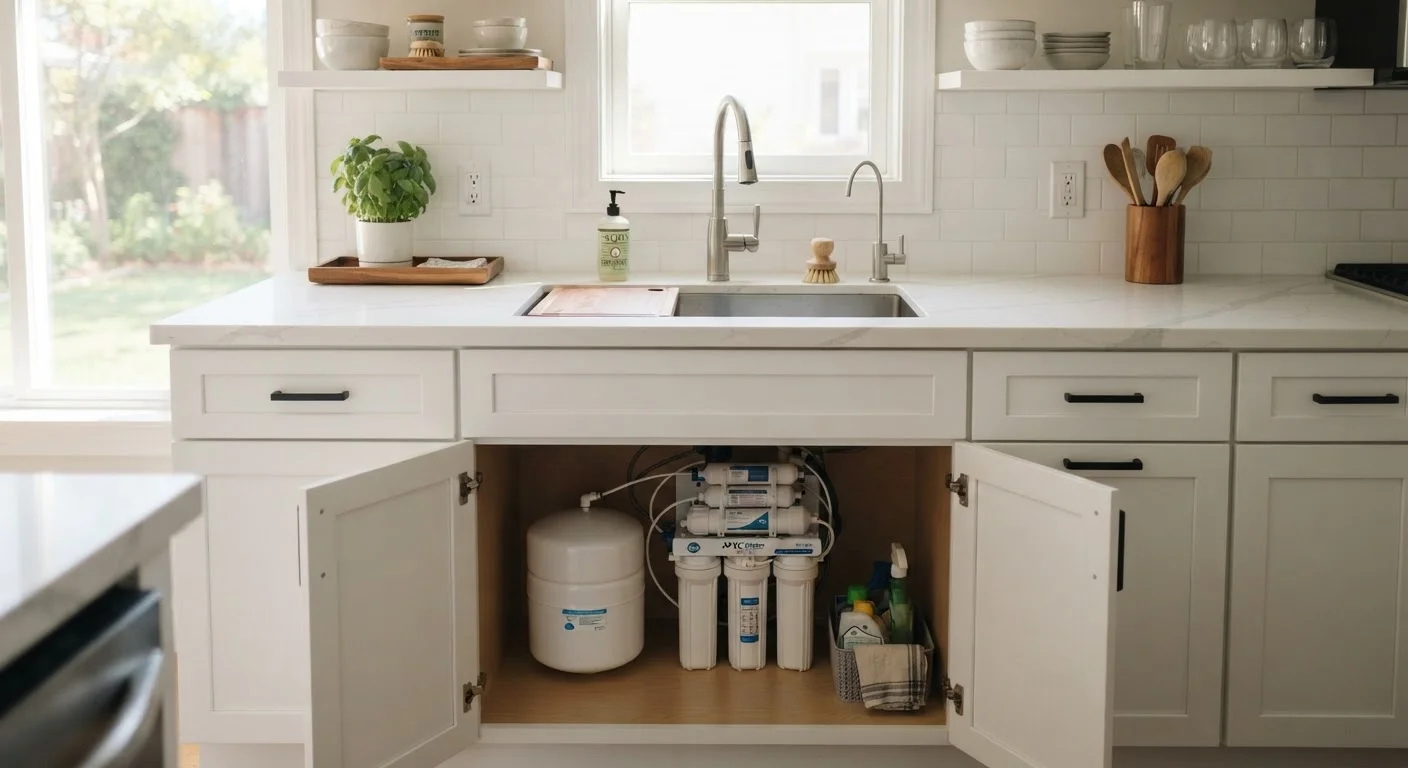
Point-of-use systems are generally far less expensive to purchase and, in many cases, can be installed by a handy homeowner. Under-sink reverse osmosis units, countertop carbon filters, and faucet-mounted filters all fall into this category. Filter cartridge replacement is a recurring cost, but the intervals and prices are typically lower than whole-house media replacements.
As a general principle, the lowest upfront price doesn't always represent the best long-term value - factor in filter replacement frequency and lifespan when comparing options. Similarly, matching the system's capability to your actual problem prevents overspending on features you don't need.
~85%
US homes served by public water systems
The EPA estimates roughly 85% of US residents receive water from a community water system subject to federal quality standards.
15%
US homes relying on private wells
According to the EPA, approximately 15% of Americans rely on private wells, which are not regulated federally and require owner-initiated testing.
Choosing the Right Fit for Your Home
A few practical questions can help narrow the decision:
- What problem are you solving? Taste and odor at the kitchen sink points toward a POU system. Sediment damaging appliances or chlorine irritating skin in the shower points toward a whole-house solution.
- How long do you plan to stay? Whole-house systems are infrastructure investments that make more sense for long-term homeowners. For renters or those planning to sell soon, a portable or removable POU unit is more practical.
- What does your water report show? Some contaminants - like lead from older household pipes - occur after water enters your home, meaning a whole-house entry filter may not address them. A POU filter certified for lead reduction at the tap can be more effective in that specific scenario.
It's also worth noting that these systems aren't mutually exclusive. Some homeowners use a whole-house sediment pre-filter to protect appliances alongside a reverse osmosis POU unit for drinking water - a layered approach that addresses distinct concerns at each scale.
Check Filter Certifications Before Buying
Not all filters remove the same contaminants. Look for systems certified by NSF International or the Water Quality Association to the relevant NSF/ANSI standard for the contaminant you want addressed - for example, NSF/ANSI 53 for health-related contaminants or NSF/ANSI 58 for reverse osmosis systems. A certification tells you the filter has been independently tested to perform as claimed, not just marketed that way.
If your home has other water-related infrastructure, like a tankless water heater, whole-house sediment filtration can also extend the life of that equipment by reducing mineral buildup in heat exchangers.