

Key Takeaways
- Floor models and display units are pre-owned items that have been handled by many shoppers before you.
- Price reductions on floor models vary widely - inspect carefully to judge whether the discount reflects real value.
- Warranty terms on floor models are frequently reduced, altered, or absent entirely.
- Condition varies significantly by product category; some items hold up well on display, others don't.
- Return policies on floor models are often more restrictive than standard store policy.
Potential for meaningful price reduction
Retailers generally have negotiating room on floor models, particularly when clearing space for newer inventory. The discount on large-ticket items can be substantial in absolute dollar terms.
Ability to inspect the exact unit
Unlike ordering new, you can evaluate the actual item for cosmetic condition, finish, and fit before purchase - removing some uncertainty about appearance.
Immediate availability
Floor models are on-site and ready to go, which can be an advantage when delivery timelines for new stock are long.
Functional proof in some categories
For items like furniture or non-electronic appliances, extended display use can sometimes confirm basic durability rather than undermine it.
Warranty coverage is often reduced or absent
Manufacturer warranties typically start from the date of original purchase or activation - meaning months may already be used up. Some warranties are voided entirely for items used in commercial or display settings.
Unknown usage history and handling
Floor models are handled by an indeterminate number of people with varying degrees of care. Internal wear on mechanical or electronic components isn't always visible on the surface.
Frequently sold as final sale with no returns
Retailers often apply a stricter no-return policy to floor models. If a problem surfaces after purchase, your options may be limited to whatever warranty coverage remains.
Missing accessories or original packaging
Original boxes, manuals, remotes, and bundled accessories are often missing or mismatched. Replacement parts may be difficult or costly to source.
Cosmetic wear that affects perceived value
Scratches, scuffs, discoloration, and worn controls are common. These may be purely aesthetic, but they affect resale value and may matter to the buyer over time.
Our Verdict
Floor models can represent genuine value for shoppers who know what to inspect and what questions to ask. The discount is most meaningful when the item shows minimal wear, manufacturer warranty remains intact, and the return window is acceptable. Treating every floor model as a straightforward bargain, however, is a mistake - the trade-offs are real and category-dependent.
Best suited for practical, detail-oriented shoppers buying low-wear categories - such as large furniture or certain appliances - who are comfortable inspecting condition thoroughly and negotiating terms before purchase.
What Floor Models Actually Are
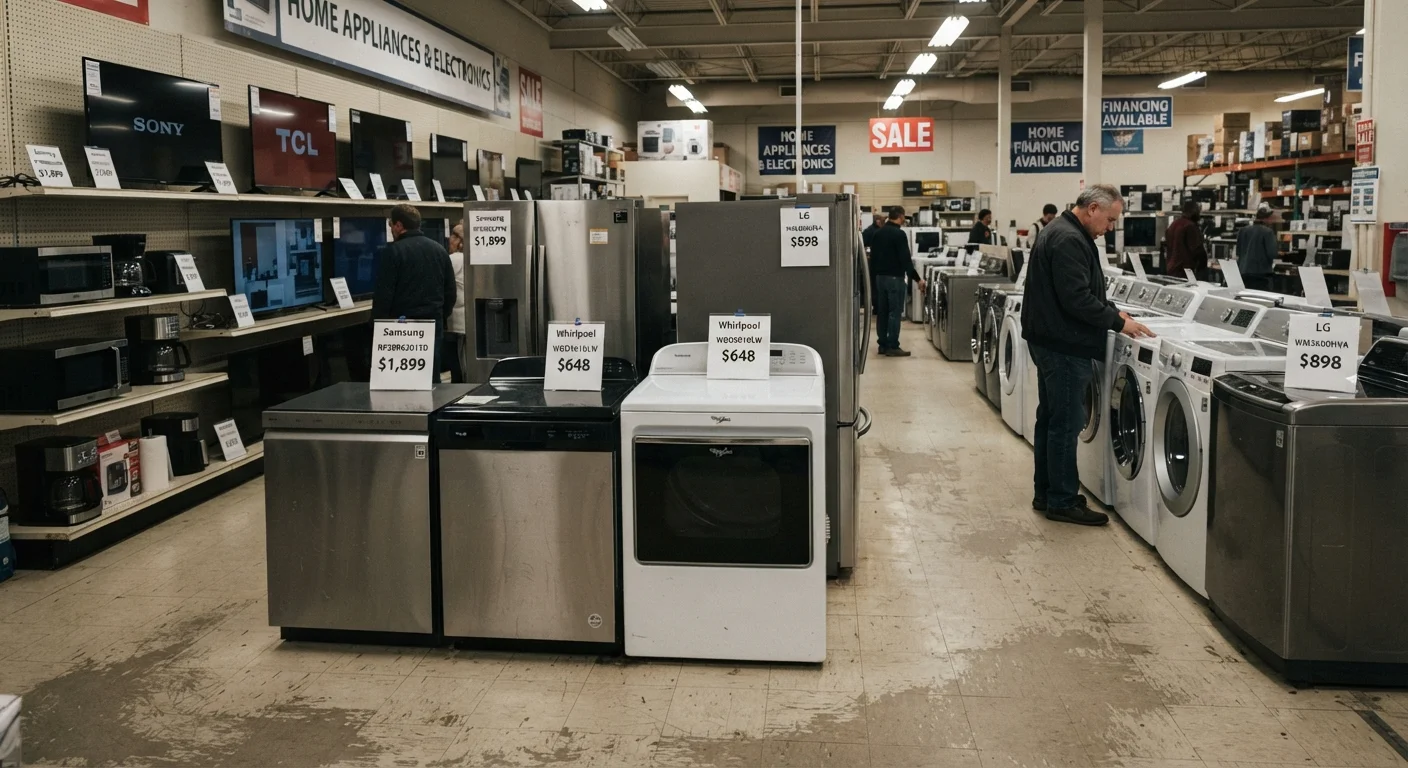
A floor model - sometimes called a display unit - is a product that has been used in a retail environment for demonstration purposes. Shoppers have touched it, tested it, and in many cases used it heavily over weeks or months. When a store refreshes its floor inventory or discontinues a product line, these units are typically sold off at a reduced price.
Floor models differ meaningfully from open-box items, which are products returned by customers but not necessarily used for display. Understanding that distinction matters when evaluating condition. For a deeper look at that category, see what open-box really means.
The category spans a wide range: refrigerators, sofas, televisions, exercise equipment, mattresses, and small appliances all appear as floor models regularly. How well a unit holds up depends heavily on what it is - a steel-framed sofa may survive a year of display with minimal impact, while a touchscreen device showing heavy daily interaction is a different story entirely.
Floor Models vs. Open-Box: A Key Distinction
Floor models have been actively used in the store environment, often for months. Open-box items are typically customer returns that have been repackaged - they may be unused or barely used. The two categories carry different risk profiles, and retailers don't always label them consistently. Always ask which category applies to any discounted unit you're evaluating.
The Case For Considering a Floor Model
Potential for meaningful price reduction
Retailers generally have negotiating room on floor models, particularly when clearing space for newer inventory. The discount on large-ticket items can be substantial in absolute dollar terms.
Ability to inspect the exact unit
Unlike ordering new, you can evaluate the actual item for cosmetic condition, finish, and fit before purchase - removing some uncertainty about appearance.
Immediate availability
Floor models are on-site and ready to go, which can be an advantage when delivery timelines for new stock are long.
Functional proof in some categories
For items like furniture or non-electronic appliances, extended display use can sometimes confirm basic durability rather than undermine it.
The most straightforward appeal is price. Retailers need to move floor inventory to make room for new stock, and they typically have flexibility to negotiate - especially toward the end of a model cycle. If you're considering a large purchase where even a modest percentage reduction translates to meaningful dollars, that leverage is worth understanding.
There's also an informational advantage: you can evaluate the actual unit, not just a spec sheet or a staged demo. What you see is what you get. That transparency cuts both ways, but at minimum it eliminates uncertainty about dimensions, finish, and any aesthetic quirks. Be aware, though, that store demos are curated - what in-store demonstrations are designed to show doesn't always reflect real-world use conditions.
The Trade-Offs Worth Taking Seriously
Warranty coverage is often reduced or absent
Manufacturer warranties typically start from the date of original purchase or activation - meaning months may already be used up. Some warranties are voided entirely for items used in commercial or display settings.
Unknown usage history and handling
Floor models are handled by an indeterminate number of people with varying degrees of care. Internal wear on mechanical or electronic components isn't always visible on the surface.
Frequently sold as final sale with no returns
Retailers often apply a stricter no-return policy to floor models. If a problem surfaces after purchase, your options may be limited to whatever warranty coverage remains.
Missing accessories or original packaging
Original boxes, manuals, remotes, and bundled accessories are often missing or mismatched. Replacement parts may be difficult or costly to source.
Cosmetic wear that affects perceived value
Scratches, scuffs, discoloration, and worn controls are common. These may be purely aesthetic, but they affect resale value and may matter to the buyer over time.
Before committing to a floor model, it's worth mapping out the full cost picture. Missing accessories, required installation services, or the absence of original packaging can all add to your out-of-pocket total. Hidden costs that shoppers routinely overlook - delivery, setup, extended coverage - are especially relevant here.
A lower sticker price doesn't automatically mean better economics. Why the cheapest option isn't always the most economical applies directly: a discounted floor model with reduced warranty coverage and no return window can end up costing more than a new-in-box unit when something goes wrong.
10-30%
Typical floor model discount range
Industry observers generally cite discounts in this range, though actual markdowns vary significantly by retailer, category, and how long the unit has been on display.
Final sale
Return policy for most floor models
Many major retailers classify floor models as non-returnable at point of sale, making pre-purchase inspection more critical than it is for standard new inventory.
What to Verify Before You Decide
Approach any floor model with a checklist mindset rather than a bargain mindset. These are the questions worth getting answered before you agree to anything:
- Warranty status: Has the manufacturer warranty already started running? Has it been voided by the retail use? Get this in writing, not as a verbal assurance.
- What's included: Are all original accessories, remotes, cords, manuals, and mounting hardware present? Missing components may be unavailable or expensive to source separately.
- Return and exchange policy: Many retailers sell floor models as final sale. Confirm this explicitly - and factor it into your risk tolerance.
- Functional testing: Test every function, not just the primary one. On a washer, run a cycle. On a TV, check all inputs, brightness uniformity, and speakers. On exercise equipment, check all resistance levels.
- Physical condition: Examine under adequate lighting. Surface scratches on a stainless appliance or a sofa's armrests may be cosmetic - or they may indicate harder use than typical retail handling.
If you're uncertain how to weigh these factors against the discount on offer, stepping back to treat the purchase as an investment rather than an impulse is the right instinct.