

Key Takeaways
- Scarcity and urgency signals are deliberate design choices, not neutral product information.
- Low-stock warnings and countdown timers can be genuine or artificially constructed.
- Time pressure activates loss aversion, which can override careful, deliberate thinking.
- A simple pause before purchasing is one of the most effective ways to neutralize pressure tactics.
- Real scarcity exists - but it's worth verifying before acting on any urgency signal.
Scarcity and Urgency Tactics
Scarcity and urgency tactics are marketing techniques that make a product appear limited in quantity or availability in order to accelerate a purchase decision. They work by triggering a psychological fear of missing out, pushing consumers to act before fully evaluating whether they need or want the item. Common examples include countdown timers, low-stock warnings, and flash sale deadlines.
These tactics leverage a well-documented cognitive bias called 'loss aversion,' where the perceived pain of losing something outweighs the pleasure of gaining an equivalent benefit - a concept associated with behavioral economics research.
What Scarcity and Urgency Tactics Actually Are
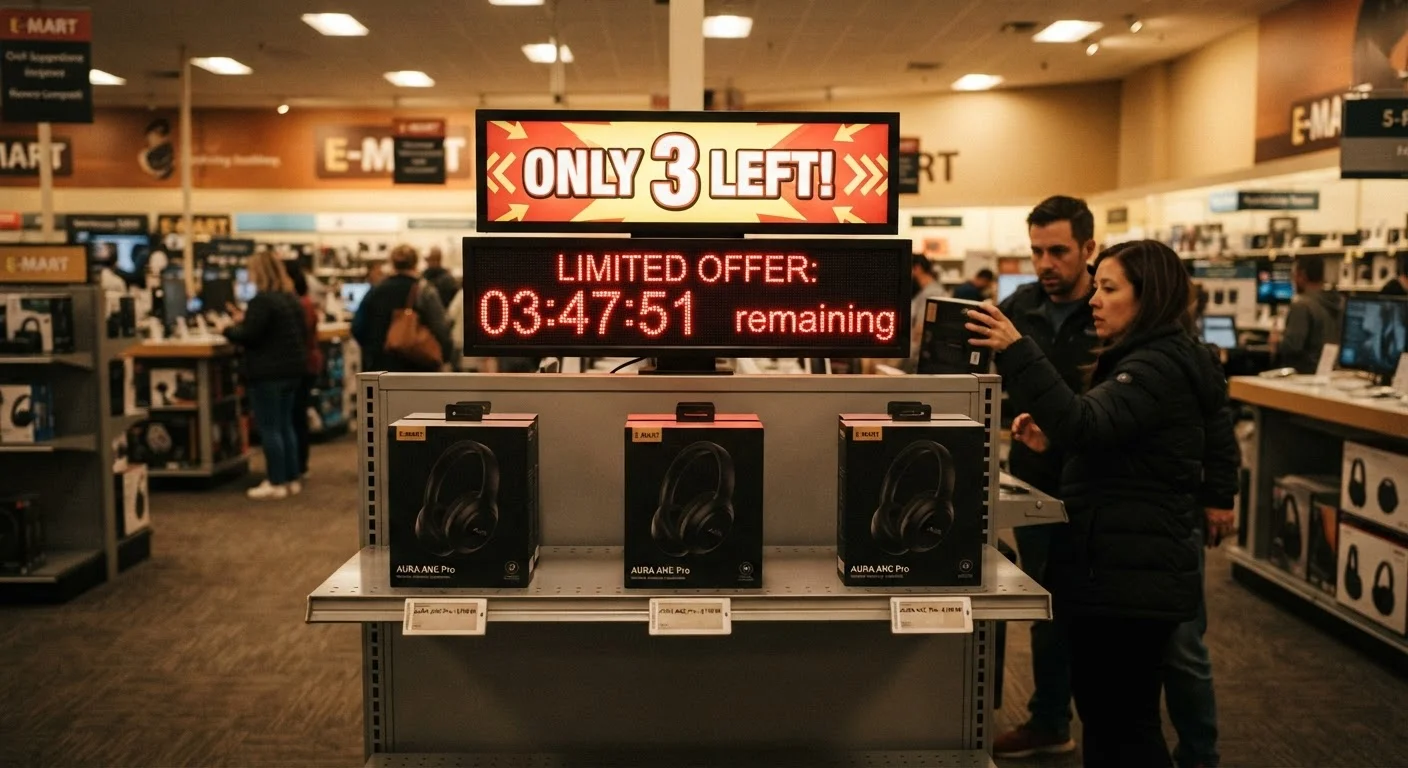
Walk through any retail site and you'll encounter them quickly: a timer counting down to zero, a badge reading 'Only 2 left!', a banner warning that a price expires at midnight. These are scarcity and urgency signals - and they are not incidental design elements. They are intentional psychological tools engineered to shorten the time between consideration and purchase.
Scarcity signals suggest limited supply. Urgency signals suggest limited time. Often they appear together. Both exploit the same underlying mechanism: the discomfort of potentially losing access to something, even something you weren't sure you wanted five minutes ago.
Understanding how these tactics work is not about becoming cynical about retail. It's about reclaiming your judgment at the moment it's most likely to be compressed. For a broader look at how these signals are built into the shopping experience, see how retailers construct urgency signals.
When Urgency Signals Are Legally Required to Be Accurate
In the United States, the Federal Trade Commission (FTC) has guidelines that prohibit deceptive pricing and promotional claims. Retailers cannot legally advertise a fake 'original price' to manufacture the appearance of a discount. However, enforcement is uneven and consumers rarely have visibility into whether a specific urgency claim meets the legal standard. Treating all urgency signals with some skepticism is a reasonable default.
The Psychology at Work: Why Pressure Overrides Deliberation
The mechanism behind these tactics is loss aversion - a behavioral tendency where the prospect of losing something feels more motivating than gaining something of equal value. When a timer is running, your brain reframes the decision: it's no longer 'should I buy this?' but 'am I going to let this slip away?'
This shift is significant. It moves you from an evaluative mindset to a reactive one. Deliberate reasoning about whether you need the item, whether the price is fair, and whether alternatives exist gets crowded out by the emotional urgency of not missing out.
These tactics interact closely with impulse buying behavior. If you want to understand the broader set of mental triggers that contribute to unplanned purchases, the psychology behind impulse buying covers that territory in detail.
60%+
Shoppers who report impulse purchases they later regretted
Multiple consumer surveys across retail contexts suggest a majority of shoppers have made at least one unplanned purchase they later questioned, with time-pressure environments among the most commonly cited contexts.
2x
Likelihood of purchase when scarcity messaging is present
Academic research in consumer psychology has found that scarcity cues can roughly double purchase likelihood compared to identical offers without scarcity framing, even when the product itself is unchanged.
Real vs. Manufactured Scarcity
Not all scarcity is fabricated. Genuine supply constraints exist - a manufacturer produces a fixed run, an event has a hard seat limit, a seasonal product isn't restocked. In those cases, acting on a scarcity signal can be rational, provided the item genuinely meets a need at a fair price.
The problem is that manufactured scarcity is indistinguishable on the surface from real scarcity. Retailers know this. Countdown timers that reset after expiring, stock warnings that remain unchanged for days, and 'limited edition' labels applied to large production runs all mimic genuine constraint without reflecting it.
A practical check: if you can return to the same product page 24 hours later and the timer has reset or the 'only 3 left' warning is unchanged, you've identified manufactured urgency. Price history tools - which track a product's pricing over time on major platforms - can also help you evaluate whether a 'sale' price represents a genuine reduction.
Use the 24-Hour Rule Before Acting
When you feel the pull of a time-pressure signal, bookmark the item and come back in 24 hours. If the deal has genuinely expired and the item is gone, that's useful information about real scarcity. If the same offer is still running - or the timer has reset - you've confirmed that the urgency was constructed. Either way, you've made a more deliberate decision.
A Framework for Deciding Under Pressure
When you feel the pull of a countdown or a low-stock warning, a short mental checklist can restore deliberate thinking:
- Would I want this at full price? If the answer is no, the discount is doing more work than the product itself - a signal worth noting.
- Have I verified the scarcity? Check whether the warning has been persistent or whether the timer resets. Look up the item's price history if the platform supports it.
- What's the realistic worst case if I wait? For most everyday purchases, the item will be available again. For genuinely time-sensitive items, weigh that honestly - without the retailer's framing inflating the stakes.
- Am I in a heightened emotional state? Holiday shopping, last-minute gift buying, and late-night browsing all elevate susceptibility. Recognize those contexts. Gift buying under pressure is a specific area where urgency tactics do significant damage to purchasing decisions.
The goal isn't to never act on a time-sensitive offer - it's to ensure the decision is yours, not the interface's.