

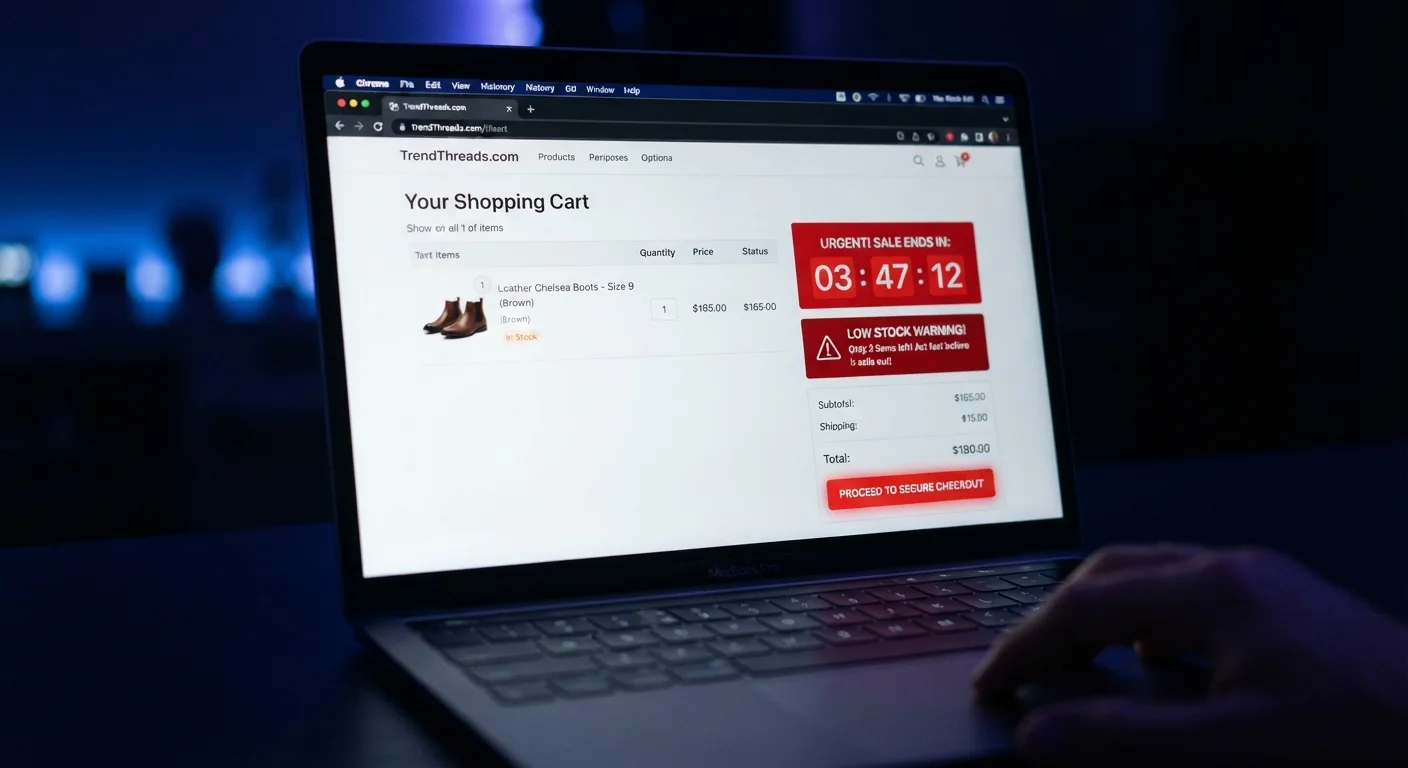
Key Takeaways
- Low-stock warnings and countdown timers are deliberate design choices, not neutral inventory disclosures.
- Urgency signals exploit loss aversion, a well-documented cognitive bias.
- Some scarcity claims are artificial - manufactured to create pressure rather than reflecting real supply.
- Pausing before acting on urgency signals is the most effective consumer countermeasure.
- Understanding these tactics doesn't eliminate their effect, but it meaningfully reduces it.
Scarcity and Urgency Signals
Scarcity and urgency signals are design elements retailers use to suggest that a product is running out or that a deal is about to expire. Common examples include "Only 3 left in stock," countdown timers, and "Selling fast" badges. These signals are intended to accelerate purchase decisions by triggering time pressure or fear of missing out.
In behavioral economics, this leverages loss aversion - the tendency for people to weight potential losses more heavily than equivalent gains - making inaction feel costlier than it objectively may be.
Where These Signals Show Up
Scarcity and urgency signals appear across virtually every major retail channel - e-commerce sites, mobile apps, email campaigns, and in-store displays. Online, the most common forms are stock-count warnings ("Only 2 left!"), countdown timers attached to sale prices, real-time activity indicators ("14 people viewing this right now"), and limited-availability labels like "Today only" or "Flash deal."
These elements are not accidental or informational afterthoughts. They are deliberate components of what user experience designers call persuasive design - interface choices engineered to guide behavior toward a specific action. Retailers invest significantly in A/B testing which wording, color, and placement of urgency signals drives the highest conversion rates.
This connects directly to other framing techniques covered in our guide to price anchoring and retail framing. Urgency signals don't change the actual value of a product - they change the emotional context in which you evaluate it.
Urgency Signals Aren't Inherently Deceptive
Retailers are generally permitted to use urgency and scarcity language as long as it isn't demonstrably false. The Federal Trade Commission (FTC) has guidance on deceptive advertising practices, but low-stock warnings occupy a gray area because retailers are not required to prove a specific inventory threshold triggered the alert. Consumers should treat these signals as design choices rather than verified facts.
The Psychology Behind the Pressure
The effectiveness of scarcity and urgency signals is grounded in two related psychological principles. The first is loss aversion: people tend to feel the pain of losing something more acutely than the pleasure of gaining something of equal value. A countdown timer reframes inaction as a potential loss - you're not just delaying a purchase, you're risking losing the deal.
The second principle is social proof. Indicators like "12 others have this in their cart" imply that many other people have already validated the decision. This can short-circuit independent evaluation, particularly when you're uncertain about whether a product or price is actually good.
Together, these mechanisms can push shoppers toward faster, less deliberate decisions. That's not a character flaw - it's a predictable response to how the brain processes risk and social information. For a deeper look at how time pressure shapes buying behavior specifically, see our article on how time-pressure tactics affect buying decisions.
“Scarcity cues work not because consumers are irrational, but because in many real-world contexts, scarcity genuinely signals quality and demand. Retailers are exploiting a heuristic that evolved to be useful.”
— Cialdini, R.B., Author of 'Influence: The Psychology of Persuasion'
When Scarcity Is Real - and When It Isn't
Not all scarcity signals are manufactured. Limited production runs, seasonal inventory, and high-demand product launches can create genuine supply constraints. In those situations, a low-stock warning serves a legitimate informational purpose.
The problem is that retailers are not required to disclose what threshold triggers a "low stock" label, and the same design element is commonly applied regardless of actual inventory levels. A warning that appears every time you visit a product page over several weeks is almost certainly a design default, not an accurate supply update.
60%+
Online shoppers who report urgency influences their pace
Multiple e-commerce usability studies have found that a majority of shoppers say time-pressure signals cause them to decide faster than they otherwise would.
~2x
Conversion lift typically attributed to scarcity messaging
Retail optimization case studies frequently cite conversion rate increases near double when low-stock or limited-time labels are added to product pages, though results vary by category and audience.
Practical ways to assess whether scarcity is genuine: check the product page on multiple visits over several days; look up the item on competing retail sites or the manufacturer's direct channel; and note whether the urgency language changes at all. Artificially scarce products tend to stay "almost gone" indefinitely.
Persistent deal fatigue is one side effect of overused urgency tactics - our article on why constant promotions create deal fatigue explains how shoppers gradually recalibrate when urgency signals lose their credibility.
How to Shop More Deliberately
Awareness is the first and most reliable tool. Research consistently shows that simply knowing a tactic is being used reduces - though doesn't eliminate - its influence on decision-making. If you recognize a countdown timer as a design element rather than a neutral clock, you're already in a better position to evaluate it clearly.
A few practical habits help:
- Pause before acting. Even a 60-second delay is enough to engage more deliberate thinking rather than reactive purchasing.
- Ask whether you'd buy it without the timer. If the answer is no, the urgency signal - not the product - is doing the work.
- Research the regular price. Urgency is most effective when you don't have a clear baseline for what something normally costs.
- Watch for repeating timers. A countdown that resets after it expires is not measuring a real deadline.
For a broader approach to staying informed without being pressured by retail trends, see our piece on staying aware of retail trends without being swayed by them. And if flash sales are where you most often feel this pressure, understanding how flash sales are structured can help you approach them with a clearer head.
Use a Wish List as a Cooling-Off Tool
Instead of adding an item to your cart when you feel urgency pressure, add it to a wish list or save it in a browser tab and return the next day. If the "last few" warning is still there - or the item is still available at the same price - you'll have real information about whether the scarcity was genuine. This single habit can significantly reduce impulse purchases driven by artificial urgency.