

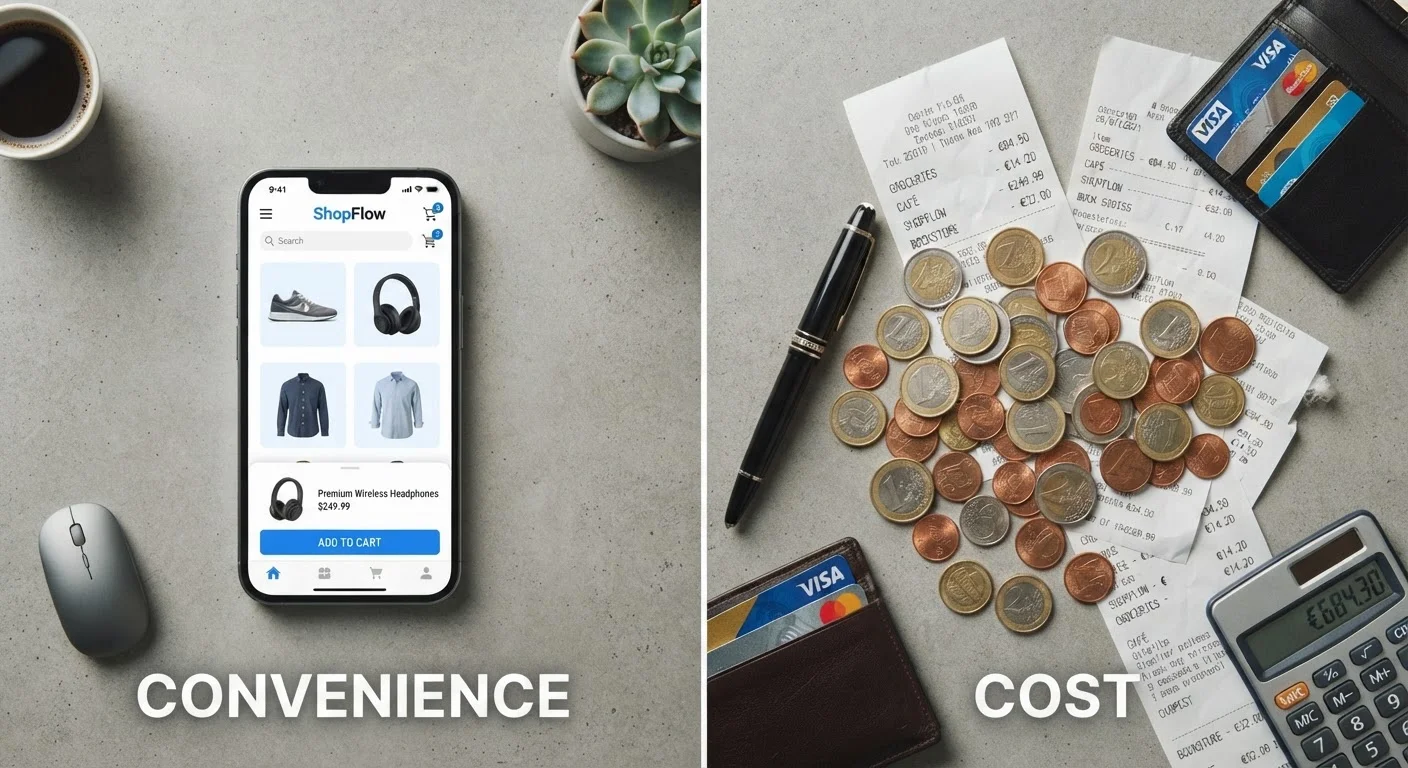
Key Takeaways
- Convenience features like same-day delivery and one-click checkout often come with measurable price premiums.
- The cost-vs-convenience tradeoff varies significantly by product category and household budget.
- Retailers design convenience to encourage spending - awareness of that dynamic is itself useful.
- Some cost-saving habits require little effort once built into a routine.
- Neither prioritizing convenience nor cost exclusively is the right approach for every shopper.
Saves meaningful time on routine purchases
For working households, the hours saved by delivery or one-click reordering represent a real resource. Time has economic value, and convenience can legitimately return it.
Reduces decision fatigue on low-stakes items
Auto-replenishment for household staples eliminates repetitive decisions, which research suggests has psychological benefits for people managing many competing demands.
Enables access for mobility-limited shoppers
Delivery and digital retail meaningfully expand purchasing access for consumers who cannot easily reach physical stores, a population that is often underserved by cost-focused alternatives.
Faster response to urgent needs
Same-day fulfillment addresses genuine situations - a missing ingredient, a broken appliance part - where the alternative to a convenience premium is a disrupted day.
Item-level markups often invisible to shoppers
Prices on convenience platforms frequently exceed in-store equivalents before fees are applied. Shoppers comparing only the delivery fee miss the total cost differential.
Encourages impulse and unplanned spending
Streamlined checkout removes the pauses that prompt reconsideration. One-click purchasing and saved payment methods reduce the friction that can catch low-value spending.
Subscription costs add up across services
Many convenience tiers require ongoing subscriptions. Consumers enrolled in multiple services often underestimate their total monthly commitment to access those benefits.
Behavioral data collection is heavier on platforms
Convenience-optimized platforms gather extensive purchase and browsing data to drive personalization. That data exchange is a real, if non-financial, cost of the service.
Reduces price awareness over time
Shoppers who consistently default to convenience channels lose the reference points that help them recognize when they're paying above-market prices for commonly purchased items.
Our Verdict
The convenience-vs-cost tension is real, and neither side is automatically the right answer. Shoppers who understand when convenience is worth paying for - and when it quietly inflates a bill - are better positioned to make choices that reflect their actual priorities. Building a few deliberate habits around pricing awareness can close the gap between what you spend and what you intended to spend.
Consumers who want to spend more intentionally and understand the structural forces shaping what they pay at checkout.
The Core Tension Hasn't Gone Away
American shoppers have always faced a version of this tradeoff: pay more for ease, or invest time to pay less. What's changed is the scale and sophistication of how that choice is presented. Subscription delivery services, app-exclusive pricing, and algorithm-driven recommendations have made convenience both more seamless and more profitable - for retailers.
The result is a shopping environment where the path of least resistance tends to be the path of highest spend. That's not accidental. Retailers invest heavily in reducing friction because lower friction correlates with higher cart values and repeat purchasing. Understanding that dynamic doesn't require cynicism - it just requires honesty about what you're trading when you tap "buy now."
For a broader look at how the retail experience has evolved to shape these choices, see how retail experiences have changed in the last decade.
What Convenience Actually Costs
Convenience charges take forms that aren't always labeled as such. Same-day or next-day delivery fees are visible - but the markup on items sold through premium fulfillment services is often less so. Studies tracking grocery delivery platforms have found that individual item prices are frequently higher than in-store shelf prices, independent of any delivery fee.
20-30%
Typical grocery delivery cost premium
Consumer advocacy research has found grocery delivery can cost 20-30% more than an equivalent in-store shop when markups, fees, and tips are combined.
73%
Shoppers citing convenience as a top purchase driver
Surveys conducted by the National Retail Federation have consistently found convenience ranking among the top factors influencing where US consumers choose to shop.
In apparel and electronics, "convenience" often shows up as curated discovery - algorithms that surface items you're statistically likely to buy, reducing the search time but also reducing your exposure to lower-priced alternatives. In grocery, it appears as pre-assembled meal kits that trade ingredient sourcing effort for a significant per-serving cost premium over buying components individually.
None of this means convenience is a bad deal. For households where time is the binding constraint, paying for it may be entirely rational. The issue is when convenience costs accumulate invisibly across many small decisions.
Pros and Cons of Prioritizing Convenience
Convenience-first shopping has genuine advantages - particularly for time-pressed consumers - but the financial and behavioral costs are worth naming clearly.
Saves meaningful time on routine purchases
For working households, the hours saved by delivery or one-click reordering represent a real resource. Time has economic value, and convenience can legitimately return it.
Reduces decision fatigue on low-stakes items
Auto-replenishment for household staples eliminates repetitive decisions, which research suggests has psychological benefits for people managing many competing demands.
Enables access for mobility-limited shoppers
Delivery and digital retail meaningfully expand purchasing access for consumers who cannot easily reach physical stores, a population that is often underserved by cost-focused alternatives.
Faster response to urgent needs
Same-day fulfillment addresses genuine situations - a missing ingredient, a broken appliance part - where the alternative to a convenience premium is a disrupted day.
Item-level markups often invisible to shoppers
Prices on convenience platforms frequently exceed in-store equivalents before fees are applied. Shoppers comparing only the delivery fee miss the total cost differential.
Encourages impulse and unplanned spending
Streamlined checkout removes the pauses that prompt reconsideration. One-click purchasing and saved payment methods reduce the friction that can catch low-value spending.
Subscription costs add up across services
Many convenience tiers require ongoing subscriptions. Consumers enrolled in multiple services often underestimate their total monthly commitment to access those benefits.
Behavioral data collection is heavier on platforms
Convenience-optimized platforms gather extensive purchase and browsing data to drive personalization. That data exchange is a real, if non-financial, cost of the service.
Reduces price awareness over time
Shoppers who consistently default to convenience channels lose the reference points that help them recognize when they're paying above-market prices for commonly purchased items.
The data privacy dimension is also worth noting. Convenient platforms tend to collect more behavioral data than traditional retail interactions. For more on what that means practically, see what retailers collect and why.
Category-by-Category: Where the Tradeoff Hits Hardest
Groceries: The convenience premium is most measurable here. Delivery markups, service fees, and tips can add 20-30% to a grocery bill compared to an in-store visit, according to consumer advocacy research. For staples bought weekly, that compounds quickly.
Electronics: Price parity between online and in-store has tightened significantly, meaning convenience often costs less in this category than it once did. The main cost risk is impulse purchasing enabled by frictionless checkout.
Apparel: Free returns have made online clothing purchases more convenient, but come with environmental and logistical costs that are increasingly being passed back to consumers through restocking fees or modified return windows.
Home goods: Large items often carry delivery or installation fees that dwarf the convenience benefit. Comparing total delivered cost, not sticker price, matters most here.
Return Policies Are Changing
Free and easy returns were a major driver of online apparel adoption, but that model is shifting. A growing number of retailers have introduced return fees or shortened return windows to offset logistics costs. Before purchasing clothing or footwear online, checking the current return terms - not the policy you remember from a previous order - is a practical step worth taking.
For guidance on matching the channel to what you're buying, this breakdown of online vs. in-store by purchase type is a practical starting point.
Spending More Intentionally Without Overhauling Your Life
Closing the gap between convenience spending and value doesn't require aggressive coupon habits or hours of price research. A few durable behaviors - checking the unit price on staples, using a browser extension that flags price history on electronics, or setting a 24-hour pause on non-urgent online carts - can reduce low-awareness spending without adding real friction to your day.
Smart deal-hunting habits worth building into your routine covers several of these approaches in more depth. The underlying principle: the goal isn't to optimize every transaction, but to be deliberate about which convenience costs you're consciously choosing to pay.
Shoppers who also want to understand how their preferences have shifted over time - and what's driving those changes industry-wide - will find useful context in how consumer preferences between in-store and online have shifted.