

Key Takeaways
- Retail has shifted from purely transactional to a blend of digital and physical experiences.
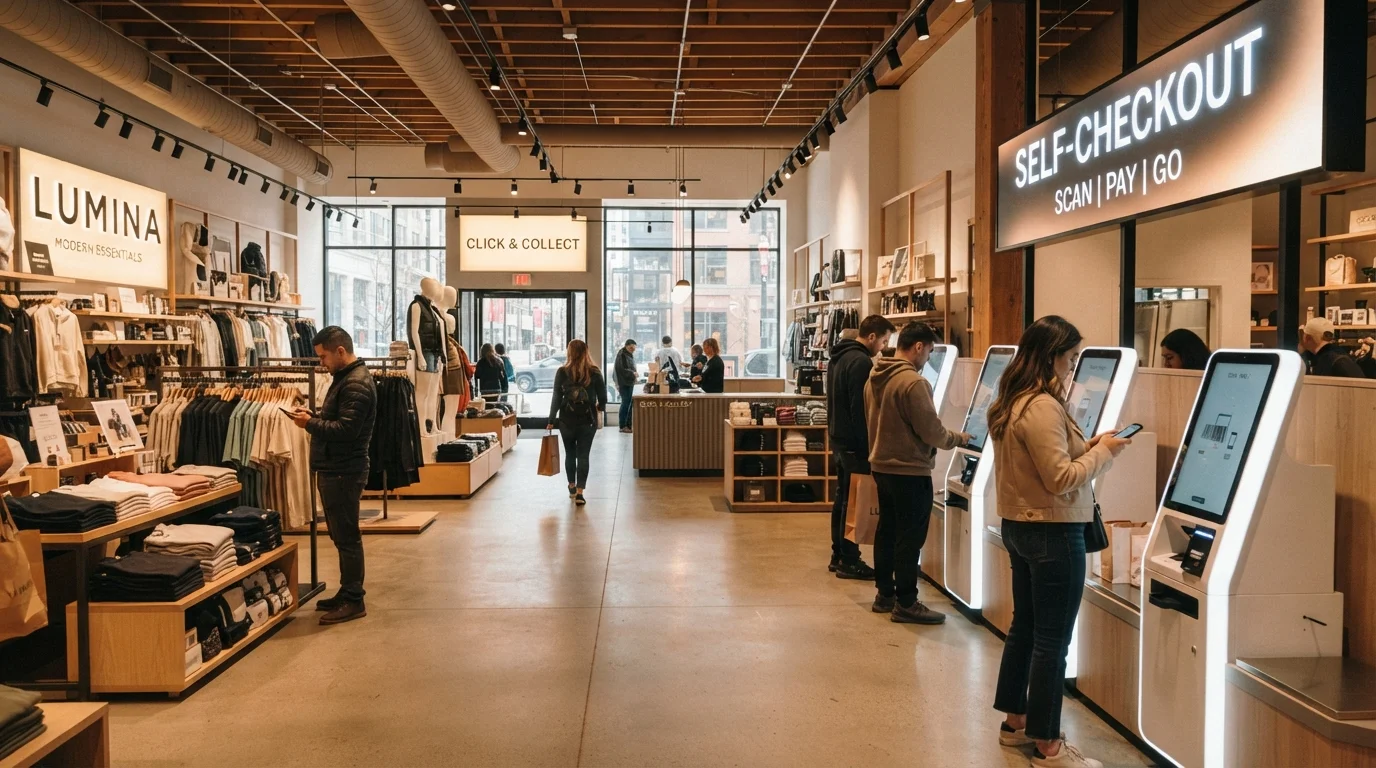
- Contactless payment and self-checkout have become standard, not experimental, features.
- Experiential stores use events and services to drive foot traffic in an e-commerce era.
- Consumers now expect real-time inventory, delivery tracking, and flexible return policies.
- Despite digital growth, physical retail still accounts for the majority of US retail sales.
The Starting Point: Retail a Decade Ago
Ten years ago, the average American shopping trip was still largely analog in feel. Cashiers scanned every item. Loyalty programs lived on plastic keychain cards. Store associates looked up inventory on back-office terminals - if they could look it up at all. E-commerce existed, but for most categories it was a secondary channel, not the default.
The smartphone was already in most pockets, yet retailers had not yet restructured their operations around it. Apps were novelties. Mobile payments were a curiosity. Same-day delivery was an expensive pilot program, not a standard expectation. Understanding where retail stood then makes the pace of change since look genuinely remarkable.
~85%
Share of US retail sales still occurring in physical stores
Despite e-commerce growth, the U.S. Census Bureau's retail trade data consistently shows the majority of sales occurring in brick-and-mortar locations.
3x
Growth in BOPIS adoption among major US retailers
Industry research firms tracking omnichannel capabilities have documented a dramatic expansion of buy-online-pickup-in-store programs across retail categories since the early 2010s.
~$1.1T
US e-commerce sales (annual, recent estimates)
The U.S. Census Bureau's annual retail e-commerce estimates have tracked consistent year-over-year growth across the past decade.
The Rise of Omnichannel Shopping
The single biggest structural shift has been the collapse of the wall between online and in-store. Retailers who once ran digital and physical operations as separate businesses were forced - first by competition, then by consumer expectation - to unify them. "Buy online, pick up in store" (BOPIS) moved from a differentiator to a baseline requirement. Curbside pickup, accelerated dramatically during the pandemic years, became a permanent fixture for grocers and big-box chains alike.
This integration changed how stores function physically. Back-stock areas were repurposed as mini-fulfillment hubs. Associates took on picking and packing duties alongside floor service. For consumers, the practical benefit is real: the ability to check local inventory from a phone before making the drive is something shoppers now take for granted, even though it required significant infrastructure investment to deliver. See how these patterns compare in our look at how consumer preferences have shifted between in-store and online shopping.
Checkout Redesigns and Frictionless Payment
The checkout lane - once a reliable source of retail frustration - has been redesigned repeatedly over the past decade. Self-checkout expanded from grocery to nearly every retail format. Contactless payment via NFC (near-field communication) technology went from a bank pilot to an everyday expectation. The infrastructure behind this shift is explored in more depth in our piece on tech trends that quietly became infrastructure.
When evaluating a retailer's checkout experience, look beyond speed - consider whether the system handles exceptions (price overrides, produce codes, returns) gracefully, because that's where friction actually builds.
Self-checkout satisfaction research consistently shows that the largest driver of negative experience is not wait time but the inability to resolve errors without staff intervention.
If a retailer offers app-based checkout, try it once on a small basket before relying on it for a major trip - app reliability and store Wi-Fi quality vary significantly by location.
Consumer reviews of scan-and-go programs frequently cite connectivity issues and app crashes as the primary barrier to repeat use.
Mobile point-of-sale (mPOS) systems - handheld devices that let associates complete a transaction anywhere on the floor - reduced the need for fixed register banks in some formats. App-based checkout, where a shopper scans items on their own phone and pays without interacting with any terminal, has been piloted at scale by several major chains, though adoption rates vary significantly by shopper demographic.
Self-Checkout Shrinkage Policies Are Tightening
Several large US retailers have publicly reduced their self-checkout footprint or added weight-sensor verification in response to shrinkage concerns. Shoppers should be aware that audit and receipt-check practices have become more common at self-checkout exits. Honest scanning is not just ethical - in many states, misscanning at self-checkout carries the same legal exposure as traditional shoplifting.
Experiential Retail: When Stores Became Destinations
Facing real competition from e-commerce, many physical retailers responded not by shrinking but by changing the purpose of the store. The term "experiential retail" - meaning stores designed around an activity or service rather than pure product selection - moved from a retail consultant buzzword to an observable design strategy.
Format experiments included in-store coffee bars, fitness classes, repair stations, and product demonstration areas that had nothing to do with moving inventory by the unit. The underlying logic is straightforward: a consumer who comes in for an event or a service is exposed to merchandise in a lower-pressure, more browsable environment. Whether the model drives sufficient revenue to justify the square footage is a calculation retailers continue to debate, but the experiential direction has clearly influenced how new store formats are designed. The tension between the cost of these experiences and everyday consumer expectations is explored in our piece on convenience vs. cost tradeoffs shaping how Americans shop.
Supply Chain Visibility and the Informed Consumer
Consumers know more about where their products come from than they did a decade ago - not necessarily because retailers volunteered the information, but because supply chain disruptions made origin and availability visible in uncomfortable ways. Out-of-stock notifications, shipping delay alerts, and real-time tracking updates have trained shoppers to expect transparency at every stage of a purchase.
This visibility has also changed expectations around returns. Easy, no-questions-asked return policies, once a competitive differentiator, are now close to table stakes in most categories. Retailers have responded with extended windows, in-store drop-off for online purchases, and third-party return logistics partnerships - all of which add operational cost that gets priced into the broader retail ecosystem.
Return Policies Are Not Universally Standardized
While generous return windows have become more common, they vary significantly by retailer, category, and whether the item was purchased in-store versus online. Marketplace purchases from third-party sellers on major platforms often fall under seller-specific policies rather than the platform's own standards. Always check the specific return terms before purchasing, especially for higher-priced items.
What Hasn't Changed - and Why It Matters
For all the transformation, some fundamentals remain stubbornly durable. Physical retail still represents the majority of total US retail sales by dollar volume, even accounting for substantial e-commerce growth. Consumers still go to stores for immediacy, tactile evaluation, and, for many categories, the assurance of seeing something before buying it.
Price sensitivity has not diminished. Convenience and ease matter enormously, but most shoppers still weigh cost carefully - a dynamic our analysis of convenience versus cost tradeoffs covers in detail. What has changed is the bar for what "good enough" looks like. Retailers who once competed on selection alone now compete on speed, flexibility, experience, and transparency simultaneously. That is a meaningfully harder operating environment - and one that continues to evolve as consumer expectations compound year over year.
“The store of the future isn't defined by what it sells - it's defined by what it makes possible. The transaction is just one part of a much longer customer relationship.”
— Robin Lewis, Retail industry analyst and co-author of 'The New Rules of Retail'