

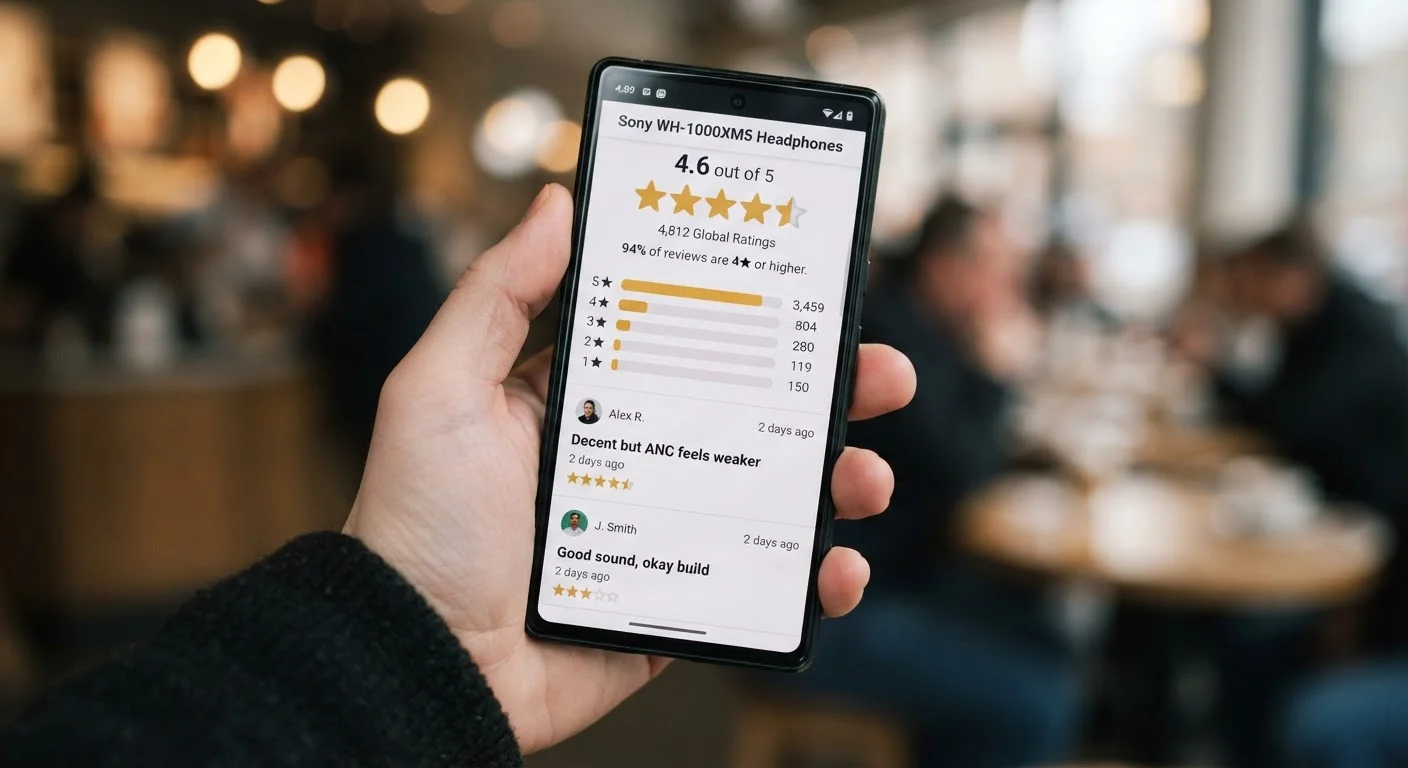
Key Takeaways
- A higher review count signals popularity, not necessarily product quality or reliability.
- Average star ratings are distorted by selection bias, incentivized reviews, and rating manipulation.
- A 4.2-star product with 800 honest reviews often tells you more than a 4.9-star product with 30.
- Recency, reviewer context, and written content matter more than the aggregate score alone.
- Platform rating systems vary widely - a five-star scale on one site isn't equivalent to another's.
Why We Over-Trust Aggregate Ratings
Online ratings have become shorthand for quality - a mental shortcut that saves time when browsing hundreds of options. The problem is that the number we glance at (an aggregate star score) compresses a lot of messy, contradictory information into a single figure that can obscure more than it reveals.
Rating systems were designed to surface useful signal from crowd wisdom. Under ideal conditions, they can. But in practice, they're shaped by who chooses to leave a review, how the platform solicits and displays feedback, and whether the review pool has been manipulated. Understanding these forces doesn't mean ratings are worthless - it means knowing how to read them accurately.
Myth
More reviews always means a product is better quality.
Fact
Review count reflects sales volume and market exposure, not product quality.
A product with thousands of reviews simply means many people bought it - often because it was algorithmically promoted, heavily discounted, or available from a dominant seller. Mass-market items accumulate reviews faster than niche or newer products that may actually outperform them. Volume is a proxy for reach, not excellence.
For a fuller picture, look at the distribution of ratings (the breakdown chart, not just the average), and prioritize verified-purchase reviews with detailed written feedback over bare star taps.
Myth
A 5-star average means nearly everyone loved the product.
Fact
Near-perfect averages are statistically suspicious and often reflect manipulation or a skewed reviewer pool.
Genuinely diverse consumer groups rarely agree perfectly. A 4.9 or 5.0 average across hundreds of reviews frequently indicates one of three things: early reviews were disproportionately from enthusiastic fans, the seller used incentivized or solicited reviews, or low-star reviews were suppressed or removed.
Research on rating distributions consistently shows a J-shaped curve - a spike of 5-star reviews and another smaller spike at 1-star - because moderate-experience buyers rarely bother to review at all. An unusually smooth, high average should raise your skepticism, not lower it. Our companion piece on evaluating user reviews without being misled explains what a healthy distribution looks like.
Myth
Star ratings mean the same thing across different platforms.
Fact
Rating scales, review policies, and verification standards differ substantially between platforms.
A 4.2 on one retailer is not equivalent to a 4.2 on another. Some platforms allow unverified reviews, others restrict them to confirmed buyers. Some weight recent reviews more heavily; others use lifetime averages. Review moderation practices vary - one platform may aggressively remove suspected fakes while another leaves them in place.
This context gap is especially relevant when comparing entertainment or media ratings. A critic aggregator like Rotten Tomatoes uses a binary fresh/rotten threshold rather than a weighted average - meaning a 90% score tells you most critics liked it, but says nothing about how much. See why Rotten Tomatoes scores don't always reflect your experience for how that system specifically works.
Myth
If a product has a lot of negative reviews, it's a bad product.
Fact
Negative reviews reflect a mix of product issues, user error, shipping problems, and unmet expectations - not all of which are the product's fault.
One-star reviews frequently cite issues outside the product itself: delayed delivery, damaged packaging, a seller misrepresenting the item, or a mismatch between what the buyer expected and what was actually described. Reading the content of negative reviews matters more than counting them.
Look for patterns: if 40 of 50 negative reviews mention the same specific flaw, that's actionable information. If they're scattered complaints about logistics and personal preference, the product may be perfectly adequate for your use case.
Myth
Reviewer credentials don't matter - all opinions count equally.
Fact
A review's value depends heavily on whether the reviewer's context matches yours.
A professional contractor reviewing a power tool and a first-time DIYer reviewing the same tool are providing genuinely different information - and both are useful, but for different audiences. Neither is objectively more valid, but the relevance to you depends on your own knowledge level and intended use.
This same logic applies well beyond shopping. The gap between professional critics and general audiences is a documented phenomenon in entertainment - explored in detail in our piece on the difference between a film critic and a movie reviewer. When reading any review, ask: does this person's situation resemble mine?
What Actually Makes a Rating Trustworthy
Trustworthy ratings share a few observable characteristics. Look for a realistic score distribution - not just the average, but the full breakdown. Genuine products typically show a range of 1- through 5-star ratings, with the bulk clustering in the 3-5 range and a meaningful tail of lower scores.
42%
Of online reviews estimated as potentially unreliable
A 2023 analysis by Fakespot, a review-analysis service, estimated that a large share of reviews across major e-commerce platforms show signals of inauthenticity, including unusual posting patterns and unverified purchases.
4.2 vs 4.9
Score that often reflects more honest feedback
Consumer behavior researchers have noted that near-perfect scores on high-volume products are statistically less likely to represent genuine diverse opinion than moderately high scores with a wider distribution of feedback.
Recency matters too. A product that earned strong reviews two years ago may have since changed in manufacturing quality, software support, or packaging. Filter for recent reviews when a platform allows it, and check whether the score has shifted over time.
Written content in reviews is far more valuable than the star score alone. Detailed, specific feedback - mentioning particular features, describing real use cases, noting dimensions or performance under specific conditions - is harder to fake and more useful than a five-star tap with no comment. For a structured approach to filtering useful signal from noise, see our guide on how to evaluate user reviews without being misled.
Finally, context scales across categories. Just as a high megapixel count doesn't automatically mean a better camera (explored in the megapixel myth), a high star rating doesn't automatically mean a better product. Both are simplified metrics that compress complex performance into a single number.
Incentivized Reviews Skew Averages Upward
When sellers offer discounts, free products, or other perks in exchange for reviews, recipients tend to leave higher ratings - even when required disclosures are present. The FTC requires disclosure of material incentives, but enforcement is inconsistent and disclosures are easy to miss. If a product's reviews are overwhelmingly positive with minimal variation, it's worth checking whether they carry incentive disclosures or show other signs of coordination.