

Key Takeaways
- Fake reviews often share identifiable language patterns, posting timing, and reviewer history red flags.
- A suspiciously high star average with few detailed reviews is a common warning signal.
- Cross-referencing reviews across multiple platforms reduces your exposure to coordinated manipulation.
- Third-party review analysis tools can surface statistical anomalies invisible to the naked eye.
- Verified purchase labels and reviewer profiles add context but are not foolproof indicators of authenticity.
What you will need
Why Fake Reviews Are a Persistent Problem
Inauthentic reviews are not a fringe issue. Researchers, regulators, and platforms themselves have documented the scale of the problem across major retail sites. The incentive structure is straightforward: higher ratings drive more visibility in search algorithms, and more visibility drives more sales. That dynamic creates strong pressure - for some sellers - to game the system.
Tactics range from soliciting reviews in exchange for refunds or free products, to using third-party services that generate bulk submissions, to review hijacking, where a high-rated product listing is swapped out for an entirely different item. Understanding that these schemes exist - and that they are specifically designed to look credible - is the first step toward reading reviews more critically.
For a deeper look at how ratings can mislead even without outright fraud, see our article on common rating misconceptions.
Review analysis browser extension
Automatically scans review distributions on retail pages to flag statistical anomalies and suspicious patterns.
Retailer's review filter controls
Lets you sort and filter reviews by star rating, recency, or verified status to isolate patterns manually.
Search engine
Used to cross-reference a product or seller name against reviews on third-party sites and forums.
How to Spot Fake Reviews: Step-by-Step
The following process works best when you apply multiple checks in sequence rather than relying on any single indicator. Think of it as building a case: each signal either strengthens or weakens your confidence in the review set as a whole.
What you will need
Check the overall rating distribution
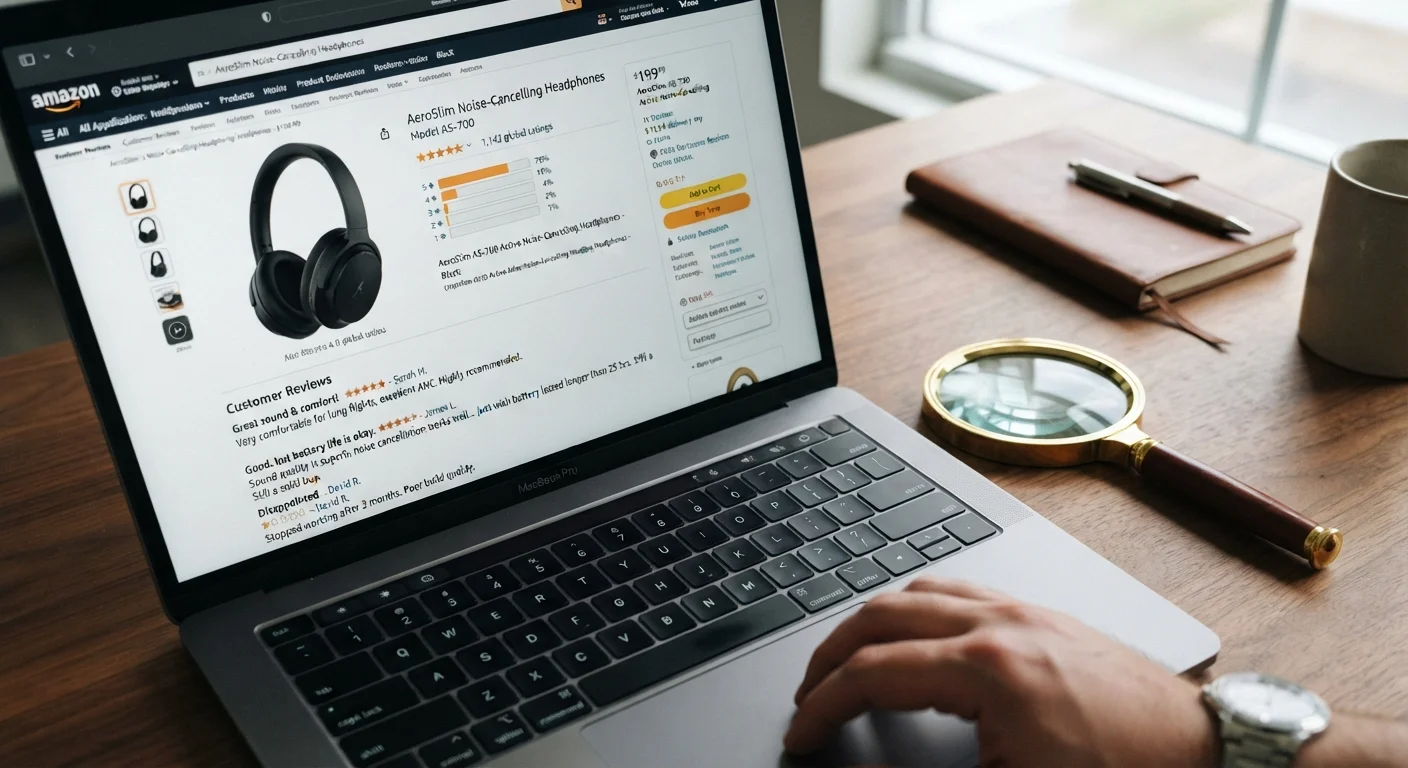
Pull up the star rating breakdown - most platforms display a histogram showing how many reviews fall at each star level. A legitimate product with hundreds of reviews typically shows a natural distribution: a mix of ratings with a concentration somewhere in the middle-to-upper range. Be skeptical of products where 90% or more of reviews are 5-star with very few 3- or 4-star entries. This J-curve or extreme skew pattern can indicate coordinated positive review activity.
Also note the total review count relative to how long the product has been listed. A product launched recently with thousands of reviews deserves closer scrutiny.
Read for specificity and language patterns
Scroll through a sample of reviews - particularly the 5-star ones - and read them carefully. Genuine reviews tend to be specific: they mention how long the buyer has used the product, what they used it for, and what minor issues they noticed. Fake reviews frequently rely on vague, marketing-style language ('Amazing product! Highly recommend!') with no practical detail.
Watch for repeated phrases across multiple reviews. If several reviewers use nearly identical wording, it may indicate templated or coordinated submissions. Also look for reviews that describe a different product category entirely - a sign of review merging, where an existing high-rated listing is repurposed for a new product.
Examine reviewer profiles
Click through to the profiles of several reviewers, particularly those leaving glowing 5-star assessments. Look for accounts that have only reviewed one or two products, accounts created very recently, or accounts whose review history consists entirely of 5-star ratings across unrelated product categories. These patterns are consistent with accounts created specifically for fake review activity.
Conversely, a reviewer with a long, varied history of both positive and critical reviews across different product types is more likely to represent a genuine consumer.
Check posting dates for suspicious clustering
Sort reviews by date and look for unnatural bursts. A product receiving 50 reviews in a single week after months of sparse activity warrants skepticism. Legitimate review accumulation tends to be gradual and correlates with sales volume. Sudden spikes - particularly before a product appears in search rankings or during a competitive period - can indicate an organized campaign to artificially boost credibility.
Cross-reference on independent platforms
Search the product name alongside terms like 'review,' 'experience,' or 'problem' in a general search engine. Look for discussion on independent forums, community sites, or video platforms where users are less likely to have been incentivized. Real consumer conversations tend to surface both enthusiasm and frustration in roughly realistic proportions.
This approach also complements the broader research habits covered in our guide to building an honest information diet - verifying claims across diverse, independent sources before committing to a purchase.
Run the page through a review analysis tool
Several independent tools and browser extensions analyze review distributions and flag anomalies automatically. These tools can detect patterns like reviewer overlap, unnatural rating spikes, and statistically improbable score distributions - signals that are difficult to spot manually when reviewing hundreds of entries. No tool is infallible, but they add a useful quantitative layer to your qualitative reading.
Use Free Review Analysis Tools
Browser extensions and independent websites exist specifically to flag statistical anomalies in review distributions - such as sudden spikes in 5-star ratings or unnatural reviewer overlap. These tools won't catch every fake review, but they surface patterns that are tedious to spot manually and can quickly shift your confidence level before a purchase.
Verified Purchase Labels Have Limits
A 'Verified Purchase' badge confirms a transaction occurred, but it doesn't confirm the reviewer wrote the text themselves or that they weren't incentivized to leave positive feedback. Some review manipulation schemes involve actual purchases specifically to acquire that badge. Use it as one signal, not a seal of authenticity.
No Single Signal Is Definitive
One generic-sounding review or a newly created reviewer profile doesn't confirm fraud on its own. Fake review detection works best when you stack multiple signals together. Treat each indicator as one data point in a broader picture, not as conclusive proof.
After You've Evaluated the Reviews
Even a thoroughly vetted review set is just one input. Genuine reviews can still reflect a skewed sample - early adopters, enthusiasts, or people with strong opinions in either direction tend to leave reviews at higher rates than satisfied mainstream buyers. That sampling bias exists independently of fraud.
Pair your review analysis with other verification habits. If you're buying from an unfamiliar retailer, our guide to verifying unknown sellers walks through how to assess legitimacy before completing an order. And if you want to understand how platform algorithms influence which reviews and products you see in the first place, the piece on how recommendation algorithms shape what you see online adds useful context.
The goal isn't to distrust all reviews - it's to read them with enough awareness that manufactured consensus doesn't substitute for genuine consumer experience.