

Key Takeaways
- Spec numbers rarely tell the full story - real-world performance depends heavily on software and integration.
- Ecosystem lock-in is one of the most consequential decisions a consumer makes when buying any device.
- Marketing language is designed to create desire, not communicate objective value.
- Privacy trade-offs are built into most connected devices and deserve deliberate consideration.
- A cohesive, modest tech setup usually outperforms a collection of incompatible flagship devices.
What 'Consumer Electronics' Actually Covers
Consumer electronics is a broad category that spans any electronic device designed for everyday personal use - smartphones, laptops, tablets, televisions, wireless headphones, smart speakers, fitness trackers, e-readers, gaming consoles, and increasingly, smart home hardware. The term is less about the device type and more about the intended audience: individuals and households rather than industrial or enterprise operations.
Understanding this landscape starts with recognizing that these devices fall into a few functional clusters. Personal computing includes laptops and tablets. Communication and connectivity covers smartphones and wearables. Audio and visual entertainment spans TVs, speakers, and headphones. Smart home encompasses everything from connected plugs to thermostats and doorbells - a category explained in depth in our guide to smart home devices for first-time users.
Knowing which cluster a device belongs to helps set the right expectations before you ever read a single review.
5.4B
Smartphone users worldwide
According to GSMA Intelligence data, more than two-thirds of the global population uses a smartphone, making it the most widely adopted consumer electronic device in history.
~3 years
Average smartphone replacement cycle
Consumer research from CIRP and similar firms consistently shows US consumers hold smartphones for roughly three years before replacing them, up from under two years a decade ago.
10+
Connected devices per US household
Deloitte's Digital Media Trends research has reported that the average US household connects more than ten devices to home Wi-Fi networks, a number that continues to grow.
How to Read a Spec Sheet Without Getting Lost
Spec sheets are written for marketers as much as consumers. A few principles help decode them honestly.
- Processor speed and core count matter for demanding tasks like video editing or gaming, but for everyday browsing and streaming, mid-range chips perform nearly identically to flagship ones under typical loads.
- RAM (Random Access Memory) affects how many tasks a device handles simultaneously. More is generally better, but past a threshold that varies by device type, the gains become imperceptible in daily use.
- Storage is straightforward - focus on how much you actually use, not the maximum a device supports.
- Display resolution is often overstated. The human eye stops distinguishing additional pixels at normal viewing distances, making ultra-high-resolution screens on small devices a marketing point more than a usability one.
- Battery life figures in spec sheets are measured under controlled, often optimistic conditions. Treat manufacturer claims as a ceiling, not a guarantee.
Before trusting any spec comparison, ask whether the two devices were tested under identical conditions - processor benchmarks, for example, behave very differently under sustained load versus short bursts.
Manufacturers and reviewers often use peak-performance figures that don't reflect the sustained workloads real users place on devices, leading to misleading comparisons.
Check when the manufacturer last updated a device's operating system before buying - a device with a short update history is a security liability, not a bargain.
Security patches address newly discovered vulnerabilities. Devices that stop receiving them become progressively more exposed over time, regardless of their hardware quality.
The most reliable spec to trust is the one that matches your specific, most demanding use case - not the headline number on the box.
Software Ecosystems: Why They Matter More Than Specs
The ecosystem a device belongs to shapes your experience long after the hardware novelty wears off. An ecosystem is the network of software, services, and compatible devices a platform ties together. When you commit to one, you implicitly accept its update policies, data practices, app availability, and cross-device behavior.
Key questions to ask before buying into any ecosystem include: How long does the manufacturer commit to software updates? Can your data move freely if you switch platforms later? Do the devices you already own integrate meaningfully with this new one?
“People don't want to buy a quarter-inch drill. They want a quarter-inch hole. The same logic applies to consumer electronics - the device is never the point; what it enables is.”
— Theodore Levitt, Harvard Business School professor and author of 'Marketing Myopia'
Ecosystem decisions often feel invisible until they aren't - when a device stops receiving security patches, or when a peripheral works seamlessly with one platform but barely at all with another. For consumers navigating the broader world of digital tools and apps, our Digital guidance hub covers practical strategies for getting the most from connected technology.
Evaluating Real-World Value Over Marketing Claims
Marketing in consumer electronics is sophisticated. Terms like "revolutionary," "AI-powered," and "pro-grade" carry no standardized definition. They are signals of positioning, not objective benchmarks.
A more reliable evaluation framework centers on three questions:
- Does it solve a problem I actually have? Gadgets that address a genuine friction point in your daily routine deliver compounding value. Those bought for novelty often get abandoned.
- What does the ownership experience look like over two to three years? Repairability, software support duration, and availability of accessories affect long-term satisfaction more than launch-day features.
- What am I giving up by choosing this device over alternatives? Every choice has trade-offs. A device with exceptional battery life may compromise on display brightness. Identifying your personal priority helps cut through noise.
Use Independent Reviews, Not Launch Coverage
Product launch coverage is often based on brief, manufacturer-controlled demos. Independent reviews published weeks or months after launch - especially those that test devices under sustained use - reveal far more about real-world performance. Look for reviewers who disclose how long they used the device before publishing.
For broader context on approaching major purchases thoughtfully, the guide to smart shopping habits for first-time buyers offers a grounded framework worth reading alongside this one.
Privacy, Data, and What Your Devices Know About You
Most connected consumer electronics collect data by design. Smartphones track location. Smart speakers process audio. Fitness trackers log biometric patterns. This isn't hidden - it's disclosed in privacy policies that few consumers read in full.
Understanding the basics protects you. Device microphones and cameras can be managed through operating-system-level permissions, not just app settings. Cloud backup services store your data on third-party servers subject to their own retention and sharing policies. Smart home devices connected to your home network create potential entry points if not secured with strong passwords and firmware updates.
Connected Devices Carry Real Privacy Trade-Offs
Every device connected to your home network or a manufacturer's cloud service is a potential data-collection point. Review permission settings at the operating system level, not just within individual apps. Assume default settings favor data collection, and adjust them deliberately rather than accepting them passively.
Data collected by your devices doesn't stay siloed. Retailers, advertisers, and data brokers often access behavioral signals from multiple sources. For a fuller picture of how that data moves, see our consumer's guide to shopping data.
Building a Sensible Tech Setup for Everyday Life
The most effective personal tech setup isn't the most feature-rich - it's the one that integrates cleanly into how you actually live and work. A few principles hold across most situations.
Start with purpose, not products. Define what you need a device to do before researching options. Mapping needs first prevents impulse additions that create clutter and cost without adding function.
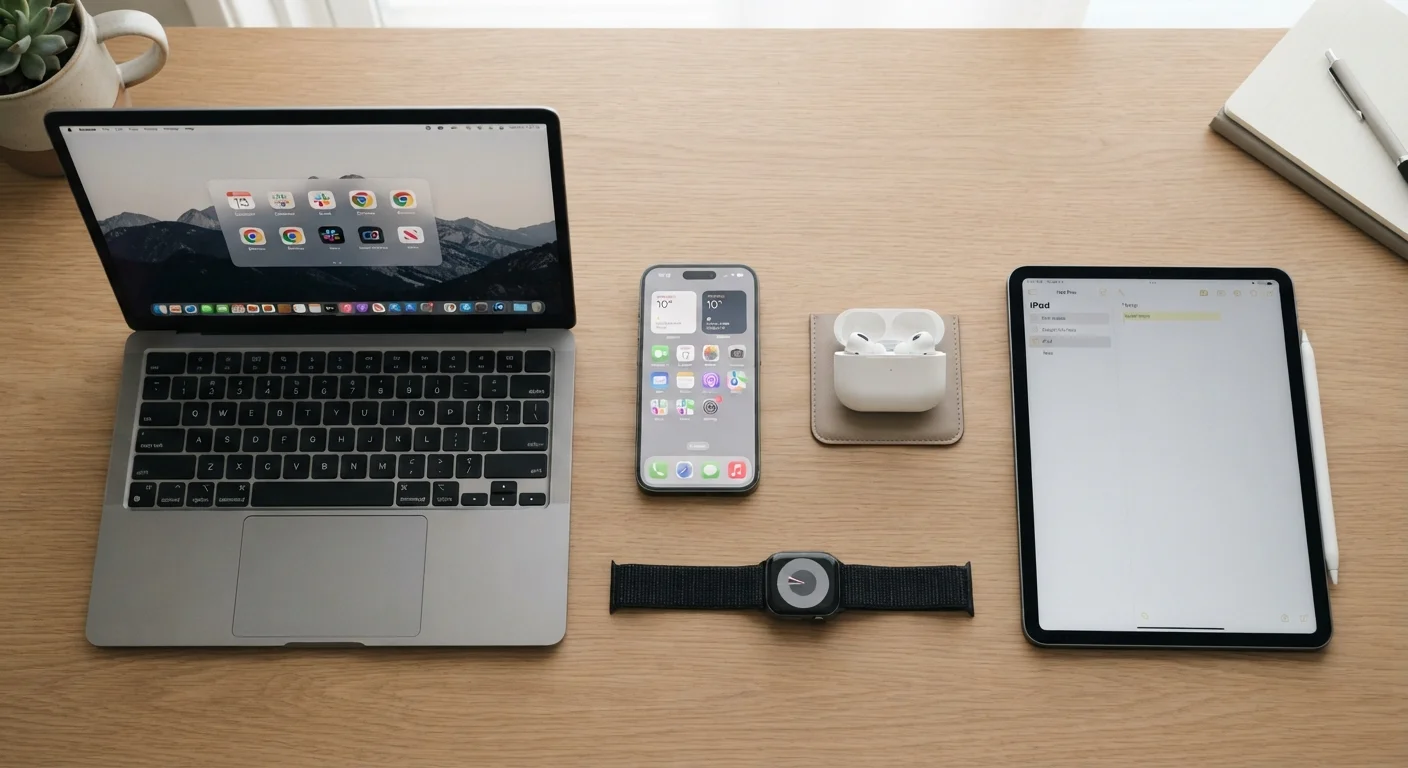
Fewer, better-integrated devices outperform many loosely connected ones. A smartphone, a laptop or tablet, and one pair of reliable headphones covers the vast majority of consumer computing needs. Each additional device introduces a charging requirement, a software account, and a point of potential failure.
Budget reflects priorities, not social signals. Spending on electronics should be weighed against competing financial goals. For a structured way to think about that balance, the complete guide to personal budgeting provides a practical foundation. For emerging technology trends shaping what devices will look like in coming years, the Tech Trends hub tracks developments worth watching.
A sensible setup evolves gradually. Resist the pressure of release cycles - hardware refreshes are rarely as transformative as their announcements suggest.
Release Cycle Pressure Is a Marketing Tactic
Annual hardware refreshes are designed to create urgency, not because meaningful improvements happen on a fixed schedule. Buying a device simply because a newer model was announced - or because a manufacturer discontinued software support on a device that still functions well - often delivers very little practical benefit at significant cost.