

Key Takeaways
- Edge computing processes data near the source rather than sending it to a remote cloud server.
- Lower latency and faster response times are the primary practical benefits for consumers.
- Smart home devices, self-driving vehicles, and industrial sensors all commonly use edge computing.
- Edge and cloud computing work together - they are complementary, not competing approaches.
- Privacy can improve when sensitive data is processed locally and never leaves the device.
Edge Computing
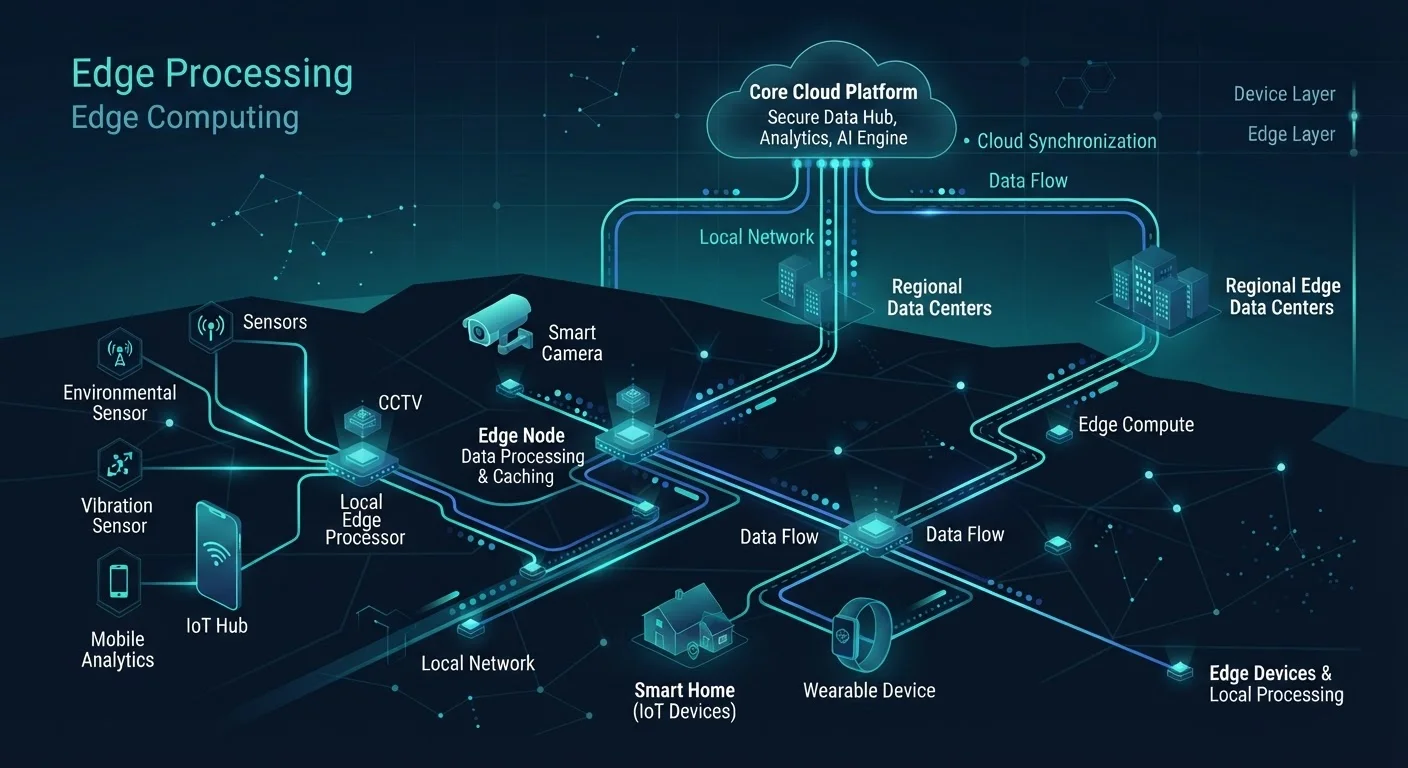
Edge computing is an approach to data processing where computation happens close to the source of the data - on or near the device itself - rather than being sent to a distant data center. Think of it as putting a small brain near the device instead of routing every question back to a central headquarters. This reduces the time it takes to get a response and reduces the amount of data that needs to travel across the internet.
In technical terms, 'the edge' refers to any computing resource physically closer to the end device than a centralized cloud server - this can include local servers, gateways, or processing chips embedded in the devices themselves.
The Core Idea: Why Location Matters in Computing
When you ask a voice assistant a question, your device traditionally packages that request and sends it to a data center - sometimes hundreds or thousands of miles away - for processing, then receives the answer back. This back-and-forth happens quickly under normal conditions, but any congestion or distance adds delay.
Edge computing changes that equation. Instead of routing data to a faraway server, processing happens at or near the device - on a local chip, a nearby gateway, or a small server housed within the same building or neighborhood. The result is faster responses, reduced network strain, and in many cases, better reliability when internet connectivity is spotty.
To understand why this matters, compare it to ordering food. Getting a delivery from across town takes longer than picking it up from the kitchen next door. Edge computing is the kitchen next door.
Edge Computing Is Not One Single Technology
The term 'edge computing' covers a wide range of implementations - from a chip inside your phone to a server rack in a neighborhood cell tower. What they share is the principle of processing data close to where it originates. The specific hardware, software, and network setup varies significantly depending on the industry and use case.
How Edge Computing Shows Up in Everyday Technology
Edge computing is less abstract than it sounds - it already powers many devices consumers use daily.
- Smartphones: Modern phones include dedicated processors - often called neural engines or AI chips - that handle tasks like photo enhancement, face unlock, and voice recognition locally, without sending data to the cloud.
- Smart speakers and home hubs: Many devices process wake-word detection on the device itself, only connecting to the cloud once they confirm a command was intended.
- Connected vehicles: Cars equipped with driver-assistance systems analyze camera and sensor data in real time on onboard processors. Waiting for a cloud server to decide whether to apply the brakes is not a viable option. This connects closely to broader developments in electric vehicle technology, where onboard computing is growing rapidly.
- Industrial equipment: Factories and power grids use edge processing to monitor sensors and detect anomalies instantly, without depending on a stable internet connection.
For a wider look at how connected devices are reshaping daily life, see our explainer on the Internet of Things.
75%
Of enterprise data generated outside the data center by 2025
According to Gartner research projections, the majority of enterprise data will be created and processed at the edge rather than in centralized facilities.
<10ms
Target latency for edge-processed applications
Many real-time applications - from autonomous vehicle systems to industrial automation - require response times under 10 milliseconds, which centralized cloud servers often cannot reliably deliver.
Billions
IoT devices expected to benefit from edge processing
Industry analysts project tens of billions of connected devices will be in use globally within this decade, with edge computing cited as essential infrastructure for managing their data locally.
Edge vs. Cloud: A Partnership, Not a Competition
A common misconception is that edge computing is replacing the cloud. In practice, the two work together. Edge handles tasks that require speed and local context - a camera detecting motion, a thermostat adjusting temperature. The cloud handles storage, large-scale analysis, software updates, and tasks that benefit from aggregating data across many devices.
Think of edge as handling the reflexes and the cloud as handling the memory and reasoning. Neither is sufficient alone for most modern applications. Our coverage of cloud computing misconceptions explores how the cloud is often misunderstood - and this partnership with edge is one of the most commonly overlooked nuances.
Edge computing also connects to broader computing trends worth understanding. As processing moves closer to users and environments, it enables experiences described in emerging concepts like ambient computing - where technology fades into the background of daily life.
How to Think About Your Own Devices
When evaluating a smart device, it is worth asking whether its core functions work without an internet connection. If a device can still perform its primary job offline - responding to commands, detecting motion, controlling temperature - that is a signal it uses on-device or local edge processing. Devices that stop working entirely when the internet goes down rely more heavily on centralized cloud servers.
What This Means for Consumers Going Forward
For most people, edge computing will remain largely invisible - which is the point. Faster responses, more reliable device behavior during network outages, and potentially stronger privacy controls are the consumer-facing benefits.
As wireless networks expand and chips grow more efficient, the boundary between on-device and cloud processing will continue to shift. Devices will handle more complex tasks locally, and users will notice that in tangible ways: quicker camera processing, more responsive smart home setups, and voice assistants that work even when the internet is down.
Understanding where computation actually happens - and what that means for your data - is increasingly relevant for anyone navigating today's connected environment. For practical guidance on getting more from your everyday devices, explore our digital technology hub.