

Key Takeaways
- 5G is a cellular standard that works anywhere with carrier coverage; Wi-Fi 6 requires a local router.
- Wi-Fi 6 typically delivers higher peak speeds and lower latency indoors where signal conditions are controlled.
- 5G excels for mobile users on the go; Wi-Fi 6 excels when many devices share the same network.
- Both technologies can coexist - most modern smartphones use whichever connection is stronger at any moment.
- Neither technology replaces the other; they solve different connectivity problems.
Option A
5G
The wide-area cellular network built for mobility.
Best for: Staying connected anywhere outside the home - commuting, traveling, or working in areas without Wi-Fi.
Option B
Wi-Fi 6
The high-efficiency local network built for crowded indoor spaces.
Best for: Delivering fast, reliable connections to many devices simultaneously within a home or office.
If you need a reliable connection while commuting or traveling
5G
5G works wherever your carrier has coverage, independent of any local router or infrastructure. It's the only option when there's no trusted Wi-Fi available.
If you have many smart home devices and want smooth performance for all of them
Wi-Fi 6
Wi-Fi 6's OFDMA and MU-MIMO technologies allow the router to serve many devices simultaneously without the slowdowns common on older Wi-Fi standards.
If you work from home and need stable video calls and fast file transfers
Wi-Fi 6
A well-placed Wi-Fi 6 router offers lower, more consistent latency indoors than cellular, which can vary depending on tower congestion and building materials.
If you live in a rural area with limited broadband infrastructure
5G
5G home broadband services are increasingly available in underserved areas, offering a viable alternative to traditional cable or fiber internet.
What Each Technology Actually Is
The confusion between 5G and Wi-Fi 6 is understandable - both launched around the same time, both promise dramatically faster wireless speeds, and both sound like upgrades to whatever came before. But they are fundamentally different types of wireless technology serving different purposes.
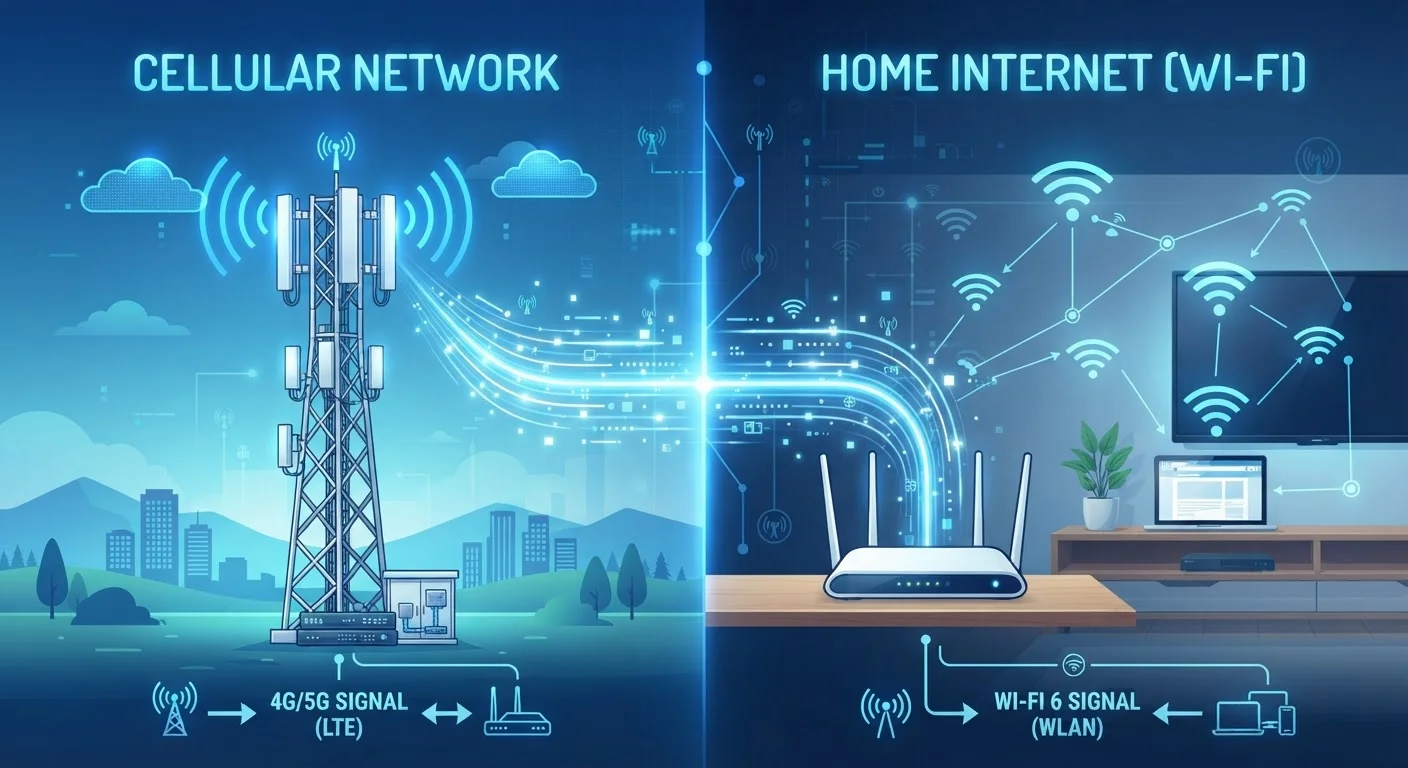
5G is the fifth generation of cellular networking - the same category of technology as 4G LTE. It's managed by mobile carriers, transmitted from cell towers, and works across wide geographic areas. You use 5G when your phone connects to the internet without a router nearby.
Wi-Fi 6 (technically called IEEE 802.11ax) is the latest version of the Wi-Fi standard. It operates over short distances - typically within a home or building - and requires a local router connected to a broadband internet service. Wi-Fi 6 didn't replace 5G, and 5G didn't replace Wi-Fi 6. They run in parallel, often on the same device.
For a deeper look at how Wi-Fi generations compare to one another, see how Wi-Fi 5 and Wi-Fi 6 differ in practice.
| Criterion | 5G | Wi-Fi 6 |
|---|---|---|
| Network type | Cellular (carrier-managed) | Local wireless (router-based) |
| Coverage area | Wide-area, outdoors and indoors | Short-range, typically within one building |
| Peak speed potential | Up to several Gbps (mmWave); 100-400 Mbps typical (sub-6 GHz) | Up to ~9.6 Gbps theoretical; 500+ Mbps realistic indoors |
| Latency | Typically 10-30ms on modern networks | Typically 2-10ms in good indoor conditions |
| Device density handling | Improved over 4G; shared with other area users | Designed for dense device environments via OFDMA |
| Requires subscription | Yes - mobile carrier data plan | No - uses existing broadband connection |
| Mobility | Follows you anywhere with carrier signal | Fixed to the location of the router |
Where Each Technology Performs Best
The performance gap between 5G and Wi-Fi 6 narrows or widens dramatically depending on where you're using them.
Outdoors and on the move, 5G has no real competitor. Wi-Fi doesn't follow you down the highway or through a shopping district - cellular does. Sub-6 GHz 5G (the most widely deployed variety) delivers meaningful speed improvements over 4G LTE, while mmWave 5G (deployed in dense urban zones) can reach multi-gigabit speeds, though with very limited range and poor building penetration.
Indoors, Wi-Fi 6 typically wins on peak speed and latency consistency. Because the router is physically close and dedicated to your household, there's far less interference from unrelated users. Wi-Fi 6's key engineering advance - a technology called OFDMA (Orthogonal Frequency Division Multiple Access) - allows the router to split its channel capacity across multiple devices simultaneously, reducing the slowdowns that occur when many devices compete for bandwidth at once.
~9.6 Gbps
Wi-Fi 6 theoretical maximum throughput
This figure represents the standard's ceiling across all simultaneous streams; real-world speeds in homes are substantially lower but remain a significant leap over Wi-Fi 5.
4x
Improvement in capacity for dense device environments
Wi-Fi 6's OFDMA technology is designed to handle roughly four times as many simultaneous device connections as Wi-Fi 5 before performance degrades, according to the Wi-Fi Alliance.
~77%
US adults with a smartphone as of recent Pew Research data
Pew Research Center tracking shows the vast majority of US adults now carry a cellular-connected device, making cellular network quality a broadly relevant consumer concern.
If your home has coverage gaps, a mesh network setup can extend Wi-Fi 6 across larger spaces without degrading speed.
The Practical Overlap - and How to Think About Both
For most people, 5G and Wi-Fi 6 aren't competing choices - they're complementary layers. A modern smartphone switches between them automatically, preferring Wi-Fi when a trusted network is available and falling back to cellular when it isn't.
Where the distinction becomes practically important is in planning your home setup or evaluating your mobile plan. If your priority is seamless connectivity across every room in a house with dozens of smart devices, investing in a capable Wi-Fi 6 router matters more than your cellular plan. If you spend significant time working remotely from locations without reliable Wi-Fi, your 5G data plan and carrier coverage become the more critical factor.
5G Home Internet: A Third Use Case
Some carriers now offer fixed 5G home internet service, where a receiver unit in your home connects to a 5G tower and then broadcasts Wi-Fi locally. In this setup, 5G acts as the backhaul - replacing the cable or fiber line - while your router still distributes the signal indoors. If you have this type of service, pairing it with a Wi-Fi 6 router can maximize the benefit of both technologies simultaneously.
Security is also worth factoring in. Cellular connections are encrypted by the carrier infrastructure, while Wi-Fi security depends heavily on your router's configuration and password hygiene. For more on the risks of connecting through networks you don't control, see what's actually risky about public Wi-Fi.
If you're evaluating your home network more broadly, the factors that actually matter in a home Wi-Fi router can help cut through the marketing noise. And if you're troubleshooting current Wi-Fi issues, Wi-Fi troubleshooting from first principles walks through a logical diagnostic process without requiring technical expertise.