

Key Takeaways
- Deep learning is a specialized subset of machine learning, not a separate competing field.
- Machine learning generally requires humans to identify useful data features; deep learning learns features automatically.
- Deep learning needs far more data and computing power to work well than traditional machine learning methods.
- Most AI applications you encounter daily rely on one or both of these approaches working together.
- Choosing between them depends on your data type, volume, and how much you need to explain the model's decisions.
Option A
Machine Learning
The broader discipline that teaches computers to learn from data.
Best for: Structured datasets, interpretable results, and problems where human-crafted features can guide the model.
Option B
Deep Learning
A powerful subset of machine learning modeled on how the brain processes information.
Best for: Unstructured data - images, audio, text - where automatically discovering patterns beats manual feature engineering.
If you're working with structured tabular data and need explainable results
Machine Learning
Traditional ML models like decision trees or logistic regression handle structured data efficiently and produce outputs that humans can interpret and audit.
If your problem involves images, speech, or large volumes of unstructured text
Deep Learning
Deep learning's layered neural networks excel at extracting complex patterns from raw, unstructured data without manual feature design.
If you have limited data or computing resources
Machine Learning
Traditional ML algorithms can produce reliable results with smaller datasets and run effectively on standard hardware.
If you're building a system that handles natural language or generates content
Deep Learning
Modern language models and generative AI tools are all built on deep learning architectures that process language at scale.
One Field, Two Levels
The confusion between machine learning and deep learning is understandable - the terms appear constantly in technology coverage, often used as if they're interchangeable. They aren't, though they're closely related. Deep learning is a specific approach within machine learning, not a rival to it.
Think of it this way: machine learning is the broad discipline concerned with training algorithms to improve their performance based on data, without being explicitly programmed for every task. Deep learning is one particular method inside that discipline - one that uses layered mathematical structures called neural networks to process information. Every deep learning system is a machine learning system, but most machine learning systems are not deep learning.
Understanding this hierarchy matters because the two approaches have genuinely different practical profiles. They suit different types of problems, require different amounts of data, and produce results that are easier or harder for humans to interpret. For anyone trying to make sense of AI coverage - or evaluate technology that claims to use AI - that distinction has real consequences. See how similar categorization questions play out in our look at augmented reality vs. virtual reality.
How Machine Learning Actually Works
Traditional machine learning follows a recognizable pattern: a human expert examines the problem, identifies which data features are likely to matter - say, word frequency for spam detection or transaction amount for fraud detection - and then feeds those selected features into an algorithm. The algorithm learns statistical relationships and uses them to make predictions on new data.
Common machine learning methods include decision trees, random forests, support vector machines, and linear regression. These approaches are well-understood, comparatively transparent, and can deliver strong results with modest data volumes. A well-trained decision tree, for example, can be read and interpreted by a human, which matters enormously in regulated industries where decisions must be explainable.
~80%
Share of enterprise ML projects using structured data
Industry analyses consistently find that the majority of deployed machine learning systems in business settings operate on structured, tabular data rather than images or text.
10-100x
Typical compute increase for deep learning vs. classical ML
Training large deep learning models can require orders of magnitude more compute than equivalent traditional ML methods, a gap that has widened as model sizes grow.
Millions
Training examples often needed for deep learning
Researchers and practitioners generally find that deep learning models require millions of labeled examples to outperform traditional methods on complex perceptual tasks.
The tradeoff is that this feature-engineering step requires significant domain knowledge. Getting the model to perform well depends partly on a human correctly identifying what the model should pay attention to - a task that's feasible for structured data but becomes very difficult with raw images or audio.
What Deep Learning Adds - and Costs
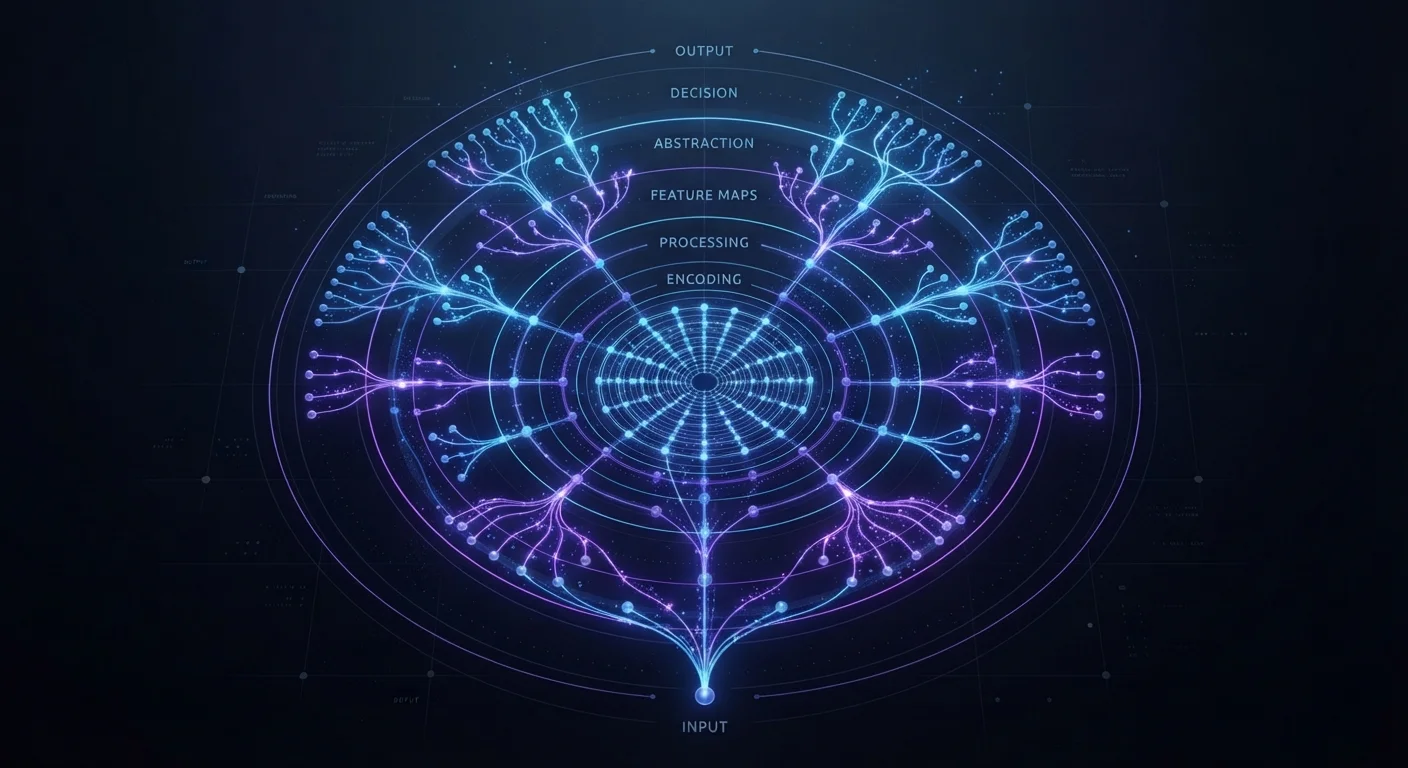
Deep learning bypasses the manual feature-engineering step by using multi-layered neural networks to discover patterns directly from raw data. Each layer of the network learns increasingly abstract representations: an early layer processing an image might detect edges; a later layer might recognize shapes; a still-later layer might identify objects. This hierarchical learning is what makes deep learning powerful for complex, unstructured inputs.
| Criterion | Machine Learning | Deep Learning |
|---|---|---|
| Relationship | The broader discipline | A subset of machine learning |
| Feature engineering | Largely human-directed | Automated by the network |
| Data requirements | Works with smaller datasets | Needs very large datasets |
| Computing power | Runs on standard hardware | Requires significant GPU resources |
| Interpretability | Generally more transparent | Often a "black box" |
| Best data type | Structured, tabular data | Images, audio, text |
| Common examples | Fraud detection, recommendation engines | Speech recognition, image classification |
The practical cost of this power is substantial. Deep learning models typically require very large datasets - often millions of examples - and significant computing resources to train. They are also considerably harder to interpret; even their designers often cannot explain exactly why a deep learning model produced a particular output. This opacity creates challenges for applications where accountability is essential, a point that connects directly to broader questions about AI governance discussed in our guide to key AI policy terms.
Despite those costs, deep learning has proven transformative for speech recognition, image classification, medical imaging analysis, and natural language processing. The large language models now embedded in everyday tools are deep learning systems at their core - a comparison explored further in our piece on large language models vs. traditional search engines.
Choosing the Right Tool for the Problem
Neither approach is universally superior. The appropriate choice depends on three practical factors: the nature of the data, the volume available, and how much the decision-making process needs to be auditable.
For structured data - customer records, financial transactions, sensor readings in tabular form - traditional machine learning methods remain highly competitive and are far more resource-efficient. For unstructured data at scale - video, speech, free-form text - deep learning typically outperforms alternatives, provided sufficient training data exists.
Organizations are increasingly combining both: using deep learning to extract meaningful representations from raw inputs, then feeding those representations into simpler, more interpretable machine learning models. This hybrid approach attempts to capture the perceptual power of deep learning while preserving some degree of explainability. For a related look at how openness in AI development shapes these choices, see our overview of open source vs. proprietary AI models.
For general consumers, the most useful takeaway is simpler: when you hear that a product uses AI or machine learning, it's worth asking what kind of data it's learning from and whether anyone can explain how it reaches its conclusions. Those two questions cut through most of the marketing haze.