

Key Takeaways
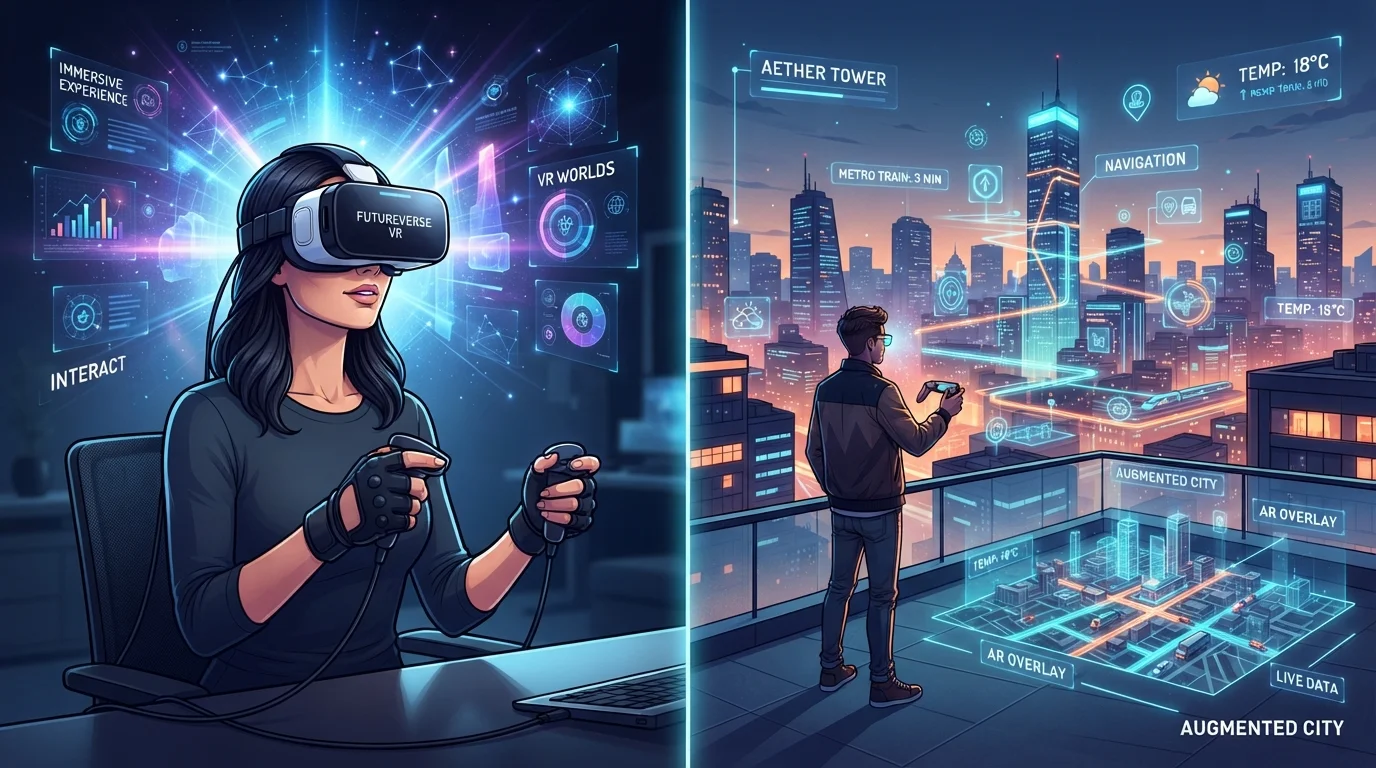
- AR overlays digital content onto the real world; VR replaces it entirely with a simulated environment.
- AR typically runs on smartphones or transparent glasses; VR requires a dedicated headset that covers the eyes.
- Both technologies have distinct practical applications across healthcare, education, retail, and entertainment.
- VR demands more processing power and specialized hardware than most AR applications.
- Neither technology is universally superior - the right choice depends entirely on the intended use case.
Option A
Augmented Reality (AR)
The technology that layers digital content onto the real world.
Best for: Everyday consumers and professionals who want digital information blended into their physical surroundings without losing situational awareness.
Option B
Virtual Reality (VR)
The technology that replaces the real world with a fully digital environment.
Best for: Users seeking deep immersion in simulated environments - whether for entertainment, training, or therapy - where blocking out the physical world is an advantage.
If you want digital information without losing awareness of your surroundings
Augmented Reality (AR)
AR keeps the real world fully visible, making it practical for navigation, on-the-job guidance, and everyday mobile use without isolation.
If you need deep, distraction-free immersion in a simulated environment
Virtual Reality (VR)
VR's total sensory replacement makes it purpose-built for training simulations, immersive gaming, and therapeutic applications where full focus is essential.
If you are a business exploring customer-facing experiences on existing devices
Augmented Reality (AR)
AR can run on smartphones already in consumers' pockets, lowering the hardware barrier significantly compared to dedicated VR headsets.
If you are designing professional skills training that requires realistic scenario practice
Virtual Reality (VR)
Research across medical and industrial training settings suggests VR's immersive scenarios can accelerate skill acquisition in environments too dangerous or costly to replicate physically.
The Core Distinction: Where Digital Meets Physical
The terms Augmented Reality and Virtual Reality are frequently treated as interchangeable in product launches and media coverage, but they describe fundamentally different relationships between digital content and the physical world.
AR adds a digital layer on top of your existing environment. Think of smartphone apps that superimpose navigation arrows onto a live camera view of the street ahead, or warehouse workers wearing glasses that display inventory data while their hands remain free. The real world stays in view; the digital layer supplements it.
VR, by contrast, replaces your environment entirely. A headset screens out all physical surroundings and substitutes a computer-generated world - you are no longer perceiving the room you are sitting in. This total immersion is the defining characteristic, and it carries meaningful implications for both the hardware required and the experiences that become possible.
Understanding this gap matters beyond semantics. These are different engineering problems producing different user experiences, which is why spatial computing - the broader discipline that encompasses both - remains an active area of development rather than a finished product category.
How Each Technology Actually Works
AR systems rely on cameras and sensors to map the real environment in real time, then use software to anchor digital objects within that space so they appear stable as the user moves. On a smartphone this happens through the device's camera; on dedicated glasses, transparent lenses let light pass through while a small projector or display overlays imagery. The technical challenge is precision - a digital instruction that floats even slightly off a physical object quickly breaks the illusion.
VR systems generate an entirely synthetic scene rendered at high frame rates to two small screens - one per eye - positioned close enough to fill the field of view. Head-tracking sensors update the rendered image in near real time so that turning your head produces the expected visual shift. Any lag between head movement and image update can cause disorientation, which is why processing power and low-latency sensors are central engineering priorities for VR hardware.
| Criterion | Augmented Reality (AR) | Virtual Reality (VR) |
|---|---|---|
| Relationship to physical world | Overlays digital content; real world remains visible | Replaces physical environment entirely |
| Primary hardware | Smartphone or transparent AR glasses | Opaque headset covering both eyes |
| Situational awareness | Maintained - user can see surroundings | Absent - physical environment blocked out |
| Processing demands | Moderate - runs on mobile hardware | High - requires dedicated processing |
| Typical use cases | Navigation, retail visualization, industrial guidance | Training simulations, immersive gaming, therapy research |
| Consumer adoption barrier | Low - smartphones already in hand | Higher - requires separate device purchase |
Both technologies share some underlying components - displays, sensors, spatial tracking - but the design goals diverge sharply, which explains why devices optimized for one rarely excel at the other without deliberate engineering compromise.
Where Each Technology Is Actually Being Used
AR has found its most widespread consumer deployment through smartphones. Mobile AR is used in retail to let shoppers visualize furniture in their homes, in education to animate diagrams, and in navigation tools that overlay directions on live camera feeds. Industrial applications include AR-guided assembly on factory floors and remote expert assistance where a specialist sees exactly what a field technician sees.
VR's strongest foothold is in environments where full immersion is an advantage rather than a limitation. Medical training programs use VR to practice surgical procedures without risk to patients. Military and aviation sectors have used simulated environments for scenario training for decades. Mental health researchers are exploring VR-based exposure therapy for anxiety disorders, though this remains an active area of clinical investigation rather than an established standard of care.
~171M
Estimated AR users in the US
eMarketer estimated approximately 171 million US augmented reality users in 2023, driven largely by smartphone-based AR features.
65%
Training retention advantage cited for VR
A PwC study examining soft-skills training found VR learners reported higher confidence applying skills compared to classroom or e-learning formats, though findings vary by context.
It is worth noting that the clearest application categories are still emerging. As with any fast-moving area, media coverage sometimes overstates the maturity of both technologies - practical deployment at scale looks quite different from controlled demonstrations.
Practical Considerations for Consumers and Organizations
For individual consumers, the most immediate difference is hardware. AR on a smartphone requires no additional purchase. Consumer VR headsets are dedicated devices with their own cost, setup requirements, and physical space considerations - a clear barrier to casual adoption.
For organizations evaluating either technology, the relevant question is whether digital overlay or full immersion better serves the specific task. AR typically integrates more readily into existing workflows because users retain awareness of their physical environment and can interact with colleagues and equipment normally. VR requires participants to pause their physical context entirely, which is a genuine operational constraint even when the immersive benefit is real.
What About Mixed Reality?
You may encounter the term Mixed Reality (MR), sometimes used to describe systems where digital objects interact with and respond to the physical environment - going beyond simple overlay. Some manufacturers use MR as a marketing label for high-end AR devices. The terminology is not standardized across the industry, so it is worth evaluating what a device actually does rather than relying on the category name alone.
This distinction is conceptually similar to how apps and mobile websites serve different needs despite appearing to do the same job - the right choice depends on what the experience actually needs to accomplish, not which label sounds more advanced. And just as machine learning and deep learning are often conflated despite meaningful technical differences, AR and VR deserve to be understood on their own terms.