

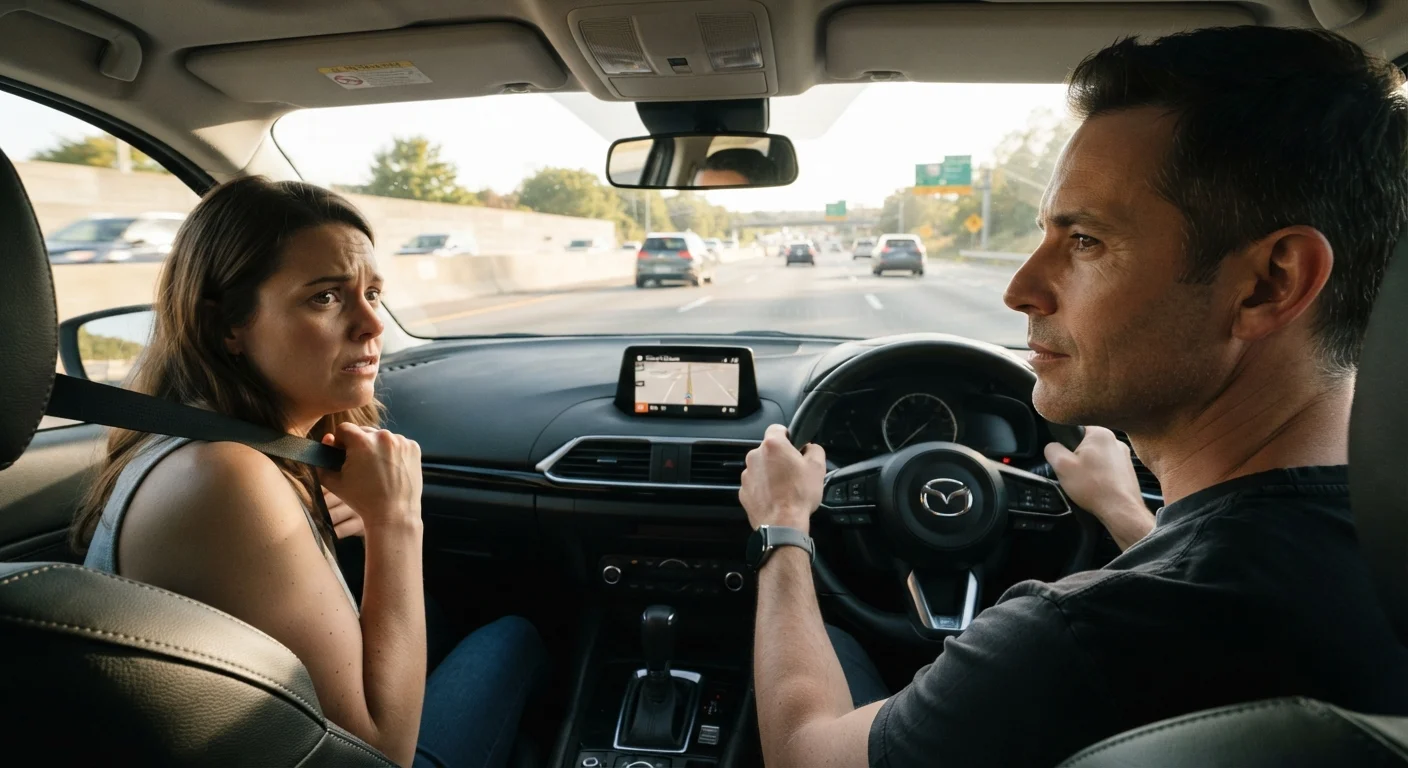
Key Takeaways
- A panicking passenger is a real distraction - treat it as seriously as a phone notification.
- Staying calm yourself is the most effective tool for de-escalating a distressed passenger.
- Brief, confident communication works better than lengthy reassurance while driving.
- Pulling over safely is always an option when passenger distress becomes unsafe to manage in motion.
- Preparation before the trip can prevent panic episodes from arising in the first place.
Why a Panicking Passenger Is a Driving Hazard
Most drivers recognize the obvious distractions - a buzzing phone, a loud radio, a dropped coffee cup. A panicking passenger is less predictable, but research consistently shows that emotionally charged conversations and in-car stress elevate cognitive load and slow reaction times. As explained in our piece on distracted driving, the brain cannot fully split attention between a demanding social interaction and the complex task of operating a vehicle.
Panic in a passenger can take different forms: a fear of highway speeds, a phobia of bridges or tunnels, anxiety during heavy traffic, or a sudden emotional breakdown unrelated to driving at all. Whatever the source, the effect on you - the driver - is similar. Your attention is being pulled away from the road, and that gap in focus is where accidents happen.
~8x
Increased crash risk from emotionally demanding conversations
Research from the AAA Foundation for Traffic Safety indicates that emotionally charged conversations - even hands-free - can significantly impair driving performance compared to silence.
~4 sec
Average attention gap from a single distraction
The National Highway Traffic Safety Administration (NHTSA) notes that taking your attention off the road for even a few seconds at highway speeds covers the length of a football field.
Best Practices for Staying in Control
These recommended approaches are ordered by immediate priority. Safety comes first; emotional support comes second.
Keep your own voice steady and tone neutral when acknowledging the passenger's distress.
Emotional contagion is real - if you respond with visible stress or irritation, a panicking passenger tends to escalate. A calm, even voice signals that the situation is under control, which is often enough to begin de-escalation. This lets you stay cognitively present for the road.
Use short, spaced responses rather than engaging in a full conversation while driving.
Extended back-and-forth dialogue draws mental resources away from driving. Brief acknowledgments - a word or two, a quick glance at a red light - communicate presence without compromising your attention on the road.
Give the passenger a simple, physical task to redirect their focus.
Redirecting attention from internal panic to an external task can interrupt the anxiety loop. Asking them to navigate, adjust the music, or hold something gives them agency and reduces the passive spiral of fear.
Reduce environmental stressors without drawing attention to the adjustment.
Loud music, aggressive lane changes, and high speeds can amplify passenger anxiety. Quietly moderating these inputs - without announcing that you're doing so - creates a calmer cabin atmosphere and reduces stimulation.
Pull over safely if the passenger's behavior directly compromises vehicle control.
No social discomfort is worth a collision. If a passenger grabs the wheel, blocks your view, or creates a level of distraction you cannot safely manage, the correct response is to exit the road using normal safe procedures. Driving on challenging conditions like at night makes this threshold even lower.
Before the Trip: Reduce the Likelihood of a Panic Episode
Many panic episodes during car travel are predictable. A passenger with a known fear of heights won't do well on a mountain pass without warning. Someone prone to motion sickness may panic if they can't see the road ahead. A quick conversation before departure - asking whether they have any concerns about the route, offering to keep the drive shorter if needed, or letting them know they can request a stop - goes a long way toward preventing a crisis while you're moving at 65 mph.
Ask Before You Drive, Not During
A quick pre-trip check-in - 'Any concerns about the route today?' - takes less than a minute and can prevent a panic episode from developing at highway speed. Passengers who feel heard before the trip are less likely to spiral once you're moving. This is especially useful on long or unfamiliar routes.
If you regularly drive someone who experiences travel anxiety, consider discussing it when you're not in the car. Understanding their triggers lets you plan routes and stops in advance, keeping both of you calmer on the road. This is especially relevant on unfamiliar roads, where unexpected conditions can amplify existing anxiety.
When to Pull Over - and How to Do It Safely
There is no rule that says you must manage a severely distressed passenger while staying in motion. If a passenger is hyperventilating, grabbing the wheel, screaming, or otherwise making it impossible to maintain safe vehicle control, pulling over is the right call - not a concession to drama.
Signal early, check mirrors, and exit the road smoothly. A rest area, parking lot, or wide shoulder are all valid options. Once stopped, you can give the situation your full attention. The same instinct applies to other sudden emergencies: as covered in our guide to tire blowouts, controlled deceleration and a composed response prevent panic from making a manageable situation worse.
Stopping Is Not a Last Resort
Many drivers hesitate to pull over because it feels like an overreaction. In practice, stopping safely on a shoulder or in a parking lot is a controlled, low-risk action. Continuing to drive while managing a severe distraction is the higher-risk choice. Treat pulling over as a standard tool, not a failure.
After the stop, keep your tone matter-of-fact and avoid expressing frustration. Communicating that stopping was the right call - rather than an inconvenience - reinforces trust and can help the passenger regulate faster.