

Key Takeaways
- The human brain cannot truly multitask; it rapidly switches between tasks, degrading performance on both.
- Hands-free phone calls carry meaningful cognitive distraction even without physical phone handling.
- Inattention blindness means a driver's eyes can be open yet fail to register hazards ahead.
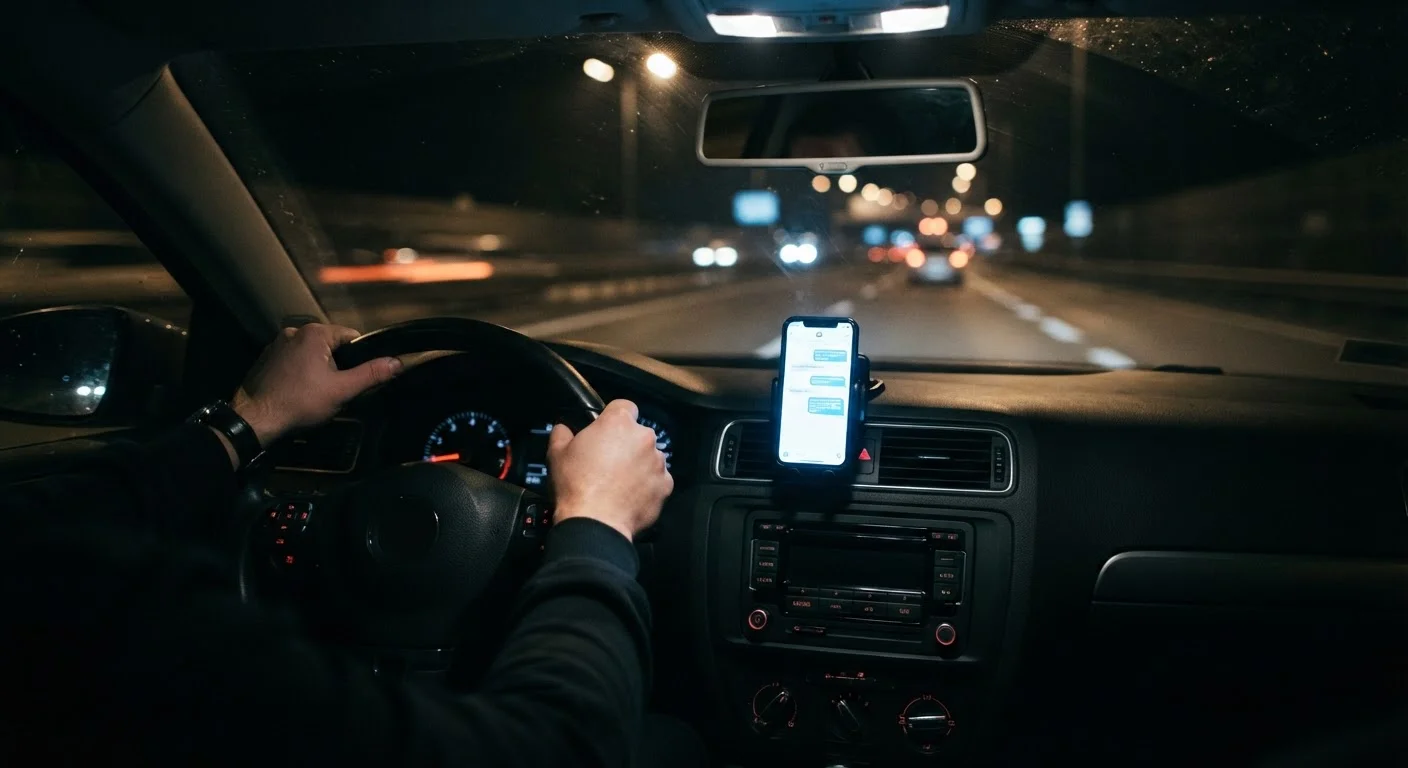
- Texting while driving combines all three distraction types simultaneously, making it especially hazardous.
- Even brief secondary tasks can meaningfully extend stopping distance at highway speeds.
Distracted Driving
Distracted driving occurs any time a driver's attention is diverted from the primary task of operating a vehicle. Distractions fall into three categories: visual (eyes off the road), manual (hands off the wheel), and cognitive (mind off the task). All three reduce a driver's ability to react to changing road conditions.
Cognitive distraction is particularly insidious because it can occur even with eyes forward and hands on the wheel - a phenomenon researchers call 'inattention blindness,' where the brain fails to process visual information it technically receives.
The Multitasking Myth Behind the Wheel
Most drivers believe they can handle a quick glance at a notification or carry on a phone conversation without meaningfully degrading their driving. That belief conflicts with decades of cognitive neuroscience research. The brain does not actually perform two demanding tasks simultaneously - it alternates between them rapidly, and each switch carries a cost in both speed and accuracy.
This rapid toggling is sometimes called task-switching, and it leaves a measurable residue. After shifting attention away from driving and back again, the brain requires a brief recovery window before it processes road information at full efficiency. At highway speeds, even that fraction of a second represents real distance traveled blind.
Understanding this isn't about inducing anxiety - it's about accurately sizing the risk so drivers can make informed choices. For a broader picture of how attentiveness connects to overall road skill, see our guide to defensive driving.
“Drivers talking on cell phones are looking out the windshield, but they're not seeing what's there. They're seeing a mental image of the conversation.”
— David Strayer, Cognitive psychologist and distracted driving researcher, University of Utah
Inattention Blindness: Seeing Without Perceiving
One of the most counterintuitive findings in distracted-driving research is inattention blindness - the brain's tendency to fail to process visual stimuli it physically receives when mental bandwidth is consumed elsewhere. A driver whose eyes are directed at the road but whose mind is engaged in a demanding conversation may not consciously register a pedestrian stepping off a curb or brake lights appearing ahead.
This is not a failure of eyesight. The eyes deliver the image; the brain simply never fully encodes it into awareness. It's why drivers who use hands-free phones frequently report that accidents seemed to come from nowhere - they weren't not looking, they were looking without seeing.
~5 sec
Average eyes-off-road time for a single text
According to NHTSA, at 55 mph this equals traveling the length of a football field without watching the road.
4x
Increased crash risk while using a handheld phone
The National Safety Council cites research indicating drivers using handheld phones are roughly four times more likely to be involved in a crash.
~27%
Reduction in brain activity associated with driving during phone calls
Carnegie Mellon University research found that listening to someone speak on a phone reduced the parietal lobe activity associated with spatial driving tasks by approximately 37 percent.
This phenomenon also helps explain why distracted driving is a factor even in low-speed, familiar environments. Cognitive load - not just physical distraction - is the operative variable.
Why Hands-Free Isn't the Safe Alternative It Feels Like
Legislation in many US states has moved to ban handheld phone use while driving, which addresses the manual and visual distraction components. However, the cognitive component persists through hands-free calling, and research suggests it accounts for a significant share of total risk.
The key distinction is that phone conversations are cognitively symmetric - both parties in the call are equally engaged regardless of external conditions. In contrast, face-to-face passenger conversations tend to be environmentally adaptive: a passenger instinctively stops talking when you're navigating a complex merge or reacting to sudden traffic.
When to Pause a Hands-Free Call
Consider ending or pausing a phone call before entering construction zones, navigating complex interchanges, driving in heavy rain or snow, or merging onto a busy highway. These are moments when full cognitive bandwidth matters most. Resuming the call once conditions stabilize is a straightforward habit that costs little and preserves attentional capacity when it's needed.
This doesn't mean hands-free calling is equally hazardous to texting - it isn't. But treating it as fully safe misrepresents what cognitive neuroscience shows. Drivers who want to minimize risk during demanding segments of a drive - merging, construction zones, poor weather - may find it worthwhile to pause calls entirely during those stretches.
Cognitive distraction interacts with other impairments too. For a comparison of how different forms of driver impairment stack up, see our article on drowsy versus drunk driving impairment.
Practical Context: What the Numbers Reflect
Federal highway safety data consistently identifies distraction as a contributing factor in a meaningful share of reported crashes annually in the United States. While precise attribution is difficult - drivers rarely self-report distraction - observational studies and crash reconstruction analyses paint a consistent picture: the risk is real and not trivial.
Texting combines all three distraction types simultaneously: the driver's eyes leave the road (visual), hands leave the wheel (manual), and mental focus shifts to message content (cognitive). This combination is what makes it particularly hazardous relative to other secondary tasks.
Nervous or agitated passengers can also compound cognitive load. Our article on managing a panicking passenger covers strategies for maintaining focus in emotionally demanding situations inside the vehicle.
Good driving habits are most effective when they're consistent. For night-specific attentiveness strategies, night driving habits that reduce risk offers targeted guidance for reduced-visibility conditions.