

Key Takeaways
- Hydroplaning happens when water pressure under the tire exceeds the tire's ability to channel it away.
- Speed is the primary trigger - slowing down before wet patches is the most effective prevention.
- Worn tires dramatically increase hydroplaning risk by reducing water-evacuation capacity.
- When hydroplaning occurs, avoid sudden braking or sharp steering inputs.
- Ease off the accelerator gradually and steer gently in your intended direction to regain traction.
- Cruise control should be turned off in wet conditions to keep the driver in full control.
Hydroplaning
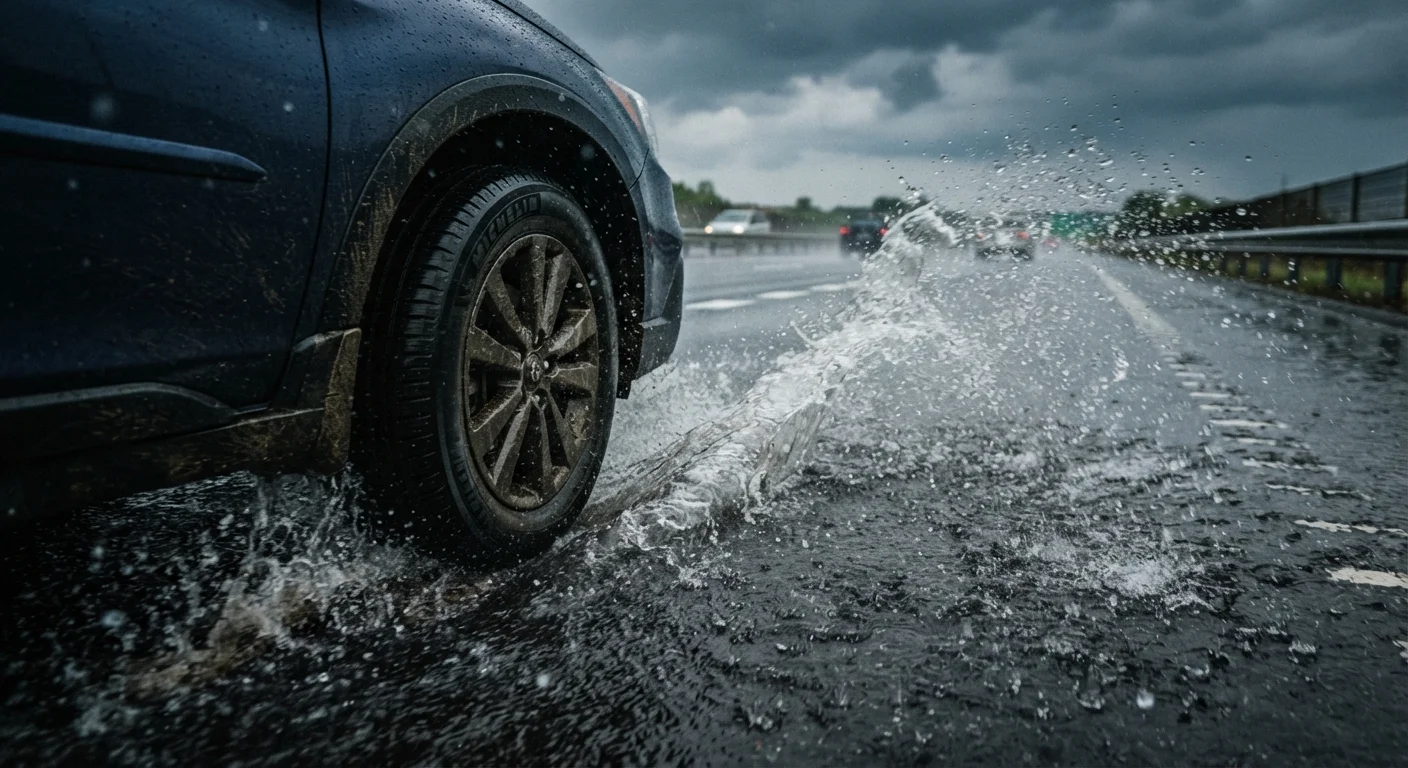
Hydroplaning occurs when a layer of water builds up between a vehicle's tires and the road surface faster than the tires can displace it. This water film separates the rubber from the pavement, causing the tire to lose direct contact with the road. The result is a sudden and significant reduction in steering response and braking effectiveness.
The threshold speed at which hydroplaning begins is influenced by tire tread depth, tire pressure, vehicle weight, and water depth - with most passenger vehicles becoming vulnerable at speeds above approximately 35 mph on wet roads.
The Physics Behind Hydroplaning
At the core of hydroplaning is a straightforward conflict: water cannot get out of the way fast enough. As a tire rolls forward, its tread grooves are designed to funnel water outward and rearward, maintaining rubber-to-pavement contact. When speed increases or water depth grows, the volume of water arriving at the tire's leading edge exceeds what the tread can evacuate. Water pressure then forces the tire upward, and the vehicle is effectively riding on a thin, frictionless film.
Three variables control when this happens: speed, water depth, and tire condition. Speed is the most significant - the faster a vehicle travels, the less time the tread has to displace water. Even a shallow film of water, sometimes less than a tenth of an inch, can cause hydroplaning at highway speeds. Tread depth is equally important: new tires have deep channels capable of evacuating roughly a gallon of water per second at speed, while worn tires lose much of that capacity.
Tire pressure also plays a role. Underinflated tires have a larger, more flexible contact patch that can bow in the center, reducing the tread's ability to channel water effectively. Properly inflated tires maintain their intended contact geometry and perform closer to their design specification in wet conditions.
ABS Does Not Prevent Hydroplaning
Anti-lock braking systems are designed to prevent wheel lockup during braking, which helps maintain steering control in a skid. However, ABS cannot restore traction when tires are riding on a water film - it operates after braking is applied, not during the float phase itself. Do not rely on ABS as a substitute for appropriate wet-weather speed.
Recognizing the Sensation and Responding Correctly
Hydroplaning often announces itself through a distinct lightening of the steering wheel - the vehicle feels as though it is floating or drifting, and small steering inputs produce little or no effect. Engine RPM may rise slightly if driven wheels lose road resistance. The key danger in that moment is the instinct to brake hard or yank the wheel, both of which can trigger a skid or spin once the tires suddenly re-engage with the pavement.
The correct response is deliberate and calm:
- Ease off the accelerator smoothly. Do not stomp the brakes.
- Hold the wheel steady, pointing in your intended direction of travel.
- Allow the vehicle to decelerate naturally until you feel the tires reconnect with the road surface.
- If braking is necessary, apply gentle, progressive pressure - modern ABS systems are designed to prevent lockup, but they work best with measured input, not a panic stab.
This response mirrors the logic covered in understanding understeer and oversteer: when traction is lost, aggressive inputs usually make things worse before they make them better.
What To Do When You Feel the Float
The moment steering feels unusually light in wet conditions, ease off the gas without braking and hold your steering line steady. Resist the urge to jerk the wheel or stomp the brake pedal. Most hydroplaning episodes resolve within seconds once speed drops enough for the tires to reconnect with the pavement.
Prevention: What Drivers Can Control
Hydroplaning is largely preventable through habits that are easy to build and inexpensive to maintain.
Slow down in rain. This is the single highest-impact action. Reducing highway speed from 65 mph to 50 mph dramatically lowers the likelihood of reaching the hydroplaning threshold. For a broader look at adapting driving behavior across weather conditions, see driving in rain, snow, ice, and fog.
Maintain tire tread. Check tread depth regularly using a tread-depth gauge or the quarter test. Most experts recommend replacing tires before they reach 4/32 of an inch of remaining tread for meaningful wet-weather safety margins, though the legal minimum in most US states is 2/32 of an inch.
Keep tires properly inflated. Check pressure monthly and before long trips. The correct pressure is found on the door jamb sticker or owner's manual - not the maximum listed on the tire sidewall.
Turn off cruise control in wet conditions. If a vehicle begins to hydroplane while cruise control is active, the system may attempt to maintain speed by applying throttle, which can worsen the loss of control. Disabling cruise control on wet roads keeps the driver in immediate command of acceleration.
Avoid standing water when possible. Puddles can hide road damage and vary significantly in depth. When lanes allow, steer around large water accumulations rather than driving through them at speed.
~75%
Weather-related crashes involving wet pavement
According to the Federal Highway Administration, approximately three-quarters of weather-related vehicle crashes in the US occur on wet pavement rather than snow or ice.
35 mph
Approximate minimum speed for hydroplaning risk
Transportation safety researchers generally identify approximately 35 mph as the lower threshold at which passenger vehicles become vulnerable to hydroplaning on wet roads, depending on tire and road conditions.
4/32"
Tread depth where wet-weather grip declines noticeably
Industry testing consistently shows a measurable increase in wet braking distance when tread depth falls below 4/32 of an inch, well before reaching the legal minimum of 2/32 of an inch.