

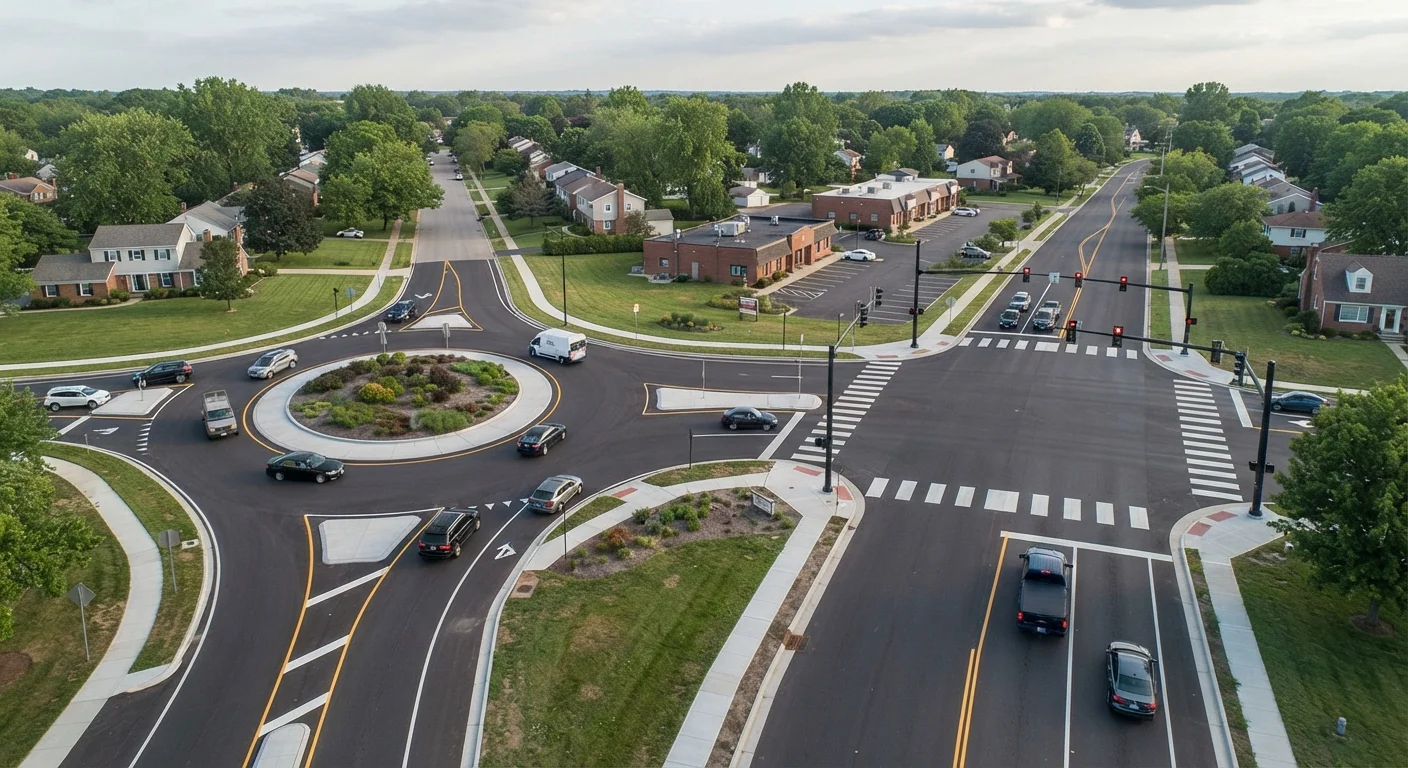
Key Takeaways
- At a roundabout, drivers yield to circulating traffic already inside the circle before entering.
- Traditional intersections use traffic signals or stop signs to assign right-of-way in sequence.
- Roundabouts eliminate left-turn conflicts, which are among the most common crash scenarios at intersections.
- Speed inside a roundabout is intentionally low - typically 15-20 mph - reducing crash severity.
- Understanding which lane to enter at a multi-lane roundabout is the step most drivers find confusing.
- Both intersection types require full attention to road markings, signage, and pedestrian crossings.
Option A
Roundabout
The circular, yield-based intersection designed for continuous flow.
Best for: Locations where traffic volumes are moderate and steady, and where reducing severe-angle collisions is a priority.
Option B
Traditional Intersection
The familiar stop-or-signal controlled crossing that most US drivers learned on.
Best for: High-volume corridors, multi-lane arterials, and situations where pedestrian crossing phases need explicit management.
If you encounter an unfamiliar roundabout
Roundabout
Follow the yield sign, enter when clear, stay in your lane through the circle, and signal before your exit. The rules are consistent at every roundabout.
If you're navigating a busy urban arterial
Traditional Intersection
Signals coordinate heavy, multi-directional traffic and provide dedicated pedestrian phases that roundabouts handle less efficiently at high volumes.
If you want to understand crash-risk differences
Roundabout
Research from the Insurance Institute for Highway Safety indicates roundabouts significantly reduce fatal and injury crashes compared with stop- or signal-controlled intersections.
How Each Intersection Type Controls Traffic
Traditional intersections - whether controlled by traffic signals or stop signs - assign right-of-way in a sequential, start-stop pattern. Vehicles wait, then move when granted permission by a signal phase or the rules of precedence. At an all-way stop, drivers take turns based on arrival order and position. See our guide to four-way stop rules for a detailed breakdown of that sequence.
Roundabouts work on an entirely different principle: continuous flow through yielding. Instead of stopping and waiting for a green light, drivers slow as they approach, check for vehicles already circulating inside the circle, and merge when there is a safe gap. Traffic moves counterclockwise around a central island. Because vehicles are always moving in the same direction, the most dangerous collision angles - head-on and right-angle impacts - are largely eliminated.
| Criterion | Roundabout | Traditional Intersection |
|---|---|---|
| Right-of-way method | Yield to circulating traffic | Signal phase or stop-sign order |
| Traffic flow pattern | Continuous, counterclockwise | Sequential, start-stop |
| Typical entry speed | 15-20 mph | Varies; full stop possible |
| Left-turn conflict points | Eliminated by design | Present; managed by signal or judgment |
| Pedestrian crossing | Set-back crosswalks, one lane at a time | Dedicated signal phase |
| Familiarity to US drivers | Growing, but still less common | Universal |
| Crash severity potential | Lower - low speeds, no right-angle impacts | Higher - right-angle and head-on risks present |
Entry, Yield, and Exit: The Key Rule Differences
At a traditional intersection, entry is governed by a signal or sign. A red light means stop; a green means proceed (after checking for cross-traffic). Left turns may require a dedicated arrow phase or a driver's judgment during a permissive green. Pedestrians receive their own crossing phase. The system is familiar to nearly every licensed US driver.
At a roundabout, three rules cover almost everything:
- Slow down on approach. Speed advisory signs typically indicate 15-20 mph inside the circle.
- Yield to circulating traffic. The dashed yield line at the entry is the key control point. If vehicles are in the circle, wait for a gap.
- Choose the correct lane before entering. At multi-lane roundabouts, right exits use the right lane; left exits (or going most of the way around) use the left lane. Lane markings and signs provide guidance - read them before you reach the yield line.
Exiting is straightforward: signal right as you approach your exit, then leave the circle. Pedestrian crossings at roundabouts are set back from the yield line, giving drivers a moment to focus on one task at a time. For a broader look at how right-of-way applies across intersection types, see right-of-way rules every US driver should know.
78%
Reduction in injury crashes
The Insurance Institute for Highway Safety (IIHS) reports roundabouts reduce injury crashes by approximately 78% compared with stop-controlled intersections.
~90%
Fewer fatal crashes
IIHS research also indicates roughly a 90% reduction in fatal crashes at locations converted from traditional intersections to roundabouts.
~7,000
Roundabouts in the US
The number of roundabouts in the United States has grown substantially over the past two decades, according to Federal Highway Administration data.
Common Points of Confusion - and How to Resolve Them
Most roundabout anxiety comes from two specific moments: choosing the right entry lane and knowing when it is actually safe to enter. Both concerns are manageable with a consistent approach.
Lane selection: Before reaching the roundabout, check the overhead or roadside signs showing which lanes serve which exits. If you miss the sign, choosing the right lane and looping around again is safer than a last-second lane change inside the circle.
When to enter: Watch only the circulating lanes you will cross when merging - not vehicles on the far side of the roundabout. If those lanes are clear, you may enter. If they are occupied, wait. Gaps open quickly at the low speeds typical inside a roundabout.
Drivers new to unfamiliar road environments may also find it useful to review how to navigate unfamiliar roads without panicking - the mental habits there apply equally to encountering a roundabout for the first time.
Emergency Vehicles at Roundabouts
If an emergency vehicle approaches while you are inside a roundabout, exit the circle at your nearest available exit before pulling over - do not stop inside the roundabout. At a traditional intersection, pull to the right and stop as directed by local traffic law. In both cases, clear the intersection or circle before yielding.