

| Intersection type | All-way (four-way) stop |
| Primary rule | First to stop, first to go |
| Tie-breaker rule | Yield to the driver on your right |
| Left turn vs. straight | Straight traffic has the right of way |
| Signage | Each approach marked with a STOP sign plus an ALL WAY or 4-WAY placard |
| Stop requirement | Complete stop before the stop line is legally required |
How the Order of Precedence Works
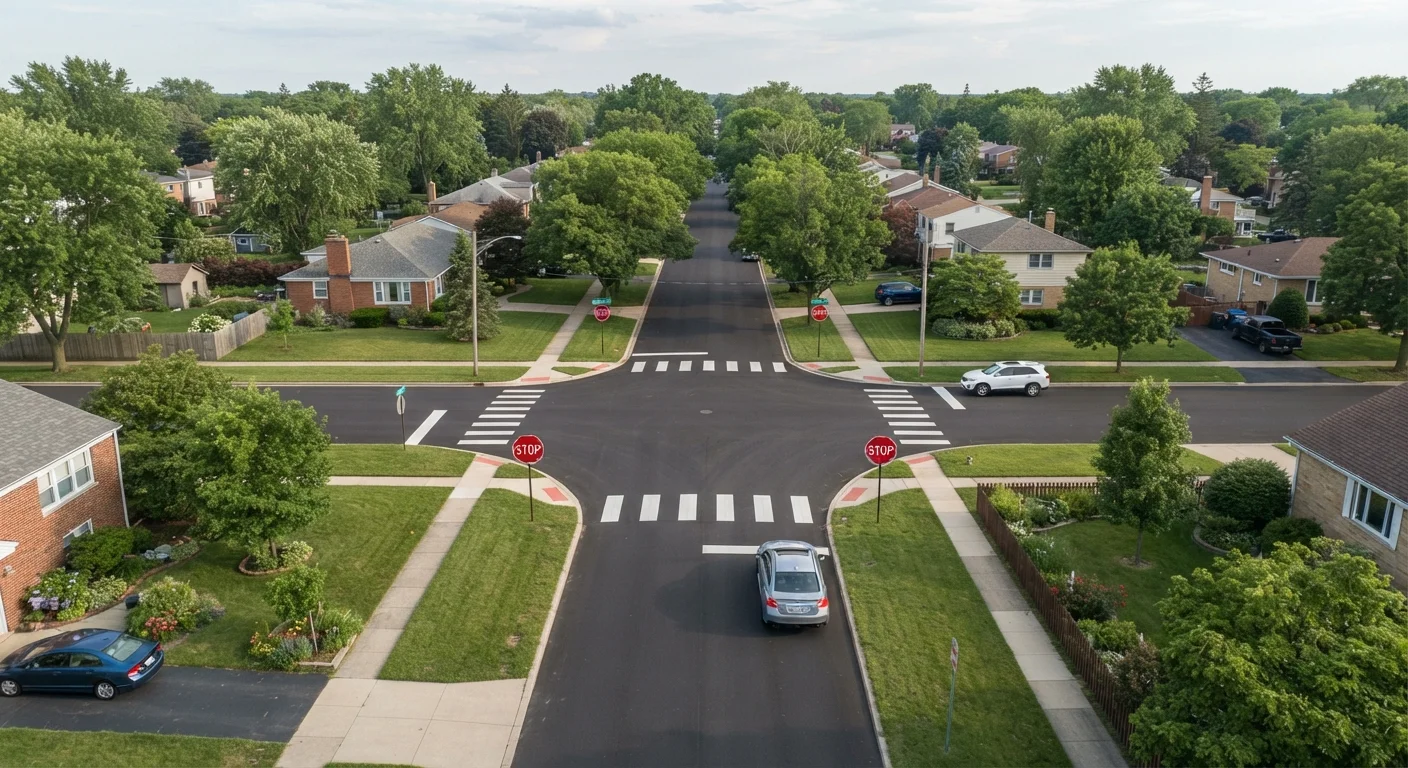
At an all-way stop - also called a four-way stop - every driver must come to a complete stop before proceeding. From there, a consistent set of precedence rules determines who goes first. These rules are uniform across most US states and are grounded in the same foundational right-of-way principles that govern other intersections.
| Intersection type | All-way (four-way) stop |
| Primary rule | First to stop, first to go |
| Tie-breaker rule | Yield to the driver on your right |
| Left turn vs. straight | Straight traffic has the right of way |
| Signage | Each approach marked with a STOP sign plus an ALL WAY or 4-WAY placard |
| Stop requirement | Complete stop before the stop line is legally required |
Rule 1: First to Arrive, First to Go
The driver who stops at the intersection first has the right of way. If only one vehicle is present when you arrive, that vehicle proceeds before you. This is the most commonly applied rule in everyday driving - but it only works cleanly when arrivals are clearly staggered. For a broader look at how right-of-way logic applies across different road situations, see Right-of-Way Rules Every US Driver Should Know.
Rule 2: Simultaneous Arrival - Yield to the Right
When two vehicles arrive at the same time, the driver on the left yields to the driver on the right. This is the standard tie-breaker and applies when two vehicles are stopped across from each other at 90-degree angles.
Rule 3: Opposite Directions - Straight Traffic Has Priority
When two vehicles face each other (arriving from opposite directions simultaneously) and one plans to turn left while the other goes straight, the vehicle going straight has the right of way. The left-turning driver must wait. This mirrors general left-turn yield rules throughout US traffic law.
Rule 4: Three or Four Vehicles Arrive Together
This is the most complex scenario. With three or four vehicles arriving at once, the yield-to-the-right principle cascades - each driver checks whether anyone to their right is also ready to proceed. In practice, drivers often make brief eye contact or use hand signals to establish a clear order. Patience and communication matter more here than strict sequence.
Common Mistakes and What to Watch For
Four-way stops generate more confusion than almost any other everyday driving scenario. Several common driving myths - like the idea that the largest vehicle always goes first, or that the driver who waves someone through forfeits any liability - have no basis in traffic law.
All-way stop
An intersection where stop signs face every approach, requiring all entering vehicles to stop regardless of direction. Also called a four-way stop.
Right of way
The legal entitlement of a driver to proceed through an intersection before another vehicle. Right of way is assigned by traffic rules, not negotiated between drivers.
Yield
To slow or stop and allow another vehicle to proceed first. At a four-way stop, yielding means waiting until the driver with precedence has cleared the intersection.
Rolling stop
Slowing significantly without coming to a complete halt at a stop sign. A rolling stop does not fulfill the legal stop requirement and may result in a traffic citation.
Mistakes That Cause Conflict
- Creeping forward without stopping: A rolling stop does not satisfy the legal requirement. All four wheels must come to a complete stop before the line.
- Assuming arrival order when it isn't clear: If you genuinely aren't sure who arrived first, it's safer to pause briefly and let the other driver proceed.
- Waving others through carelessly: Gesturing another driver to go can create confusion if a third vehicle misreads the signal. Proceed predictably according to the rules rather than improvising.
- Failing to signal turns: Signaling your intended direction before you pull forward helps other stopped drivers anticipate your path and reduces hesitation.
Maintaining appropriate spacing as you approach a stop also matters. The safe following distance principles that apply on open roads help here too - approaching a four-way stop too closely behind another vehicle limits your view of who else is present.
Finally, note that four-way stops differ significantly from roundabouts, where yielding rules apply at entry rather than at a fixed stop line. The comparison between roundabouts and traditional intersections explains those distinctions in detail.