

| Legal basis | Each state's vehicle code |
| Core principle | Assigns the duty to yield, not the right to proceed |
| Pedestrian crosswalk priority | Pedestrians generally have right-of-way in marked crosswalks in all 50 states |
| Roundabout entry rule | Yield to circulating traffic before entering |
| Simultaneous arrival tie-breaker | Yield to the vehicle on your right |
| Highway merge obligation | Entering drivers must yield to mainline traffic in most states |
What Right-of-Way Actually Means
Right-of-way is not a right you own - it's a rule about who should yield in a given traffic situation. No law gives any driver an absolute, unconditional right to proceed. Instead, right-of-way rules assign the obligation to yield to one party so that others may proceed safely. Understanding this distinction matters: even if another driver fails to yield, proceeding recklessly can still make you legally and financially liable for a collision.
| Legal basis | Each state's vehicle code |
| Core principle | Assigns the duty to yield, not the right to proceed |
| Pedestrian crosswalk priority | Pedestrians generally have right-of-way in marked crosswalks in all 50 states |
| Roundabout entry rule | Yield to circulating traffic before entering |
| Simultaneous arrival tie-breaker | Yield to the vehicle on your right |
| Highway merge obligation | Entering drivers must yield to mainline traffic in most states |
Right-of-way rules are established in each state's vehicle code, so minor details can vary. The core principles, however, are consistent across all 50 states and the District of Columbia. Learn how road sign colors reinforce these rules and which markings signal who must yield.
Intersections: Signals, Signs, and Uncontrolled Crossings
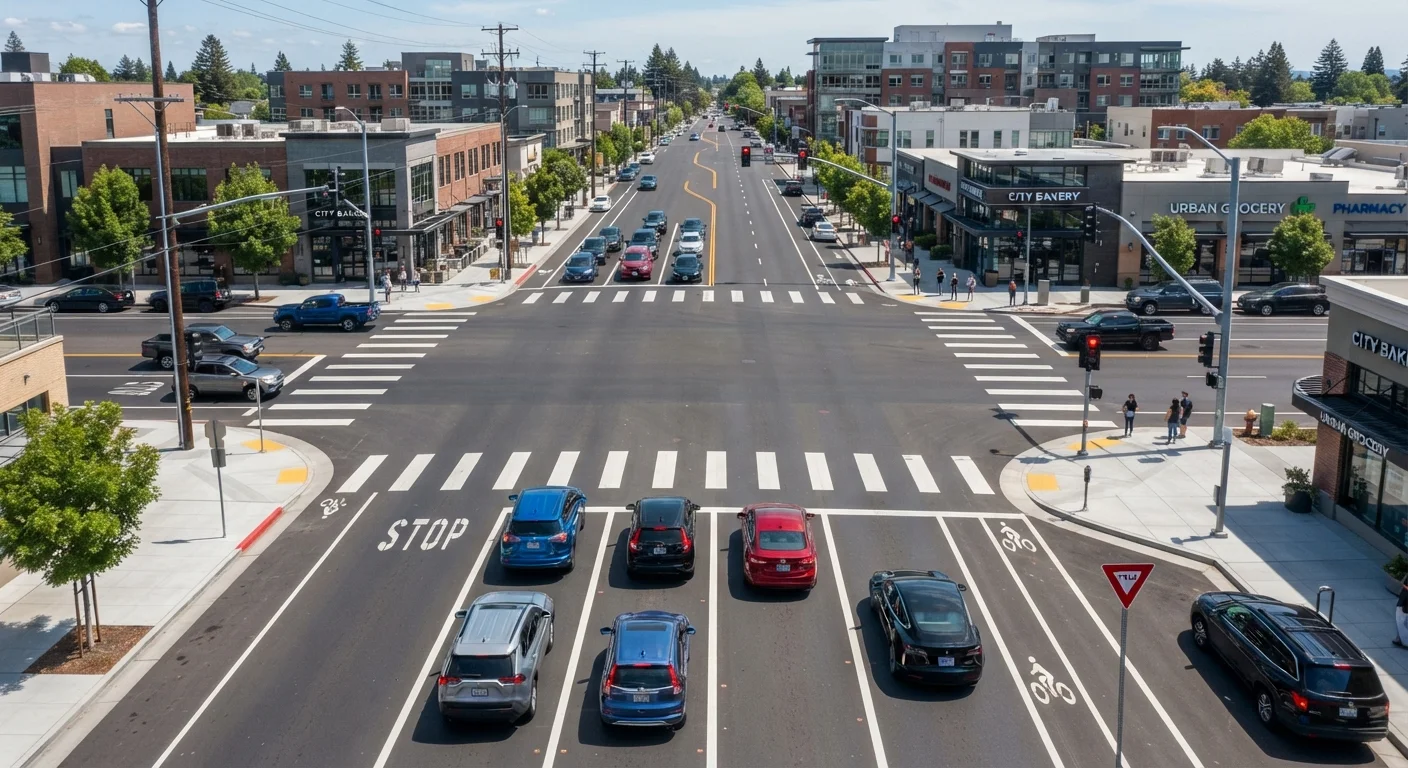
Traffic signals are the most familiar right-of-way tool. A green light permits movement - it does not guarantee the intersection is clear. Drivers must still check for cross-traffic before entering.
Stop signs: Drivers must come to a complete stop and yield to all traffic and pedestrians in or approaching the intersection before proceeding. At an all-way stop, the first vehicle to arrive goes first. When two vehicles arrive simultaneously, the driver on the left yields to the driver on the right. For a full breakdown of tie-breaking scenarios, see four-way stop rules explained.
Yield signs: Drivers must slow down and give way to traffic already in the intersection or close enough to pose a hazard. A stop is only required if needed to comply safely.
Uncontrolled intersections (no signs or signals): Treat them as yield situations. Yield to any vehicle already in the intersection, and to the vehicle on your right when two vehicles arrive at the same time.
Right-of-way
The legally assigned priority that determines which driver, cyclist, or pedestrian may proceed first in a given traffic situation. It is always granted by one party yielding, not seized unilaterally.
Yield
To slow down, stop if necessary, and allow another vehicle or pedestrian to proceed before you do. A yield obligation does not always require a full stop - only safe compliance.
Uncontrolled intersection
An intersection without traffic signals, stop signs, or yield signs. Drivers approaching must use judgment, proceed cautiously, and yield to vehicles already present or approaching from the right.
Roundabout
A circular intersection where traffic flows counterclockwise around a central island. Vehicles already in the circle have priority over those entering from any approach.
All-way stop
An intersection where every approach has a stop sign. The first vehicle to arrive and stop has priority; simultaneous arrivals yield to the driver on the right.
Roundabouts, Merge Lanes, and Special Situations
Roundabouts: Vehicles already circulating inside the roundabout have right-of-way over entering vehicles. Drivers approaching a roundabout entry must yield, wait for a gap, then merge counterclockwise. Do not stop inside the roundabout unless traffic forces it. For a side-by-side comparison of roundabout and traditional intersection rules, see how roundabouts differ from standard intersections.
Highway on-ramps and merge lanes: In most US states, drivers entering a highway from an on-ramp are legally required to yield to traffic already on the main roadway. Highway traffic generally does not have a legal obligation to move over, though courteous driving often facilitates smooth merging. For specifics on the zipper merge and state-by-state legal obligations, see who has the right when merging on the highway. New to highway driving entirely? Driving on the interstate for the first time covers entry and exit fundamentals.
Pedestrians and cyclists: Pedestrians in a marked crosswalk - and in many states, an unmarked crosswalk at an intersection - have right-of-way over turning vehicles. Cyclists operating legally on the roadway generally have the same rights and responsibilities as motor vehicles.
Emergency vehicles: All states require drivers to yield to police, fire, and ambulance vehicles displaying lights or sirens. Pull to the right and stop until the vehicle passes. Separately, Move Over laws require drivers to change lanes or slow down when passing stationary emergency or service vehicles on the shoulder.
Right-of-Way Rules Vary Slightly by State
While core right-of-way principles are consistent nationally, specific rules - such as whether pedestrians in unmarked crosswalks have legal priority, or how roundabout signage is used - can differ by state. Always consult your state's current driver handbook for the exact language that applies where you drive. This article provides general educational information, not legal advice.