

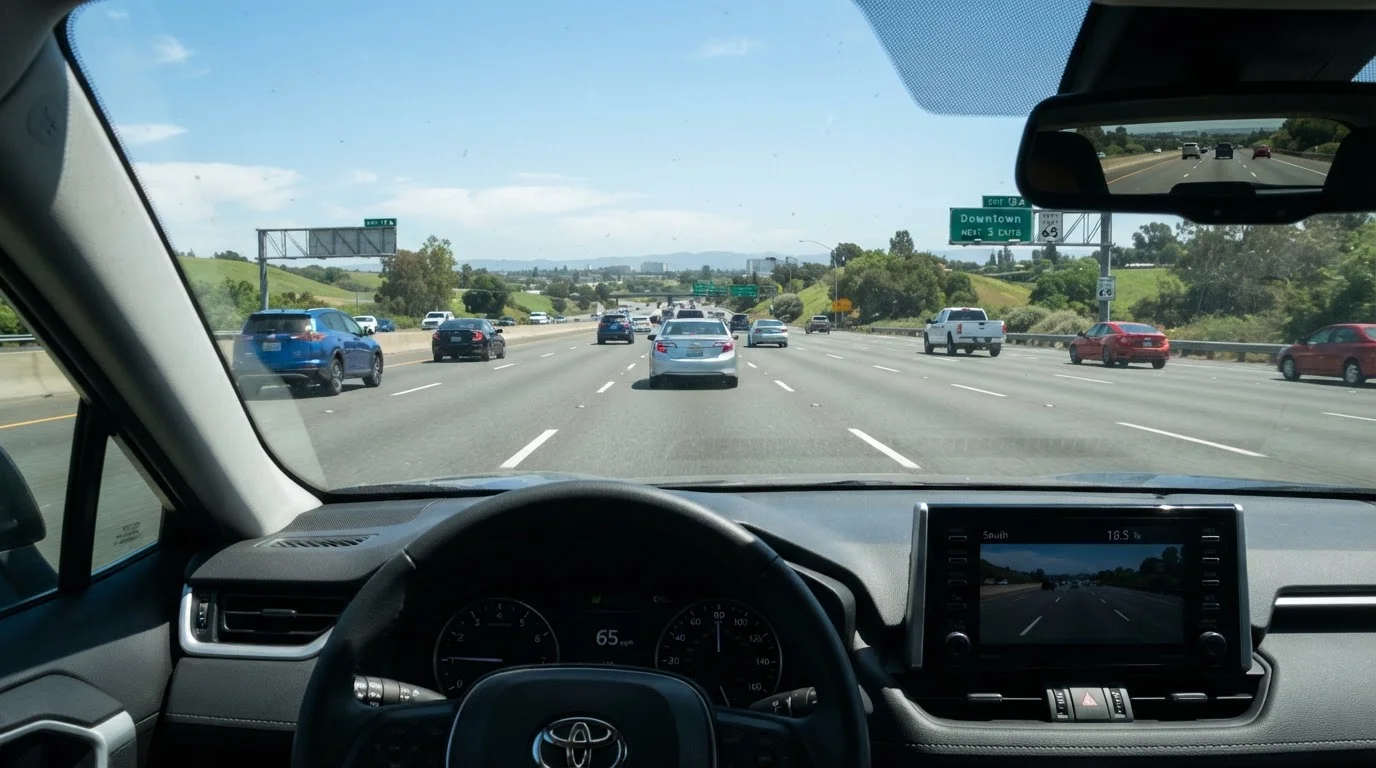
Key Takeaways
- The three-second rule is the baseline for safe following distance under normal conditions.
- Tailgating significantly reduces reaction time and is a leading cause of rear-end collisions.
- Following distance should increase in rain, fog, darkness, heavy loads, or at highway speeds.
- Large trucks require even more space due to their longer stopping distances.
- Maintaining a gap also improves fuel efficiency by reducing unnecessary braking.
Safe Following Distance
Safe following distance is the amount of space a driver intentionally keeps between their vehicle and the one ahead. It exists to give you enough time to perceive a hazard, react, and brake before a collision occurs. In standard conditions, traffic safety guidance recommends at least a three-second gap between your car and the vehicle in front.
Stopping distance is the sum of reaction distance - how far you travel while your brain processes a threat and your foot reaches the brake - plus braking distance, the space needed to bring the vehicle to a full stop. At 60 mph, total stopping distance can exceed 300 feet.
The Three-Second Rule Explained
The three-second rule is the standard baseline taught in US driver's education. To apply it, choose a stationary landmark - a bridge, a road sign, a light pole. The moment the vehicle ahead passes that landmark, begin counting: one-one-thousand, two-one-thousand, three-one-thousand. If your vehicle reaches the same landmark before you finish, close the gap.
The rule's value is that it scales automatically with speed. At 30 mph, three seconds translates to roughly 132 feet of space. At 70 mph, that same three seconds equals about 308 feet - considerably more pavement between you and the vehicle ahead, exactly as needed. This self-adjusting quality makes the method practical in real driving without requiring mental math.
Use a Fixed Object, Not the Car Itself
When applying the three-second rule, always use a stationary landmark - not the rear bumper of the car ahead - as your reference point. Judging distance visually against a moving target is unreliable and inconsistent. A road sign or overpass gives you a fixed, objective marker every time.
What makes this spacing meaningful is stopping physics. The average driver takes roughly 1.5 seconds to perceive a hazard and move their foot to the brake pedal. The remaining time accounts for actual braking. Shrink the gap and you remove the buffer - not just for comfort, but for physics.
Why Tailgating Is More Dangerous Than Drivers Assume
Tailgating is so common on American roads that many drivers have stopped registering it as risky behavior. But following at one car length or less at highway speeds leaves virtually zero margin for error. If the driver ahead brakes suddenly - for a debris strike, a deer, or a stalled car just over a hill - there is simply not enough distance to stop.
~29%
Share of all US crashes that are rear-end collisions
According to the National Highway Traffic Safety Administration (NHTSA), rear-end crashes are one of the most common crash types on American roads.
1.5 sec
Average driver perception-reaction time
Traffic safety research generally estimates that drivers take approximately 1.5 seconds to recognize a hazard and initiate braking - a key factor in calculating needed following distance.
300+ ft
Stopping distance at 60 mph on dry pavement
This combined figure - reaction distance plus braking distance - illustrates why the three-second rule provides a meaningful safety buffer at highway speeds.
Rear-end collisions account for a substantial share of all US traffic crashes each year, and insufficient following distance is among the most frequently cited contributing factors. The consequences range from minor fender damage to serious injury, particularly whiplash, which can have lasting effects even after low-speed impacts.
Aggressive tailgating also creates a downstream problem: the driver ahead may brake more frequently out of anxiety, which compresses the flow of traffic behind them. This accordion effect - sometimes called a "traffic wave" - can trigger slowdowns miles back with no visible cause at the front.
For a broader look at how spacing and awareness interact after dark, see night driving habits that reduce risk, where reduced visibility makes following distance even more critical.
When to Extend Your Following Distance
Three seconds is a floor, not a ceiling. Several conditions demand more space:
- Wet or icy roads: Braking distances increase dramatically on slick surfaces. Four to six seconds is a reasonable minimum in rain; far more on ice or packed snow.
- Reduced visibility: Fog, heavy rain, or driving at night limits how early you can detect a hazard ahead. The less you can see, the more time - and space - you need.
- Towing or hauling: A loaded trailer adds weight and increases stopping distance. Drivers often underestimate this effect until they need to brake hard.
- Following large trucks: Tractor-trailers need considerably more distance to stop than passenger vehicles. Staying well back also keeps you out of their rear blind zone. Sharing the road with large trucks covers these dynamics in detail.
- Unfamiliar roads: On winding, hilly, or construction-zone roads, increase your buffer to account for limited sight lines.
A side benefit of maintaining a comfortable gap: smoother, more fuel-efficient driving. Constant hard braking followed by acceleration is harder on both fuel economy and brake components. Keeping space ahead naturally encourages steadier throttle use.
Following Distance and Vehicle Technology
Many newer vehicles include forward collision warning and automatic emergency braking (AEB) systems. These features can reduce the severity of rear-end crashes, but they are not substitutes for safe following distance. Reaction times for automated systems vary, and the physics of stopping distance apply regardless of driver-assistance technology. Maintain your gap even if your vehicle has these features.
Putting It Into Practice
The three-second rule is easy to understand but easy to abandon under pressure - particularly when another driver is closing in behind you. If someone is following you too closely, the safest response is to gradually increase your own following distance from the car ahead. This gives you more time to brake gently, reducing the chance that the tailgater behind you will be caught off guard.
Avoid the temptation to speed up to satisfy a driver behind you, especially if that means closing your own gap. You control only your own safety margin.
Consistent following distance also helps in unpredictable situations. Common driving myths often include misconceptions about spacing and right-of-way - habits worth examining if you've been driving on autopilot for years.
Safe following distance isn't a defensive driving abstraction. It's a straightforward, physics-grounded habit that gives you the reaction time to handle what the road throws at you.