

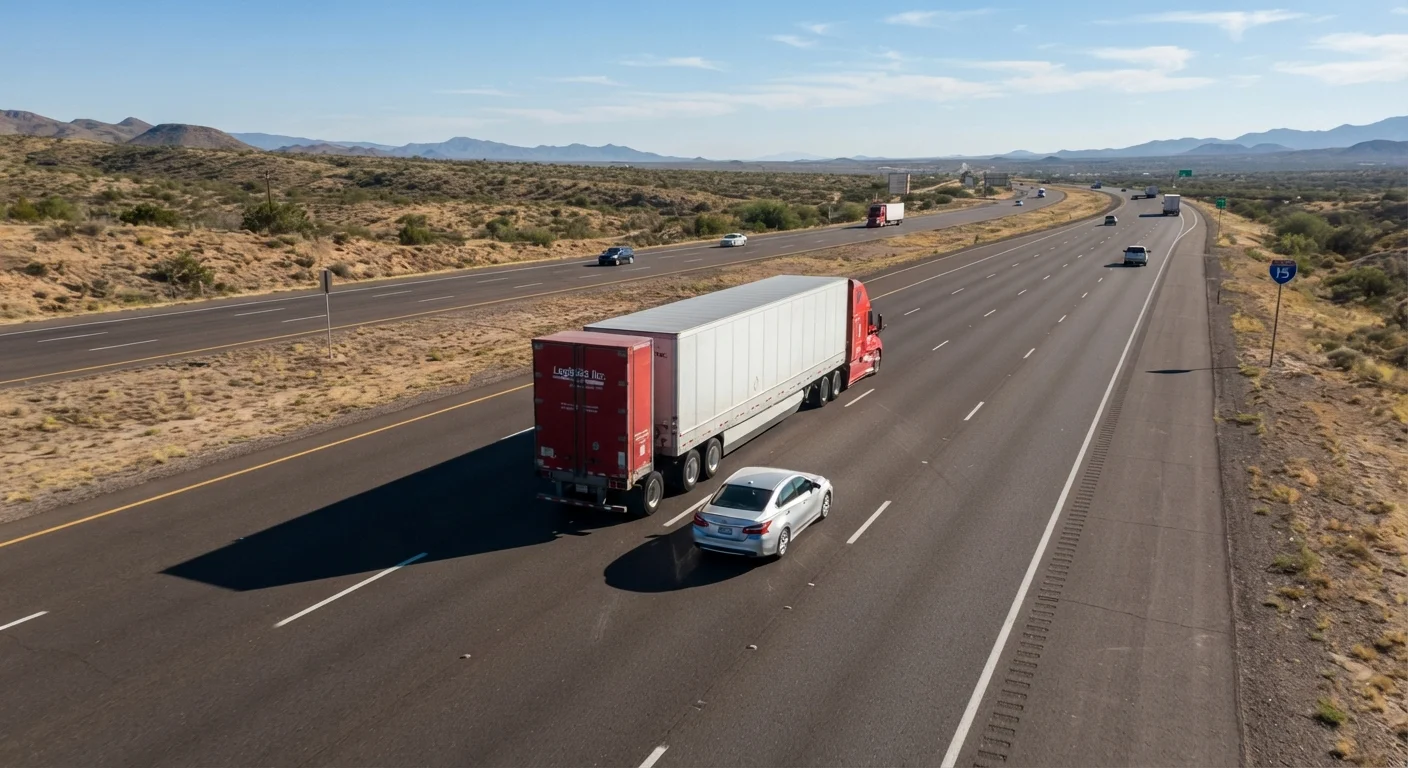
Key Takeaways
- Semi-trucks have four large blind spots where car drivers can completely disappear from the trucker's view.
- Loaded commercial trucks can require up to 40% more stopping distance than a typical passenger vehicle.
- Wide right turns by semi-trailers are a common source of intersection collisions with cars.
- Maintaining adequate following distance and avoiding prolonged blind-spot travel significantly reduces crash risk.
Why Large Trucks Behave Differently
A fully loaded semi-trailer can weigh up to 80,000 pounds - roughly 20 times the weight of an average passenger car. That mass fundamentally changes how these vehicles accelerate, steer, and stop. Recognizing these physical realities helps car drivers make smarter decisions rather than assuming trucks will behave like oversized cars.
Large commercial trucks also have significantly elevated cab positions, which affect sightlines. A trucker sitting 7-8 feet off the ground sees the road very differently than a car driver does - some areas directly in front of and behind the truck are essentially invisible from that vantage point. Combine that with the sheer length of a 53-foot trailer and you have a vehicle that demands deliberate awareness from everyone sharing the road.
Commercial Trucks Are Not All the Same Size
The term 'large truck' covers a wide range - from single-unit box trucks to full 18-wheel tractor-trailer combinations. While the principles here apply broadly, fully loaded semi-trailers represent the most extreme case. Smaller delivery and utility trucks may have shorter stopping distances and tighter turning radii, but still warrant more caution than a typical passenger vehicle.
The Four Blind Spot Zones
The Federal Motor Carrier Safety Administration (FMCSA) identifies four primary blind spot zones around large trucks, sometimes called No-Zones:
- Directly behind the trailer - a zone extending 30 or more feet where the trucker cannot see your vehicle at all.
- Directly in front of the cab - roughly 20 feet, where the elevated hood blocks the driver's view of low vehicles.
- The right side - extending up to two lanes wide, this is the largest and most hazardous blind spot.
- The left side - smaller than the right but still extends one lane beyond the truck.
A practical rule: if you can't see the truck's mirrors, the driver cannot see you. Move through these zones quickly rather than pacing alongside the trailer. For a broader look at blind-spot management in all vehicles, see our guide on blind spots and how to manage them.
Pass trucks deliberately and completely - never linger in blind-spot zones.
Extended time spent beside a truck's No-Zones means the driver has no awareness of your presence, making lane changes by the truck extremely dangerous. Speed through the pass and get clear.
Leave extra following distance - at least four seconds - when traveling behind a truck.
The rear No-Zone and the truck's extended stopping distance both demand more buffer than typical car-following rules. Adequate space gives you time to react to debris, blowouts, or sudden braking.
Never position your vehicle in the gap to the right of a truck signaling a right turn.
The wide right-turn swing is counterintuitive; the space that opens on the right is not an invitation to proceed - it will close rapidly as the trailer tracks the curve, potentially trapping smaller vehicles.
Signal lane changes early and increase following distance before merging in front of a truck.
Trucks need predictable, gradual changes to adjust their speed and position. Cutting in abruptly leaves the driver with little margin to react, given their extended stopping distance.
Increase lateral spacing from trucks in windy or adverse weather conditions.
High-profile vehicles like box trailers are susceptible to wind-induced lateral drift, particularly on bridges and open roads. A wider buffer reduces the risk of a sudden lane intrusion reaching your vehicle.
Stopping Distance, Following Distance, and Merging
Physics dictates that a loaded truck traveling at highway speed needs considerably more room to stop than your car. FMCSA data indicates that a fully loaded truck traveling at 65 mph can require up to 525 feet to come to a complete stop - nearly two football fields. Wet or slippery roads extend that further.
This has two direct implications for car drivers:
- Don't cut in front of trucks after passing. Moving into a gap that looks comfortable to you may be dangerously short for a truck driver who cannot brake quickly. Signal early, pass completely, and leave ample space before returning to the lane.
- Maintain extra following distance behind trucks. In addition to the rear blind spot, debris can fall from trailers and tire blowouts are more common on large commercial vehicles. Our article on safe following distance explains how to calibrate the right gap at various speeds.
Wide Turns and Intersection Awareness
Semi-trucks often swing left before executing a right turn - a necessary maneuver to prevent the rear trailer wheels from riding up over curbs or striking objects. This swing can be misread by car drivers as the truck moving out of the way, prompting them to pull up on the right. That gap is a trap: the trailer will sweep back to the right and can crush a vehicle caught there.
At intersections, give trucks additional room and never pull alongside a truck that has its right turn signal activated. Watch trailer wheels, not just the cab, for cues about where the vehicle is actually traveling. Understanding right-of-way rules also helps you anticipate how intersections should be navigated when large vehicles are involved.
~525 ft
Stopping distance for a loaded truck at 65 mph
According to FMCSA guidelines, a fully loaded commercial truck traveling at highway speed may need nearly the length of two football fields to stop.
80,000 lbs
Maximum legal gross weight for US commercial trucks
Federal bridge and road laws cap combination vehicle weight at 80,000 pounds, roughly 20 times the weight of a typical passenger car.
Night Driving and Adverse Conditions
Sharing the road with large trucks after dark or in adverse weather adds layers of complexity. Truck marker lights and reflective tape help, but their actual dimensions can still be deceptive at night. Always account for the full width and length of a trailer, not just the lights you can see.
High winds affect trucks disproportionately - a loaded trailer acts like a sail. Bridge crossings and open stretches of highway can cause sudden lane drift. Maintain lateral distance when conditions are gusty, and avoid lingering alongside a truck in these situations. For broader strategies on low-visibility driving, see night driving habits that reduce risk.
Use Truck Marker Lights as a Size Guide
At night, the amber and red marker lights running along a trailer's sides and top corners mark its actual outer dimensions. Use them to judge the truck's true width and length rather than guessing from the cab lights alone. This is especially useful when a truck is making a wide turn or changing lanes in low-visibility conditions.