

Key Takeaways
- The human body continues moving at the vehicle's speed after a crash begins, creating dangerous secondary impact.
- Seat belts reduce the risk of fatal injury in frontal crashes by roughly half, according to NHTSA data.
- Crumple zones extend crash duration by fractions of a second, significantly reducing peak force on occupants.
- Airbags are designed to work with seat belts, not replace them - unrestrained occupants can be harmed by airbag deployment.
- Internal injuries can occur even without visible trauma, making post-crash medical evaluation important.
Crash Biomechanics
Crash biomechanics is the study of how physical forces from a collision affect the human body. When a vehicle stops suddenly, occupants continue moving at the vehicle's original speed until something - a seat belt, airbag, or dashboard - stops them. Understanding these forces helps explain why certain safety features save lives.
Engineers describe crash forces in terms of g-force (gravitational acceleration). A 30 mph frontal collision can expose an unrestrained occupant to forces exceeding 30-50g in milliseconds.
The Physics Behind a Collision
Every crash is fundamentally a physics problem. When a vehicle traveling at highway speed strikes an object and stops, the vehicle decelerates rapidly - but the occupants inside do not. Newton's first law of motion governs what happens next: a body in motion stays in motion until acted upon by an external force.
That external force is whatever the occupant contacts first. Without restraints, it's typically the steering wheel, dashboard, or windshield. With a properly worn seat belt, that force is distributed across the belt webbing and, when deployed, supplemented by the airbag.
Speed matters enormously in determining injury severity. The energy that must be dissipated in a crash increases with the square of velocity - meaning doubling speed from 30 mph to 60 mph quadruples the kinetic energy involved. Engineers and researchers use this relationship to design vehicles that manage energy rather than simply resist it.
~45%
Reduction in frontal crash fatality risk with seat belts
According to the National Highway Traffic Safety Administration (NHTSA), seat belts reduce front-seat passenger fatality risk by approximately 45% in frontal crashes.
4×
Increase in crash energy when speed doubles
Because kinetic energy scales with the square of velocity, doubling speed from 30 to 60 mph quadruples the energy that must be managed in a collision.
~30 ms
Time for an airbag to fully deploy
Airbag systems are designed to fully inflate in approximately 30 milliseconds - faster than the human blink reflex - to cushion occupants at the moment of peak impact.
What Happens to the Body, Step by Step
A crash unfolds in three distinct phases, each lasting only milliseconds but each causing distinct physical effects on occupants.
Phase 1: Vehicle Deceleration
In the first few milliseconds, the vehicle's crumple zones begin to collapse, absorbing kinetic energy. The passenger cabin slows dramatically. Properly restrained occupants begin decelerating with the vehicle structure, which is the intended outcome.
Phase 2: Occupant Motion
The restrained body experiences a rapid forward and downward load through the seat belt. The chest compresses against the belt, the pelvis loads against the lap portion, and the airbag - if equipped and triggered - cushions the face and chest from the steering wheel or dashboard. Unrestrained occupants continue at the vehicle's original speed and strike interior surfaces with tremendous force.
Phase 3: Secondary Impacts and Internal Motion
Even after the primary impact, organs within the body continue moving briefly. The brain can impact the interior of the skull, causing contusion or concussion. The aorta - the body's largest artery - can tear due to differential deceleration between it and the heart. Solid organs like the liver and spleen are vulnerable to laceration from compressive forces. These internal injuries may not be immediately apparent, which is why seeking prompt medical evaluation after any crash is critical.
Always Wear Your Seat Belt Correctly
The shoulder belt should cross the chest and rest over the collarbone - never tucked behind the back or under the arm. The lap belt should sit low across the pelvis, not across the abdomen. Improper positioning significantly reduces belt effectiveness and can cause injury during deployment.
How Modern Safety Systems Reduce Harm
Vehicle safety technology is engineered specifically around crash biomechanics - the goal is to reduce peak forces on the body and extend the time over which deceleration occurs.
Crumple zones are sections of the vehicle's front and rear structure designed to progressively collapse during a crash. By deforming in a controlled way, they convert kinetic energy into structural deformation energy and lengthen the crash duration. Even adding 100 milliseconds to a crash sequence meaningfully reduces peak g-force on occupants.
Seat belts with pretensioners retract instantly at crash detection, removing slack and positioning the occupant optimally before peak forces arrive. Load limiters in modern belts then allow controlled webbing release to prevent excessive chest loading.
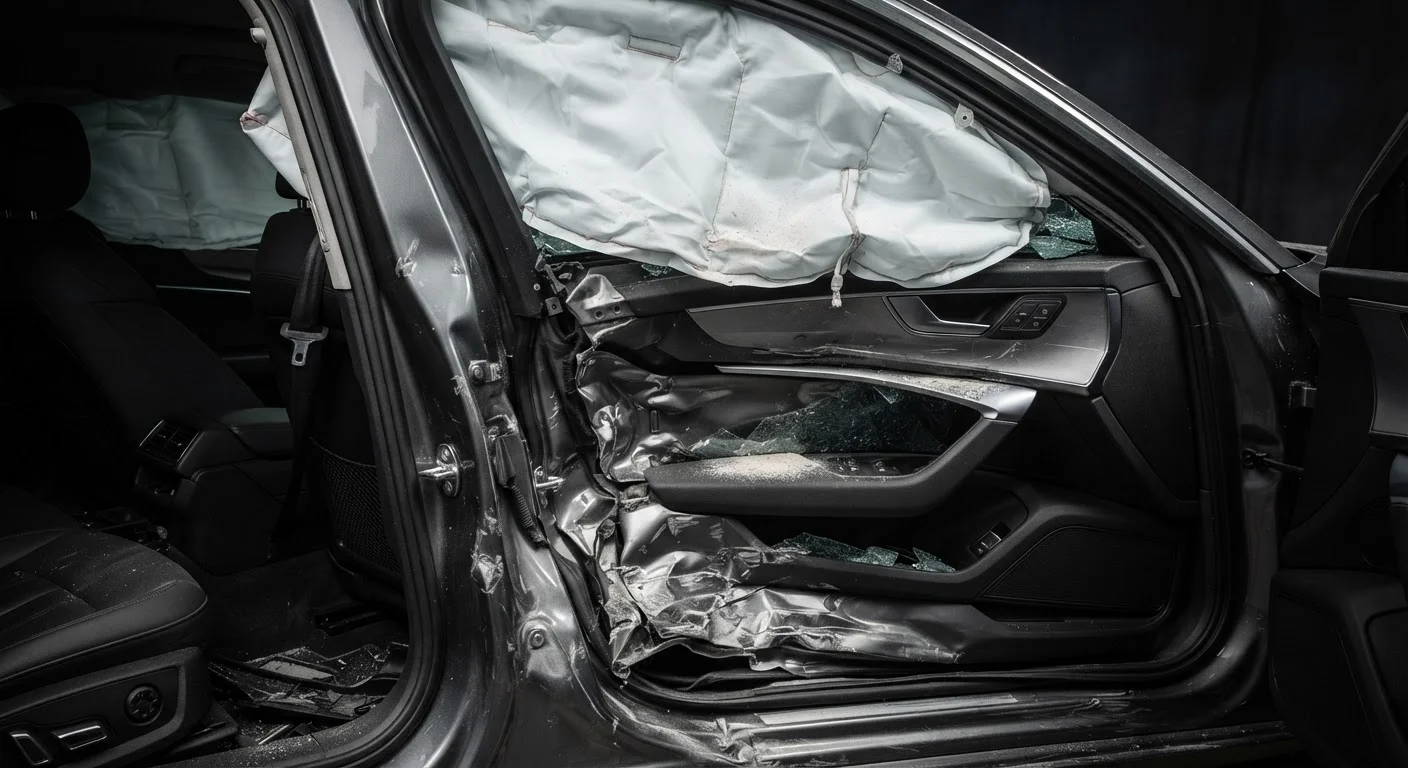
Airbags deploy in roughly 30 milliseconds - faster than a blink - inflating a cushion that absorbs head and chest energy. Side curtain airbags protect against head contact with door structures in side-impact and rollover events.
Together, these systems work as an integrated restraint system. The National Highway Traffic Safety Administration (NHTSA) has documented that seat belts alone reduce the risk of death in frontal crashes by approximately 45% for front-seat passengers. Understanding why these systems work reinforces why using them consistently matters, and it's worth knowing how your insurance coverage responds too - see our overview of collision versus comprehensive coverage for context on post-crash financial protection.
Airbags Are Supplemental Restraints
The term 'SRS' - Supplemental Restraint System - printed on most airbag-equipped steering wheels reflects an important design intent. Airbags are engineered to work alongside seat belts, not independently. An unbelted occupant positioned too close to the steering wheel during deployment can sustain serious injuries from the airbag itself, which inflates with considerable force.
Common Crash Injuries and Why They Occur
The pattern of injuries in a collision is predictable given the physics involved. Understanding their causes - not to alarm, but to inform - helps drivers appreciate what restraint systems are actually protecting against.
- Whiplash and cervical strain: Rapid forward-backward head motion stretches ligaments and muscles in the neck, most commonly in rear-end collisions. Symptoms often emerge 24-48 hours after impact.
- Traumatic brain injury (TBI): The brain can strike the inner skull wall during deceleration. Severity ranges from mild concussion to more serious injury depending on force and direction.
- Rib fractures and chest injuries: Seat belt loading, steering wheel contact, or airbag deployment can fracture ribs or bruise the sternum. These injuries are generally far preferable to the alternative.
- Abdominal organ damage: The liver and spleen are particularly vulnerable to compressive forces in frontal and side impacts. Seatbelt-related abdominal injury, while possible, is significantly less common than the injuries prevented.
- Psychological effects: Crashes can also leave lasting psychological impact. The acute stress response during and after a high-speed event is well-documented, and for some people it can develop into longer-term difficulties - a dimension explored in depth in our article on how trauma affects people differently.
This article is for general educational purposes and does not constitute medical advice. Always consult a qualified healthcare professional following any vehicle collision, even if you feel uninjured.