

| Typical capacity retention at 100,000 miles | ~85-90% for most modern EVs (Various fleet studies and battery analytics research) |
| Federal battery warranty minimum | 8 years / 100,000 miles (U.S. federal regulation for EVs sold in the US) |
| Minimum capacity threshold (most warranties) | 70% of original capacity (Common industry benchmark; terms vary by manufacturer) |
| Primary degradation accelerant | Sustained high heat exposure (Consistent across multiple independent studies) |
| Recommended daily charge ceiling | ~80% for routine use (Guidance from multiple EV manufacturers) |
What the Data Actually Shows
Concern about battery degradation is one of the most common hesitations among prospective EV buyers. The research, while still maturing, offers a more reassuring picture than many assume - though with meaningful caveats.
| Typical capacity retention at 100,000 miles | ~85-90% for most modern EVs (Various fleet studies and battery analytics research) |
| Federal battery warranty minimum | 8 years / 100,000 miles (U.S. federal regulation for EVs sold in the US) |
| Minimum capacity threshold (most warranties) | 70% of original capacity (Common industry benchmark; terms vary by manufacturer) |
| Primary degradation accelerant | Sustained high heat exposure (Consistent across multiple independent studies) |
| Recommended daily charge ceiling | ~80% for routine use (Guidance from multiple EV manufacturers) |
Studies analyzing large fleets of real-world EVs consistently find that modern lithium-ion battery packs lose capacity gradually rather than abruptly. Analysis by battery analytics firms and independent researchers, including data aggregated from tens of thousands of vehicles, generally shows that EVs retain roughly 85-90% of original battery capacity after 100,000 miles or five to eight years of typical use. These figures vary significantly by vehicle model, climate, and charging behavior.
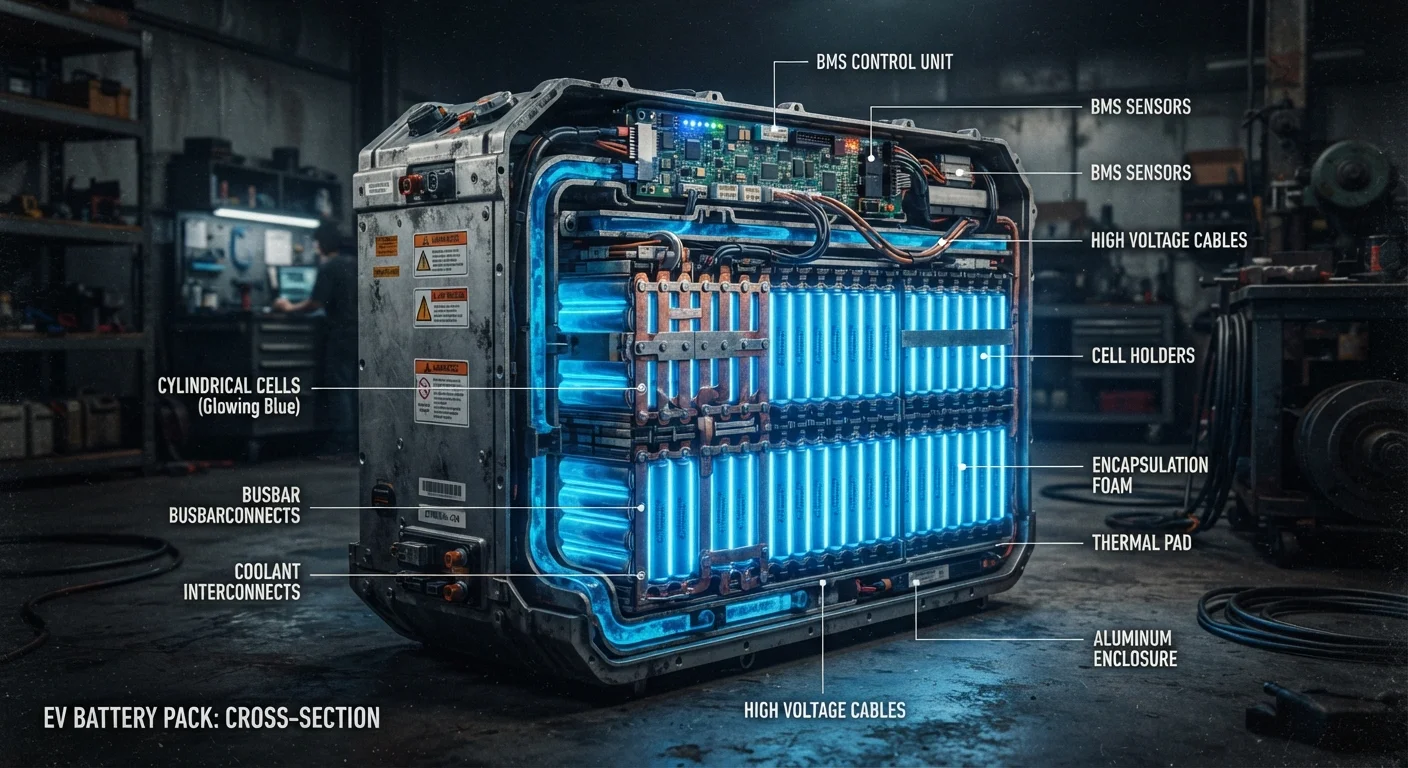
It is worth noting that early-generation EVs - particularly some first-generation models from the early 2010s - showed faster degradation rates than vehicles produced after roughly 2016. Battery management systems (BMS) have improved considerably, and the degradation curves for newer packs are generally shallower. For a plain-language look at the electrochemical mechanisms behind this aging, see our guide to how lithium-ion batteries age.
Key Factors That Accelerate or Slow Degradation
Battery degradation is not a fixed rate - it is shaped by how and where a vehicle is used. Research identifies several variables with the clearest influence:
- Frequent DC fast charging (DCFC): High-current rapid charging generates heat and stresses cell chemistry more than Level 2 AC charging. Occasional fast charging is generally considered acceptable, but relying on it as a primary charging method may accelerate capacity loss over time.
- Chronic high or low state of charge: Keeping a battery consistently near 100% or allowing it to sit near 0% for extended periods stresses the cathode and anode materials. Most automakers recommend daily charging to 80% for routine use.
- Ambient temperature extremes: Heat is particularly corrosive to battery chemistry. Vehicles operated regularly in very hot climates - without active thermal management - tend to show higher degradation rates. Cold weather temporarily reduces range but is generally less damaging long-term than sustained heat. See our detailed explainer on cold weather and EV range loss.
- Charge cycle count: Every full charge-to-discharge cycle contributes incrementally to wear. Partial cycles are less stressful than full cycles.
Battery Degradation
The gradual loss of a battery's ability to store and deliver its original energy capacity over time, caused by chemical and physical changes inside the cells during charge and discharge cycles.
State of Charge (SOC)
The current charge level of a battery expressed as a percentage of its total usable capacity, analogous to a fuel gauge reading.
Battery Management System (BMS)
Electronic hardware and software that monitors and regulates battery temperature, voltage, and current to protect cells from conditions that accelerate wear.
DC Fast Charging (DCFC)
A high-power charging method that delivers direct current directly to the battery, enabling faster charging than standard AC Level 2 chargers but generating more heat in the process.
Capacity Retention
The percentage of an EV battery's original energy storage capacity that remains available after a given number of cycles or period of use. For example, 85% retention means the pack can hold 85% of its original charge.
Charge Cycle
One complete sequence of charging a battery from a depleted state to full, then discharging it again. Partial charges count proportionally - two 50% charges equal roughly one full cycle.
Certain charging habits compound these effects. Our article on charging mistakes that shorten EV battery life covers specific behaviors researchers and automakers flag as problematic.
Warranty Benchmarks and What They Reveal
Federal regulations require automakers selling EVs in the US to provide at least an 8-year / 100,000-mile battery warranty that covers defects and, in most cases, capacity falling below a defined threshold (commonly 70%). Some manufacturers offer more generous terms.
Warranty thresholds are meaningful data points: they represent automaker confidence that the pack will retain a usable portion of its original capacity through that period under normal conditions. Real-world fleet data broadly aligns with this - widespread early battery failures have not materialized as a systemic issue for mainstream vehicles produced after roughly 2017.
85-90%
Average capacity retained after 100,000 miles
Multiple fleet data studies and battery analytics research on modern lithium-ion EV packs.
8 years
Minimum US federal battery warranty period
Required by US federal regulation for electric vehicles sold domestically; some automakers exceed this.
70%
Common warranty capacity floor
Most US EV warranties cover battery replacement or repair if capacity falls below roughly 70% of original within the warranty period.
That said, warranty coverage does not mean degradation is imperceptible. A vehicle retaining 80% of its original range will have measurably fewer miles available per charge - a real consideration, particularly for drivers with longer commutes or limited access to charging infrastructure. Battery health also intersects with resale considerations; see our overview of factors that influence EV resale value.
What Remains Uncertain
Long-term data beyond 150,000-200,000 miles remains relatively sparse, simply because mass-market EVs with modern battery chemistry have not yet accumulated enough mileage at scale. Projections beyond that range carry wider uncertainty bands.
Solid-state battery technology, currently in development, promises different aging characteristics - though it is not yet in consumer vehicles. Our piece on how solid-state batteries could change EVs explains where that technology currently stands.
The interaction between software updates, battery management refinements pushed over-the-air, and long-term capacity is also an evolving area. Some owners have seen both improvements and - in a smaller number of documented cases - unexpected reductions in usable capacity following software changes, illustrating that the relationship between pack hardware and software management is not static.
In summary: current research suggests EV batteries degrade more slowly and more predictably than early fears suggested, but individual outcomes vary. No study or warranty can guarantee a specific result for any particular driver's vehicle.
This article is for general informational purposes only and does not constitute advice about any specific vehicle purchase or financial decision. Consult manufacturer documentation and qualified automotive professionals for guidance relevant to your situation.