

Key Takeaways
- Solid-state batteries swap liquid electrolyte for a solid material, changing the battery's core chemistry.
- They promise higher energy density, meaning more power stored in a smaller, lighter package.
- Removing flammable liquid electrolyte could meaningfully reduce the risk of battery fires.
- Manufacturing at commercial scale remains the primary hurdle delaying widespread adoption.
- Both consumer electronics and electric vehicles stand to benefit, though timelines remain uncertain.
Solid-State Battery
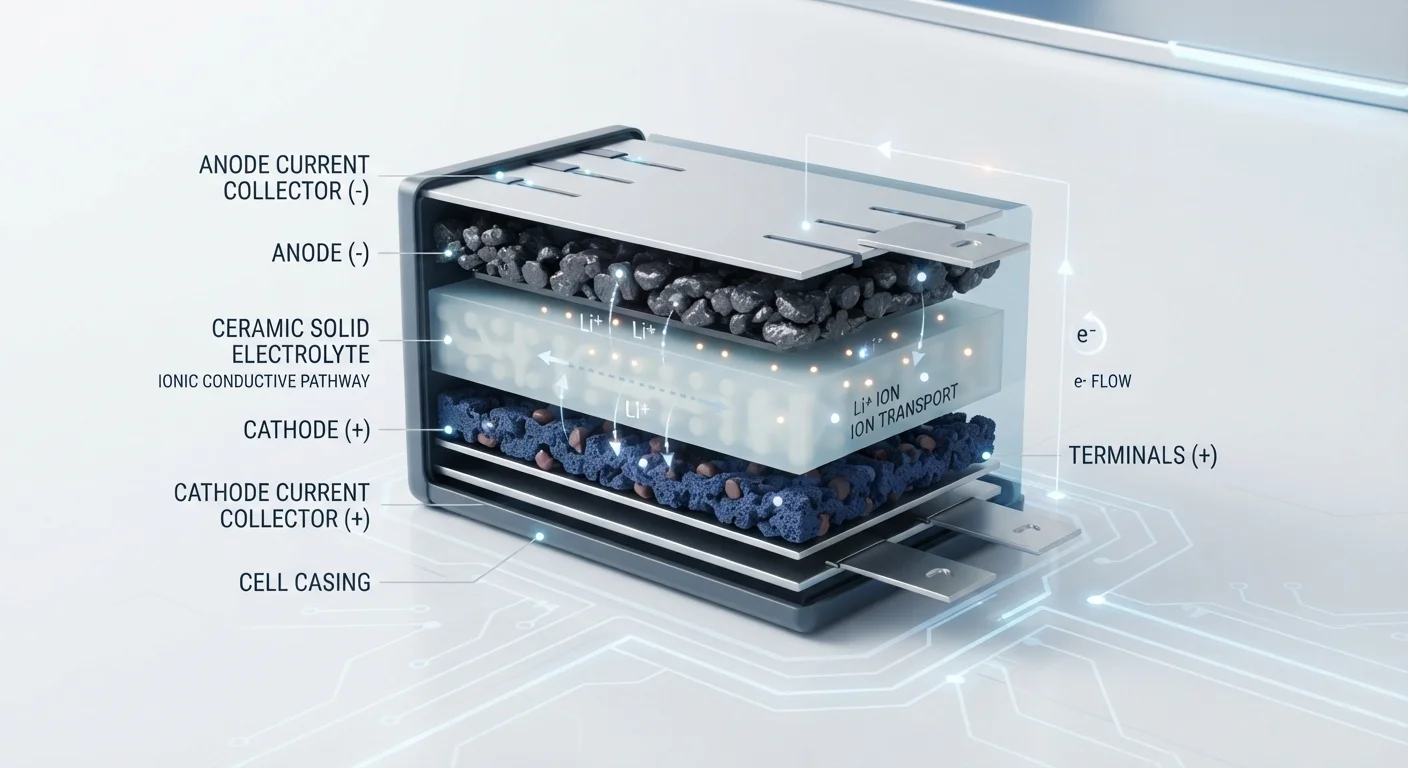
A solid-state battery is a rechargeable battery that uses a solid material as its electrolyte instead of the liquid or gel found in today's lithium-ion cells. The electrolyte is the substance that allows charged particles (ions) to move between the battery's two electrodes. By removing the liquid, solid-state designs aim to store more energy in less space and reduce certain safety risks associated with flammable electrolytes.
Most current research focuses on ceramic, glass, or sulfide-based solid electrolytes, each offering different trade-offs in ionic conductivity, temperature stability, and manufacturing complexity.
What Makes a Battery 'Solid-State'
Every rechargeable battery has three core components: a positive electrode (cathode), a negative electrode (anode), and an electrolyte that carries ions between them during charging and discharging. In today's lithium-ion cells - the dominant technology in phones, laptops, and electric vehicles - that electrolyte is a liquid or gel solution. It works well but comes with constraints: it's flammable, it degrades over time, and it limits how thin or dense the battery can be.
Solid-state batteries replace that liquid layer with a solid material. This single change has cascading effects on performance, safety, and form. The solid electrolyte acts as both the ion conductor and the physical separator between electrodes - simplifying the cell's construction while potentially improving several key metrics.
Not All Solid Electrolytes Are the Same
Solid-state research is divided among several electrolyte chemistries - ceramic oxides, sulfides, and polymers among them. Each has different characteristics for conductivity, temperature range, and how easily it can be manufactured. Progress in one class of solid electrolyte does not automatically apply to others, which is why the field moves along multiple parallel tracks.
The Potential Performance Advantages
The most discussed advantage is energy density - how much energy a battery stores relative to its weight or volume. Solid-state designs can use different electrode materials, including lithium metal anodes, which pack significantly more energy than the graphite anodes in conventional lithium-ion cells. A higher-density battery means a lighter phone that lasts longer, or an EV that travels farther on a single charge without a heavier pack.
~2-3×
Theoretical energy density advantage over lithium-ion
Researchers frequently cite lithium metal anodes as capable of approximately two to three times the theoretical energy density of graphite-based lithium-ion anodes, though real-world performance in commercial cells remains to be demonstrated.
~$100/kWh
Approximate current lithium-ion cost benchmark
Industry analysts track lithium-ion pack costs around this range as a commercial threshold; solid-state production costs remain significantly higher at current development scales.
Late 2020s
Frequently cited target for initial EV applications
Multiple automakers and battery developers have publicly cited late-decade timelines for limited solid-state EV production, though these targets have shifted before and are not guaranteed.
Safety is a second major benefit. Because solid electrolytes are generally non-flammable, the risk of thermal runaway - the chain reaction that can cause lithium-ion batteries to overheat and catch fire - is substantially lower. This matters especially in high-energy applications like EVs, where pack temperatures are actively managed by thermal systems. For more on how current EVs handle that challenge, see how EV thermal management systems work.
Longevity is a third area of interest. Liquid electrolytes degrade with use - a well-documented process explained in detail in our guide to how lithium-ion batteries age. Solid electrolytes may resist some of those degradation mechanisms, though real-world cycle data at commercial scale is still limited.
Where Development Currently Stands
Despite decades of research, solid-state batteries for high-energy applications are not yet in mainstream consumer products. The core obstacles are manufacturing and materials science. Solid electrolyte layers must be extremely thin, uniform, and free of microscopic defects - qualities that are difficult to achieve consistently in mass production. Interfaces between the solid electrolyte and electrodes can also develop resistance over repeated charge cycles, reducing performance.
“Solid-state electrolytes are not a single material - they are a family of chemistries, each with its own trade-offs. The challenge is finding one that is simultaneously conductive enough, stable enough, and manufacturable enough to compete with what liquid electrolytes already do very well.”
— Yet-Ming Chiang, Materials science professor and battery researcher at MIT
Multiple automotive manufacturers and battery developers have announced research programs and pilot facilities, with public timelines frequently targeting the late 2020s for initial vehicle applications. Those timelines have shifted before, and independent analysts generally treat them as targets rather than guarantees. Cost per kilowatt-hour also needs to fall significantly to compete with well-optimized lithium-ion production lines.
What It Could Mean for Everyday Devices and EVs
For consumer electronics, the practical implications include thinner and lighter devices with meaningfully longer battery life, as well as reduced safety concerns in densely packed gadgets. For EVs, the implications extend further - longer range, potentially faster charging, and a lighter pack could influence vehicle design, cost, and long-term battery health. Battery health also directly affects EV resale value, making durability improvements commercially significant.
How to Follow Solid-State Progress Reliably
When reading news about solid-state battery milestones, look for whether results come from laboratory cells or scaled manufacturing. Lab-scale prototypes regularly outperform what is achievable in mass production. Announcements from independent testing or peer-reviewed research typically carry more weight than company press releases alone.
It's also worth noting that solid-state technology doesn't eliminate the battery's end-of-life question. Whatever chemistry is used, batteries eventually reach the end of their useful life - a topic covered in our look at what happens to EV batteries at end of life. Solid-state cells will introduce their own recycling and second-life considerations as the technology matures.
The transition from laboratory promise to mass-market product is rarely linear in battery technology. But the fundamentals of solid-state chemistry represent a genuine architectural shift - not an incremental improvement - and that's why researchers, automakers, and consumer electronics manufacturers are watching its development closely.