

Key Takeaways
- Lithium-ion chemistry makes the last 20% of charge the most chemically stressful for battery cells.
- Charging to 80% daily preserves long-term battery health but isn't necessary before every trip.
- DC fast chargers deliberately slow down above 80% to protect cells - not because of a software glitch.
- Full charges are fine occasionally, especially before long road trips.
- Most modern EVs let you set a charge limit directly in the vehicle settings or companion app.
Charge to 80 Percent
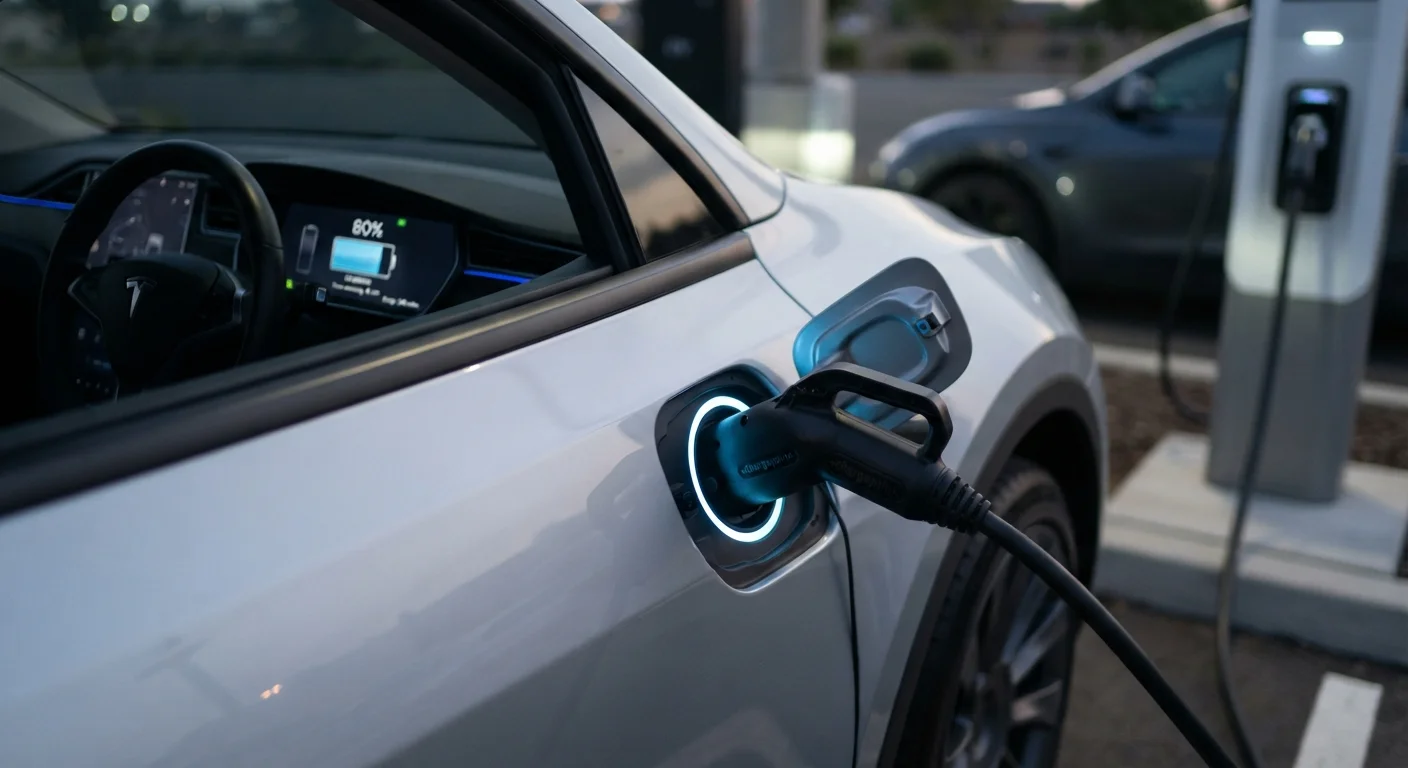
"Charge to 80 percent" refers to the practice of stopping an EV's charging session at 80% of its usable battery capacity rather than filling it completely. Automakers and charging networks recommend this limit for everyday use because lithium-ion battery cells become chemically stressed when held near their maximum capacity. Staying below 100% as a daily habit can slow the gradual degradation that reduces a battery's long-term range.
Above roughly 80% state of charge, lithium-ion cells enter a high-voltage regime where lithium plating and electrolyte oxidation accelerate, increasing internal resistance over time and reducing overall capacity.
Where the 80% Recommendation Comes From
If you own or are researching an electric vehicle, you've almost certainly encountered the advice to limit daily charging to 80%. It appears in owner's manuals, on charging network apps, and in automaker setup guides. But the recommendation isn't a conservative marketing hedge - it reflects how lithium-ion cells actually behave at the chemical level.
Lithium-ion batteries work by moving lithium ions between a graphite anode and a cathode material (typically lithium iron phosphate or a nickel-manganese-cobalt compound, depending on the vehicle). As a cell approaches full charge, the voltage rises steeply. In this high-voltage zone, several degradation mechanisms speed up: the electrolyte begins to oxidize, and lithium can deposit in metallic form on the anode - a process called lithium plating. Both increase internal resistance, which over hundreds of cycles gradually reduces how much usable energy the pack can hold.
To understand how engineers measure this over time, it helps to know the difference between state of charge and state of health - two numbers your EV tracks continuously. See our explainer on SoC and SoH for how those figures work together.
The 80% Threshold Is a General Guideline
Some automakers and battery chemistries tolerate higher daily charge limits with less degradation - lithium iron phosphate (LFP) packs, for example, are often rated by manufacturers for regular 100% charging. Always check your specific vehicle's owner's manual, as guidance varies by battery type and model year.
Why Fast Chargers Slow Down After 80%
One of the most common questions EV drivers have at a DC fast charging station is why the charge rate - often displayed in kilowatts - drops sharply once the battery passes 80%. This isn't a software bug or a throttling trick. It's the battery management system protecting the cells from exactly the high-voltage stress described above.
At lower states of charge, cells can safely absorb electricity quickly because the voltage differential between the lithium ions and the electrode surfaces is large enough to move them efficiently. As the cell fills, that differential narrows, and pushing more current risks overheating the cell or forcing lithium ions into positions that create permanent structural damage. The charger responds by tapering power delivery - sometimes dramatically, from 150 kW down to 30 kW or less in the final stretch to 100%.
This is why a charge session from 10% to 80% typically takes far less time than going from 80% to 100%, even though the latter is a smaller percentage gap. For a detailed look at the electrochemistry involved, see our companion piece on why fast charging tapers after 80%.
~40 miles
Average US daily driving distance
U.S. Department of Transportation data indicates the average American drives roughly 37-40 miles per day, meaning 80% of most modern EV ranges comfortably covers daily needs.
Up to 20%
Potential long-term capacity loss from routine full charging
Research published in battery engineering literature suggests cells cycled repeatedly to 100% can show meaningfully higher capacity fade over several years compared with cells maintained at partial charge.
When You Should Charge to 100% - and When to Skip It
The 80% guideline is a daily habit recommendation, not an absolute rule. Automakers generally acknowledge that full charges are appropriate before long road trips, when you need every mile available. The concern with 100% charging is less about reaching that level briefly and more about parking the vehicle at full charge for hours - something that exposes cells to sustained high-voltage stress without the temperature management that occurs during active charging.
For most everyday driving, 80% provides ample range. Consider the math: a vehicle rated at 300 miles of range delivers roughly 240 miles at an 80% limit - sufficient for the vast majority of US daily commutes, which average well under 40 miles round-trip.
Where the 80% habit matters most is over the long arc of ownership. Battery packs that are routinely taken to 100% and left there tend to show measurably higher capacity loss over three to five years compared with packs maintained in a mid-range charge state. This has real resale and usability implications as the vehicle ages. To understand what habits cause the most cumulative damage, our article on charging mistakes that shorten EV battery life covers the research in depth.
Set Your Limit Before You Need It
Don't wait until you notice range loss to configure a charge limit. Check your vehicle's charging settings during the first week of ownership and set a daily limit of 80% as a default. Most EVs let you schedule a one-time override for long trips without changing the permanent setting.
Setting a Charge Limit: What to Expect
Nearly all EVs sold in the US allow drivers to configure a maximum charge limit, typically through the vehicle's central display or a companion smartphone app. Common default settings vary by manufacturer - some default to 90%, others to 100% - so it's worth checking your settings rather than assuming the vehicle is already limiting itself.
A few practical points to keep in mind:
- The limit applies to scheduled and immediate charging alike unless you override it for a specific session.
- Some vehicles allow trip-specific overrides, letting you request a one-time full charge without permanently changing your default limit.
- Battery preconditioning - warming or cooling the pack before a fast-charging session - is a separate setting on many vehicles and is worth enabling for highway charging stops, as it speeds up the session significantly.
The 80% recommendation is one of the more well-supported pieces of EV ownership advice, grounded in consistent electrochemical evidence rather than manufacturer caution alone. Building the habit early, and understanding when to override it, gives you meaningful influence over how your battery performs across years of ownership.